


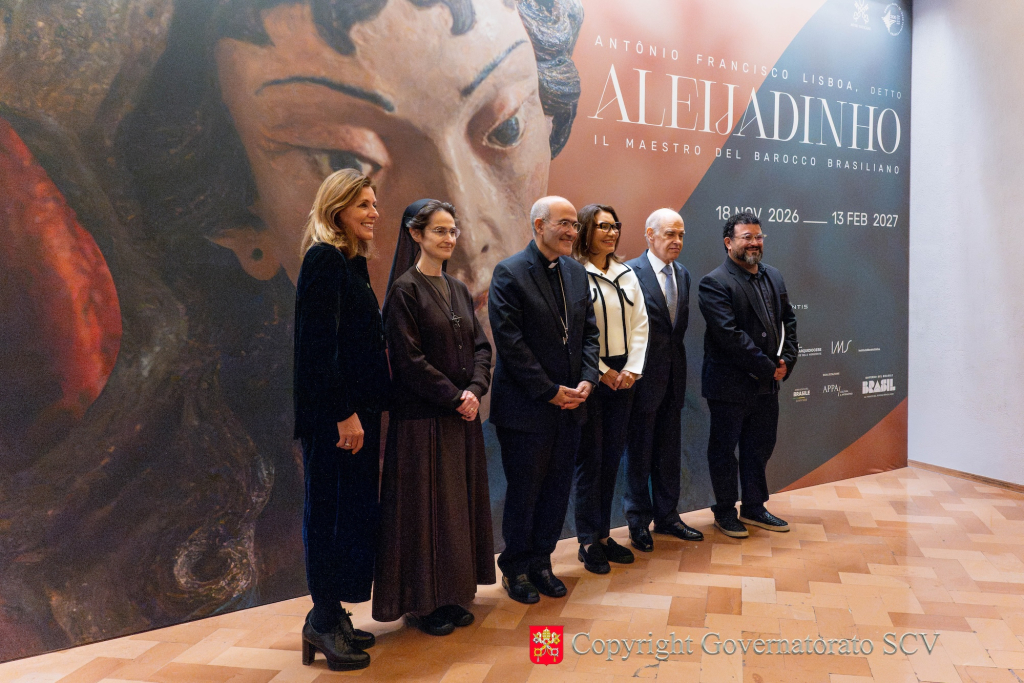
For the first time, works by Aleijadinho (Antônio Francisco Lisboa, 1738–1814) have left Brazil. Three sacred sculptures are on display at the Vatican Museums in the exhibition “Antônio Francisco Lisboa, known as Aleijadinho: the Master of Brazilian Baroque.”
The exhibition was inaugurated on Tuesday evening, November 17, in the Lapidary Gallery of the Vatican Museums. Speakers included Sr. Raffaella Petrini, President of the Governorate of Vatican City State, Cardinal José Tolentino de Mendonça, Prefect of the Dicastery for Culture and Education, H.E. Mr. Everton Vieira Vargas, Ambassador of Brazil to the Holy See, Barbara Jatta, Director of Vatican Museums and Cultural Heritage, Alex Calheiros, curator of the exhibition, and Antonio Filosa, CEO of Stellantis. Also in attendance was Rosangela da Silva, wife of President Luiz Inácio Lula da Silva and First Lady of Brazil. The exhibition is part of the celebrations marking the 200th anniversary of diplomatic relations between Brazil and the Holy See.
The three sculptures date from the 18th century. They are Saint Anne Teaching the Virgin Mary, from the Chapel of Saint Anne in the community of Chapada, Ouro Preto; Saint Joachim, from the Parish of Nossa Senhora da Conceição in Raposos; and Saint Manuel, belonging to the Parish of Nossa Senhora in Caeté. The exhibition will remain open until February 13, 2027, in the exhibition rooms of the Borgia Tower at the Vatican Museums. Before being brought to the Vatican, the sculptures underwent extensive restoration in 2021 at the Casa da Cultura Fiat in Belo Horizonte.
The following is the address delivered by the President of the Governorate:
I extend a cordial greeting to:
His Eminence Cardinal José Tolentino de Mendonça, Prefect of the Dicastery for Culture and Education,
His Excellency Mr. Everton Vieira Vargas, Ambassador of Brazil to the Holy See,
Barbara Jatta, Director of Museums and Cultural Heritage of the Governorate,
Alex Calheiros, curator of the exhibition,
Antonio Filosa, CEO of Stellantis,
the distinguished authorities and all those present.
Today, we are inaugurating an exhibition dedicated to one of the greatest exponents of Brazilian Baroque art. A sculptor, engraver, and architect, Aleijadinho, through his extraordinary genius, succeeded in expressing the spirit of a people in his sculptural art, interpreting the mysteries of faith and bringing them closer to people of every age.
It is impossible to stand before his works without being moved and filled with admiration by the emotion and reverence they inspire. The splendor and refinement, the intricate details and magnificence of dozens of statues, baptismal fonts, pulpits, fountains, and crucifixes reveal that Brazil, and the state of Minas Gerais in particular, was home to a sculptor and architect of the highest caliber.
The son of the Portuguese master builder Manuel Francisco Lisboa and an enslaved woman named Isabel, he became an interpreter of the cultural heritage of a country that was taking shape as a diverse community of men and women of different ethnic and cultural backgrounds, where the Catholic faith was spreading steadily and emerging as a unifying force.
Aleijadinho suffered from a disease of uncertain origin that caused physical deformities and made him particularly sensitive to the depiction of scenes from the Passion of Christ. Indeed, when contemplating the face of the Man of Sorrows, which he portrayed in various works, one senses his desire to represent humanity's participation in the profound mystery of redemptive suffering.
The artist's work reflects the hardships that marked Brazil during his lifetime, particularly colonial exploitation and slavery, realities with which he was intimately familiar. We also know that he himself had to overcome many obstacles before his talent was recognized, since people of mixed racial ancestry were regarded with contempt at the time.
Throughout his artistic career, Aleijadinho worked tirelessly to establish a connection between himself and those for whom his works were intended. He wanted his creations to convey a profound spiritual message.
In this regard, on October 2, Pope Leo XIV, addressing artists and curators at the gathering “The Art of Possibility: Weaving Together,” organized by the Dicastery for Culture and Education, referred to the spiritual legacy of Saint Augustine, who left us an enduring testimony to the restlessness of the human heart in search of truth. The Pope emphasized that “Art, when it is authentic, is also animated by this restlessness. For this reason, the Church has never considered art to be merely decorative. Instead, for the Church, art nurtures the fundamental posture of listening, through which we can learn about humanity’s aspirations and wounds, our thirst for beauty, justice and peace, and our search for meaning.”
Aleijadinho's sculptures, which depart from the Portuguese Baroque style and display highly distinctive personal characteristics, also passionately reflect this search for meaning on the part of wounded humanity.
The three sculptures featured in the exhibition we are inaugurating today are particularly symbolic: Saint Anne Teaching the Virgin Mary, Saint Joachim, and Saint Manuel. Dating from the 18th century, they are being exhibited outside Brazil for the first time.
Moreover, this exhibition forms part of the broader celebrations organized to mark 200 years of diplomatic relations between Brazil and the Holy See. In particular, it has been made possible through close cooperation among the Archdioceses of Belo Horizonte and Mariana, Brazil's Ministries of Culture and Foreign Affairs, and through the invaluable contributions of the Brazilian Embassy to the Holy See, the Directorate of Museums and Cultural Heritage of the Governorate of Vatican City State, the Dicastery for Culture and Education, the Instituto Guimarães Rosa (IGR), APPA – Cultura & Patrimônio, and the Instituto Moreira Salles.
I therefore conclude by once again thanking all of you present here today, as well as everyone who, in various ways, has actively contributed to making this wonderful exhibition possible, especially its curators.
I wish you all an enjoyable visit here at our Vatican Museums.