

The history and practices of sustainable cultivation in the Vatican Gardens
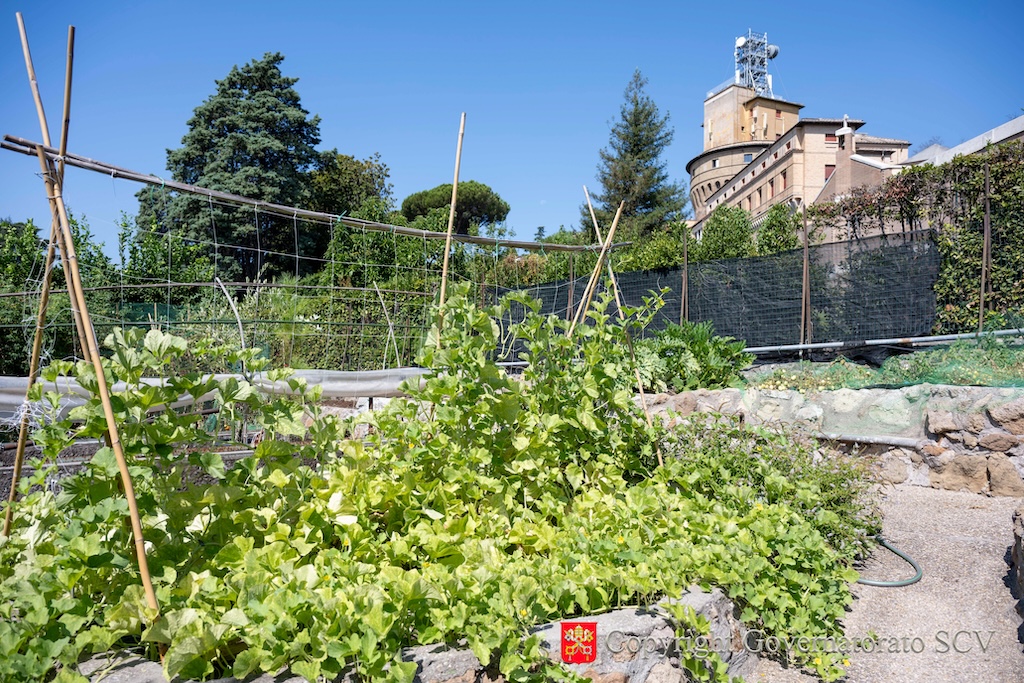
In the Vatican Gardens, next to the Mater Ecclesiae Monastery, lies a small vegetable garden whose history stretches back to the Middle Ages. It was Pope Nicholas III Orsini who, when he transferred the papal residence from the Lateran to the Vatican between 1277 and 1280, also commissioned an orchard and a proper viridarium [elegant garden], enclosed within the new walls: a productive space that also helped supply the papal kitchen.
Eight centuries later, that vocation has not disappeared. It continues, almost unchanged, beside the monastery established at the behest of John Paul II and built between 1992 and 1994 so that, at the heart of the Church, there would always be a cloistered community devoted to prayer for the Pope. It was the nuns themselves who originally worked the land directly. “Cultivating the land is prayer performed with one’s hands,” Benedictine Abbess Maria Sofia Cichetti, then prioress of the monastery, told L’Osservatore Romano on 26 August 2009. Among those same garden beds, from 2013 to 2022, Benedict XVI, as Pope Emeritus, also enjoyed taking walks during his days devoted to prayer and study.
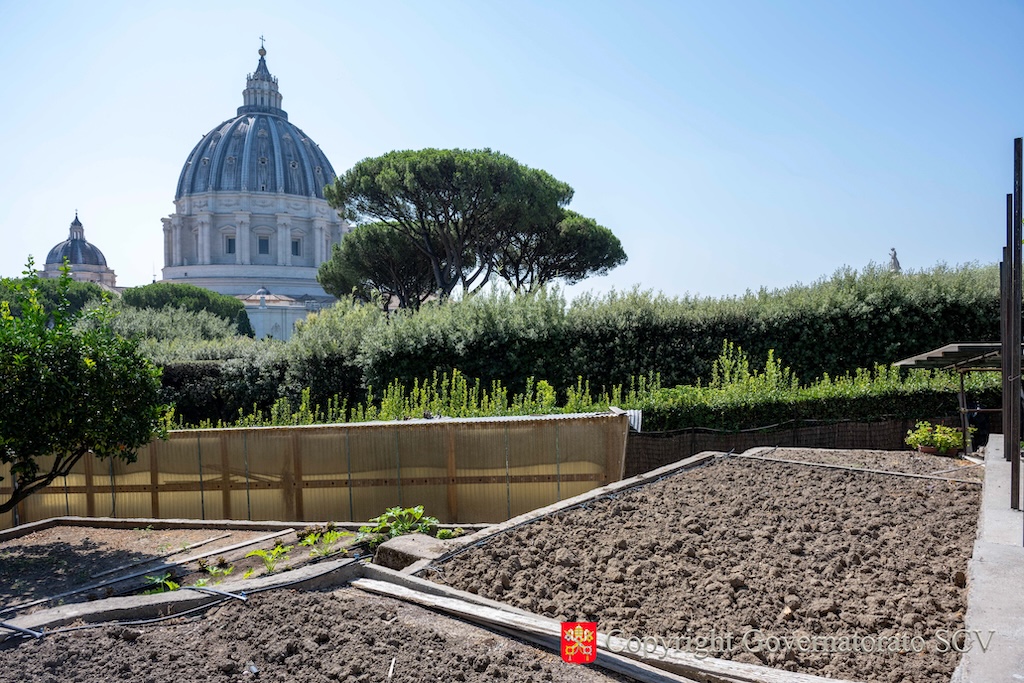
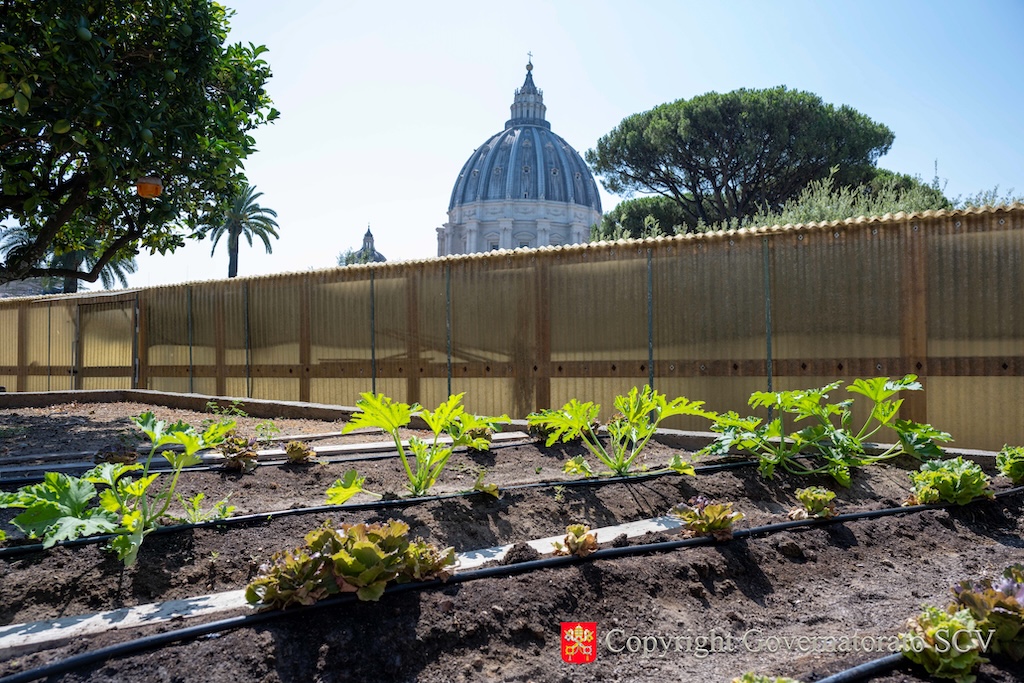
The land is overseen by the Gardens and Environment Service, headed by forestry expert Stefano Giampaolo, Head of the Service, within the Directorate of Infrastructure and Services of the Governorate of Vatican City State, led by Director Eng. Salvatore Farina. Day after day, the garden’s four terraces, comprising just under 400 square meters of cultivable land, are tended by an experienced gardener, Gilberto Bianchi, who over the years has served under three Pontiffs. More recently, a group of younger colleagues has begun working alongside him, and he is gradually passing on his valuable experience to them, so that this knowledge, made up of countless small daily practices, will not be lost—much as such expertise was handed down from monastery to monastery centuries ago. Today, the religious sisters he assists indicate what they need from time to time, in keeping with the seasons and with what the land has to offer at any given moment, so that none of the harvest goes to waste. Their requests, rarely generic, speak the language of everyday needs: five tomatoes, four zucchini, quantities carefully matched to actual consumption. Even today, irrigation remains entirely manual.
What It Really Means to Grow “Organically”
The turning point has come this year: cultivation is now 100% organic, the culmination of an approach that had already placed considerable emphasis on sustainability in the past, when the produce was destined for the papal kitchens. The aim is to transition the Vatican Gardens entirely to organic cultivation, in keeping with the principles of the Encyclical Laudato si’. The fertilizer used also reflects this transition. In the past, manure from the Pontifical Villas of Castel Gandolfo was used; today, only certified pelletized fertilizer is applied, selected according to the season and the needs of the particular plant. The seedlings, too, are sourced externally and have already been treated according to natural methods. Purchased seedlings are used rather than plants grown in an in-house nursery, in order to reduce the risk of spreading plant diseases that could jeopardize the entire crop. An in-house nursery, together with a greenhouse for bonsai trees, is nevertheless among the projects currently under consideration.
Plant Protection Products, Damage Thresholds and the Field Logbook
Good agronomic practices significantly reduce the need for plant protection products. This approach requires more time, but the goal is not maximum production; rather, it is to achieve results consistent with this method of cultivation. In natural cultivation, the principle is not eradication but control. This can be seen in the management of pests such as nematodes, which are kept below the so-called damage threshold, beyond which an infestation begins to cause significant problems. Every treatment is recorded in a field logbook, as required by regulations governing treatments for which a professional-use license is mandatory, whereas natural substances do not require registration. A plant protection product may, in fact, be approved for use in organic farming; the term is therefore not incompatible with this type of cultivation. Soil fertility is likewise maintained through specific techniques, including crop rotation, with legumes such as green beans naturally fixing nitrogen in the soil, and, this year, a seaweed-based fertilizer being tested on tomato plants.
A Year of Cultivation, Season by Season
The growing calendar closely follows the seasons: fresh garlic, basil, seedlings, chili peppers—including a Peruvian variety selected for its intensity—citrus fruits and pumpkins, which continue to ripen through November. This year, the first kiwi plants were also planted at the sisters’ request, while between late August and early September winter sowing begins, with Savoy cabbage, broccoli, spinach and lettuce. May is the most abundant month; summer, because of the heat, is the most challenging season, as tomatoes, eggplants, peppers, green beans, zucchini and cucumbers—including a variety from Apulia—reach the end of their growing cycle.
Historic Citrus Trees and the Sisters’ Preserves
The citrus trees in this corner of the garden are approximately 150 years old. Over time, different varieties have been grafted onto them—each branch bearing a separate graft—including varieties that can no longer be found on the market. Grown without any treatments whatsoever, their fruit can even be eaten with the peel. The sisters still use it to make marmalades, candied peel and biscuits, some of which are offered to guests and some sold.
Over the years, produce from this small plot has also supplied charitable institutions such as Casa Dono di Maria, a practice that is now being revived with renewed energy and commitment.
Care That Extends Beyond the Garden
This choice is part of a broader vision. The Governorate explicitly places the transition toward 100% organic cultivation within the framework of Laudato si’ and Laudate Deum, and, more recently, Pope Francis’ Motu Proprio Fratello Sole. That commitment is now being carried forward by Pope Leo XIV through the establishment of the foundation of the same name for the agrivoltaic plant at Santa Maria di Galeria: different elements of a single commitment to sustainability that now extends throughout the entire Vatican State.
It is the same “care for creation” evoked by Pope Leo XIV in 2025, in an address to Italian agronomists and foresters, when he invited them to regard their work as “a concrete form of charity toward our Mother Earth and toward the generations to come,” because the Earth “is not a possession, but a gift,” and those who cultivate it “with respect and wisdom participate in God’s creative work.”
Across four terraces, with a field logbook kept constantly up to date and a damage threshold to be respected rather than reduced to zero, that small patch of land beside the Mater Ecclesiae Monastery tells, on a miniature scale, the same story: an innovation that did not arise from nothing, but is deeply rooted in an agricultural tradition that, in the Vatican Gardens, has never truly been interrupted—culminating today in the full transition to 100% organic cultivation.