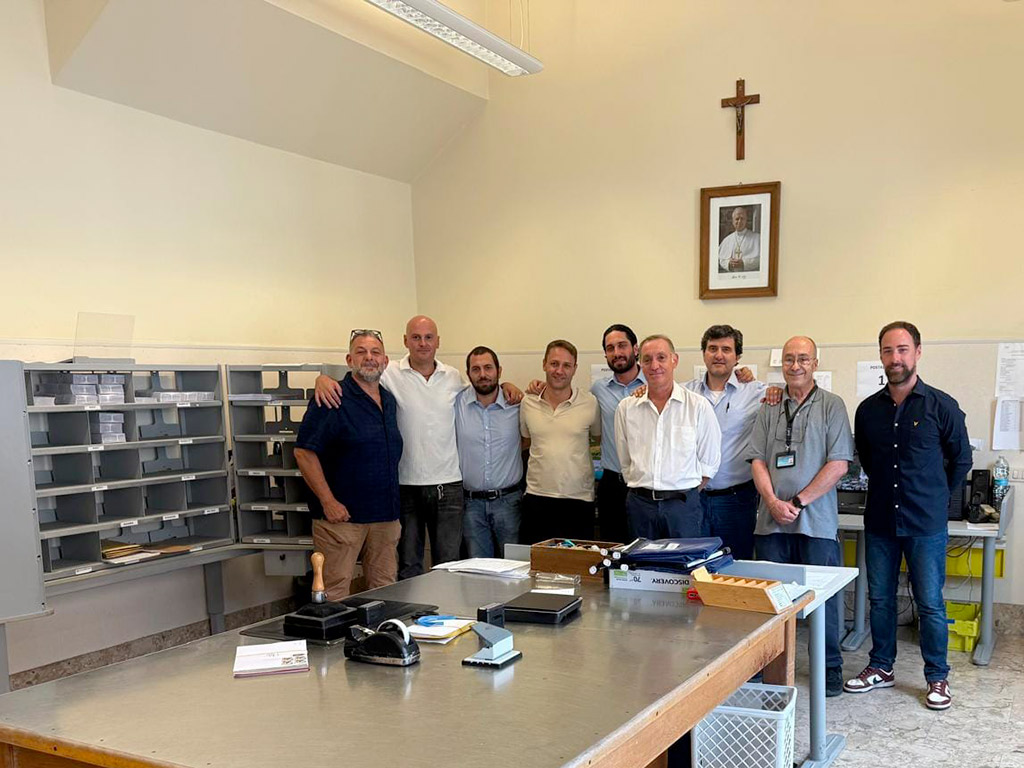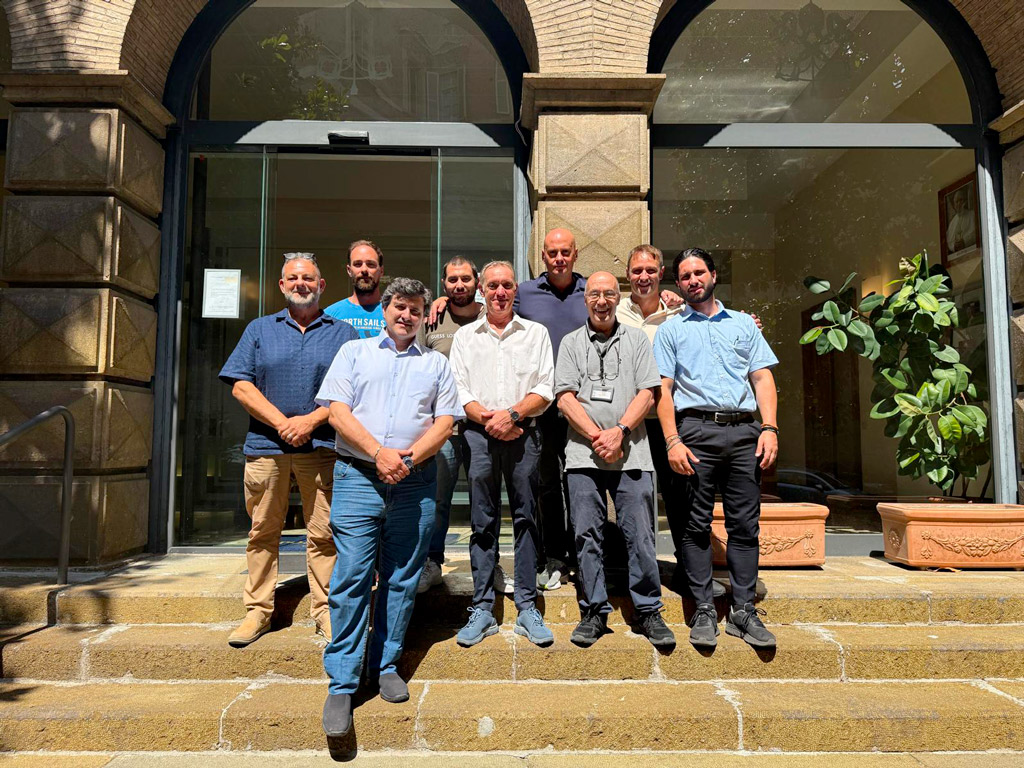


Interview with Stefano Rossi and Ermanno Croci, operators of the Outbound Mail Department of the Governorate’s Postal and Philatelic Service
Just steps away from Bernini’s Colonnade in St. Peter’s square is a place where, every day, thousands of fragments of people’s lives—postcards, letters, parcels and registered mail—begin their journey to every corner of the globe. This is no ordinary post office: it is the Post Office of the smallest State in the world.
Stefano Rossi and Ermanno Croci work here, handling correspondence in the Outbound Mail Department. In this interview with the Vatican State website, they share their experience. They have been entrusted with a uniquely special task: personally handling messages from pilgrims from all over the world, the official correspondence of the Holy See, and documents connected with historic events such as the Jubilee or the election of a new Pope. Working here means being, every day, a link in the chain that connects the Vatican with the entire world.
Can you tell us about your backgrounds and how you came to work in your current roles?
“Our professional journey at the Vatican Post began many years ago,” Stefano explains. “I began my career as a pneumatic-mail operator and switchboard operator—a detail that in itself says a great deal about how this place preserves technologies and traditions that have long since disappeared elsewhere.” Ermanno adds that he began in the mail collection service, gaining extensive hands-on experience. “Ours has been a journey of steady professional growth that has enabled us to gain an in-depth understanding of the organization and workings of an institution unlike any other in the world.”
What skills do you consider essential for a mail handler today?
“Today more than ever, we believe that solid professional training and a thorough knowledge of internal procedures are essential to performing this work effectively. Our work requires precision, reliability and great attention to detail, since every stage affects the proper functioning of the entire postal process.
“In addition to these technical skills, precision, a sense of responsibility and organizational ability are fundamental qualities for ensuring an efficient service. It is also important to be able to respond promptly to unforeseen situations. Only through a strong spirit of cooperation can we provide a service that meets the required standards.”
What does a typical working day involve?
“Our working day begins at 7:30 a.m. with the organization of shipments and the preparation of mail dispatches destined for countries around the world. During this initial phase, the day’s activities are also planned and staff members are assigned to the various services, so as to ensure a balanced distribution of the workload and the smooth execution of all operations. Coordination is a fundamental aspect of our work: every service is closely interconnected with the others and requires careful planning to prevent delays or backlogs. The aim is to ensure that every item is processed promptly and accurately.
“Throughout the day, we collect and sort the thousands of postcards that pilgrims and tourists entrust to the Vatican Post every day, directing them to their respective destinations. At the same time, we handle express-mail shipments, overseeing their processing and dispatch, as well as registered mail, which is recorded, checked and forwarded with the utmost care.
“Another important part of our work involves providing postage services for correspondence delivered to the Vatican Post by the various Institutions of the Holy See. We also prepare customs documentation for shipments containing books or goods destined for both European and non-European countries, an essential step in ensuring the smooth transit of postal items and compliance with international regulations.
“Taken together, these activities make our working day both demanding and varied: every member of staff contributes through their work to ensuring an efficient and reliable service.”
What are the main responsibilities of your role?
“The principal responsibilities of our role involve coordinating the department’s activities and supervising the entire process of collecting and processing correspondence. Each day requires careful planning of resources so that all activities can be carried out accurately and within the required timeframes.
“We ensure that every operation is carried out in accordance with established procedures, intervening promptly whenever difficulties or unforeseen situations arise. Our task is to ensure that every item—from a simple postcard to the most complex shipment—is handled with the utmost care and punctuality.”
Which tools or technologies do you use most frequently?
“Among the tools we use every day are primarily computers and postmarking machines, both of which are indispensable for managing administrative operations. Our IT systems enable us to manage the various stages involved in processing correspondence, from registering postal items to tracking shipments, while also supporting all of the department’s organizational activities.
“Scanners also play an important role and are used to inspect and verify incoming and outgoing mail, allowing shipments to be managed more accurately and securely. Franking machines, meanwhile, are essential for applying the correct postal rates, particularly to correspondence entrusted to us by the various institutions.
“These are modern tools, certainly, but here they coexist with practices and expertise handed down over time. This equipment provides indispensable support, yet it always relies on the experience and attentiveness of our staff. This is the essence of a post office unlike any other: technology at the service of people, not the other way around.”
How do you ensure efficiency and punctuality in collecting and sorting correspondence?
“It all depends on synchronizing the arrival times of mail at our facility with the subsequent processing stages. Each step is organized sequentially and coordinated so as to minimize waiting times and ensure that correspondence is received and sorted without delay.
“Internal planning allows the workload to be distributed evenly among staff and enables us to adapt the department’s organization quickly to daily requirements. Cooperation among the various sectors and constant communication also allow us to respond promptly to peaks in workload or unforeseen circumstances.”
How does your work contribute to the overall functioning of the postal service?
“Our contribution to the functioning of the entire postal chain consists in ensuring that correspondence is forwarded to its various destinations quickly, accurately and systematically. Every stage—from collection and sorting to the preparation of shipments—is designed to reduce processing times and ensure that postal items are correctly routed.
“In this sense, we can proudly say that our role represents a crucial link in the logistics chain, as it enables us to organize and optimize the flow of correspondence before it is dispatched to the subsequent services. Attention to accuracy and compliance with procedures ensures that every item reaches its destination in the shortest possible time and in the proper condition.”
How has digitalization changed your work in recent years?
“Digitalization has brought significant changes, making many procedures more practical and faster than in the past. The introduction of increasingly advanced IT systems has simplified many operational stages, reducing processing times and improving the traceability of correspondence throughout its journey.
“In particular, the ability to digitalize certain procedures has made it possible to process daily operations more quickly and has helped reduce the margin for error, resulting in greater accuracy in checks and record-keeping. Internal communication among the various departments has also become smoother and more immediate.
“There is, however, one aspect that we believe has not changed: the role of the operator. Experience and the ability to manage different situations remain essential to ensuring the quality of the service. In short, the digital revolution has not replaced human work; it has made it more efficient without diminishing its value.”
Which innovations have improved the service the most?
“The progressive mechanization of operational activities has been the most significant change. Machinery and automated systems have optimized sorting, franking and registration, reducing processing times and increasing accuracy. The result is a smoother postal process overall, capable of ensuring punctuality even during periods of peak demand.”
Do you think the role of the mail handler will continue to change in the coming years?
“Technology will certainly continue to evolve, but as long as there is a need to send and receive physical correspondence—and for a place like the Vatican, a pilgrimage destination for millions of people, that need does not appear likely to disappear—the basic function of our role will remain substantially the same.
“Managing correspondence still requires organizational skills, attention to detail and oversight that can hardly be fully automated. Even in a context of increasing technological innovation, the human contribution remains essential to ensuring accuracy, reliability and quality of service. It is therefore more realistic to envisage an evolution of the role rather than its complete transformation, with increasingly advanced tools supporting daily activities while the central role of the operator continues to be indispensable.”
What are the most sensitive aspects in terms of security?
“Security is a fundamental aspect of our work. Professional staff training is the essential foundation for ensuring that all operations are carried out correctly. Proper training helps reduce the margin for error and enables staff to deal competently with the various situations that may arise during the working day.
“Another fundamental element is discretion in handling correspondence. Acting with discretion, professionalism and a sense of responsibility is essential to protecting users and ensuring the proper functioning of the service.”
Have you observed a significant increase in activity following the 2025 Jubilee and the election of the new Pope?
“As the Vatican Post, we experienced a significant increase in activity both during the Jubilee period and on the occasion of the election of the new Pontiff. These are moments of particular importance in the life of the Holy See and result in a substantial increase in the volume of correspondence.
“These are the moments when we truly experience the privilege—and at the same time the responsibility—of working in a place that is, quite literally, the center of the world for hundreds of millions of faithful. The influx of pilgrims and visitors from every continent considerably increases the volume of postcards, letters and shipments. Despite the substantial increase in workload, the experience of our staff and our organizational structure enable us to manage these extraordinary periods while continuing to ensure the proper execution of all activities, with the quiet confidence of knowing that, every day, we are contributing in our own discreet way to a small part of history.”