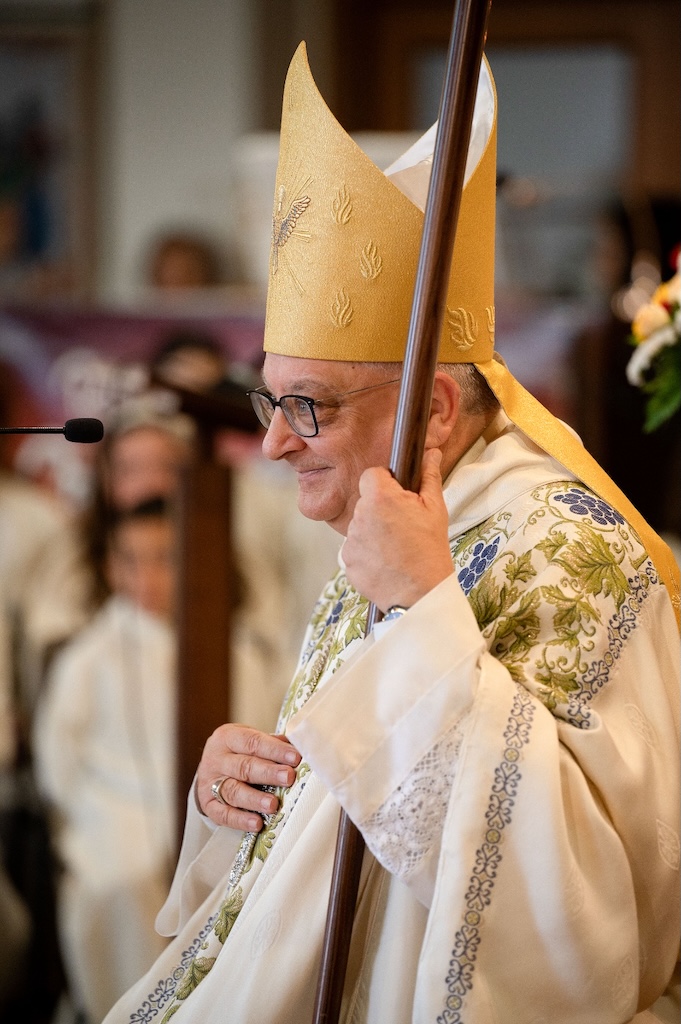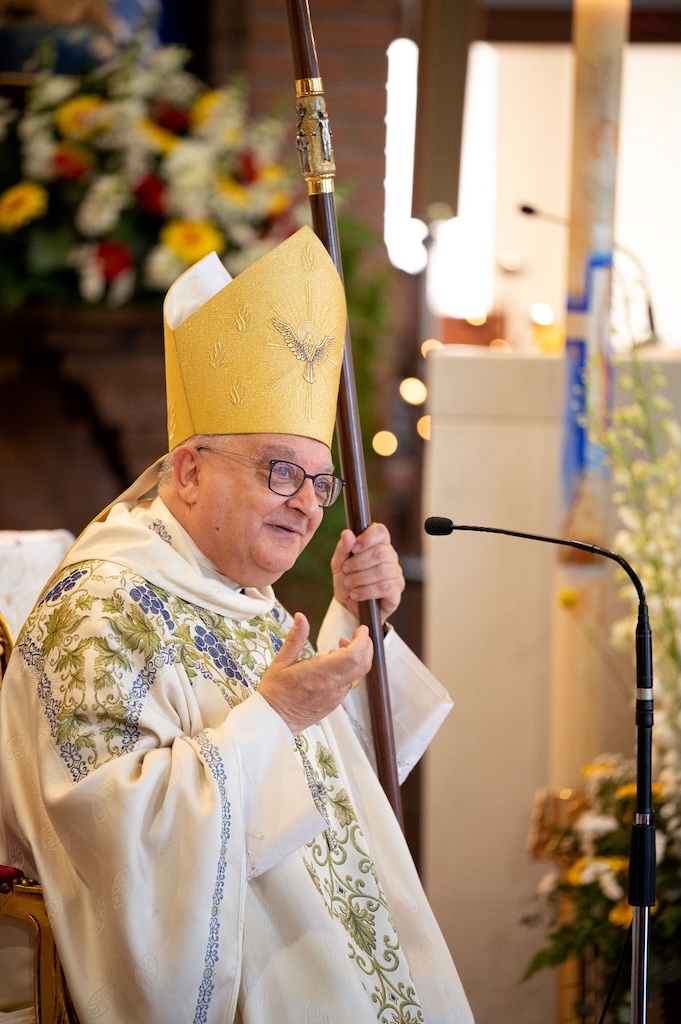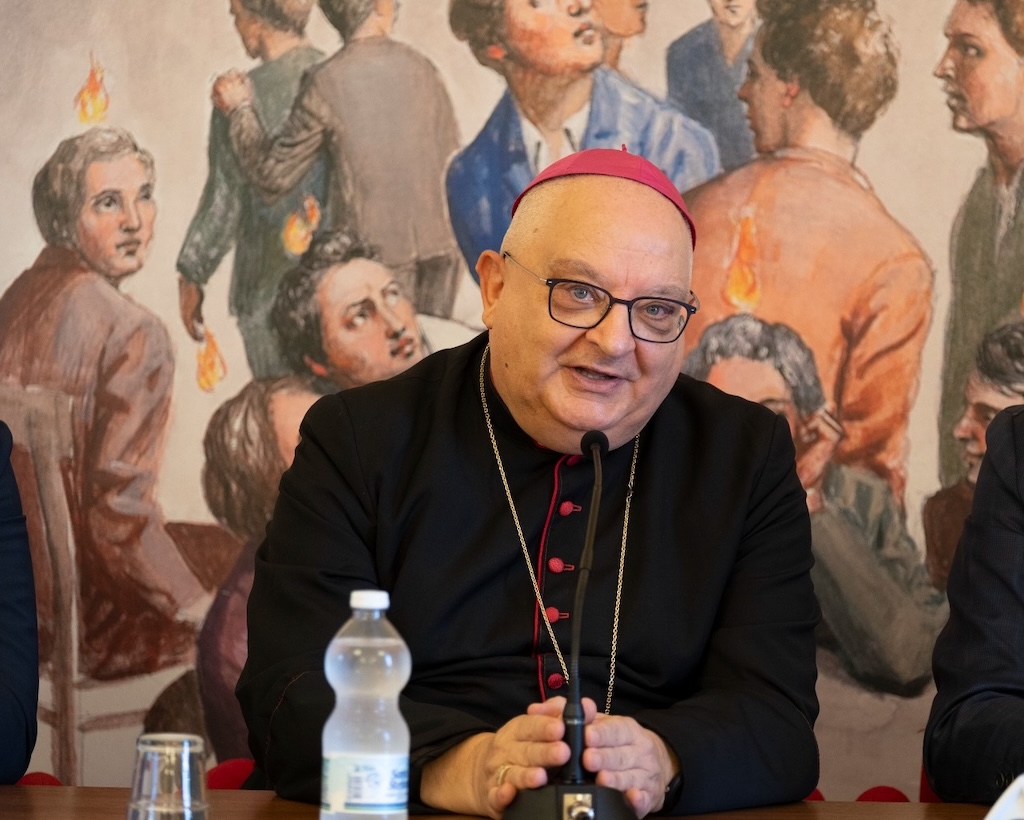


Interview with Most Reverend Giuseppe Giudice, Bishop of Nocera Inferiore-Sarno

In Memory of Saint Alphonsus de’ Liguori
An entire diocese, with all the components of its community, is mobilizing to create and set up the Nativity scene in St. Peter’s Square for Christmas 2025. It is the southern Italian Diocese of Nocera Inferiore-Sarno, within whose territory stands the basilica that houses the mortal remains of Saint Alphonsus de’ Liguori, author of the famous Italian Christmas carol Tu scendi dalle stelle. The Saint himself will be portrayed as a shepherd in the Nativity scene that will be displayed in St. Peter’s Square. Bishop Giuseppe Giudice speaks about it in this interview with http://www.vaticanstate.va
How did the Nativity tradition begin in Nocera Inferiore?
It is part of the Neapolitan Nativity tradition — that of Saint Alphonsus Maria de Liguori, whose remains rest in our diocese, in the basilica of Pagani that bears his name. As Giuseppe Verdi once said, “Without Tu scendi dalle stelle, it would not be Christmas.” It’s the centuries old tradition of our families and our communities. My earliest memories of the Nativity are connected to the parish where there was always a large scene, and at home where my eldest brother was deeply committed to setting it up. It was always a moment of welcome and togetherness. From a young age, I understood that something unique happened there — a place where everyone and everything, even the smallest sheep, had a place. It all revolves around a grotto: Heaven descended into a grotto, and our “life-grotto” opens itself to Heaven.
Are there any events or exhibitions dedicated to Nativity scenes in your diocese?
Certainly. The Nativity scene that will be displayed in St. Peter’s Square represents an entire territory — it is the fruit of our whole community. We have tried to showcase the beauty and goodness that can be found throughout our diocese, which encompasses thirteen municipalities across the provinces of Salerno and Naples.
Alongside this unique initiative, there will be many local events: the presentation of the Christmas letter inspired by the Nativity scene created for the Vatican, public concerts, school activities and a Nativity scene competition. We will also host a widespread Nativity exhibition throughout the diocese, beginning with two symbolic sites — the Diocesan Museum of San Prisco in Nocera Inferiore and the Monastery of the Purity in Pagani. Additionally, two tourist itineraries will be offered that highlight the many artistic and architectural treasures of our territory. Those who admire the Nativity scene in St. Peter’s Square will be able to connect, at least ideally, with the beauty of our diocese which we hope will be inspired visitors to come and see the territory in person.
What materials are used to build the Nativity scene?
Our technicians have combined shaped wooden panels and metal supports for the main structures. For special decorative elements such as columns, arches, capitals, and the details of the basin and fountain, we used sintered expanded polystyrene. For the finishing touches, vinyl glue was essential, as it gives elasticity to the plaster and prevents future cracking. The figures will be made in the classical 18th-century Neapolitan style but using innovative techniques: while the bodies are made of straw and the hand-sewn clothes are of fabric as tradition dictates, the limbs and heads are produced with 3D printers — while maintaining the traditional glass eyes.
How long does it take to complete?
A project of this scale naturally required a long period of preparation. The design phase actively began last spring; the actual production of components started in June and the first assembly of the structures and figures began at the end of August 2025.
Have you included any modern or local elements in the scene?
The main setting will feature a view of the early Christian baptistery of Santa Maria Maggiore in Nocera Superiore. There will be a courtyard house representing our historic town centers, the Roman-era Helvius Fountain and other small depictions of local landmarks. Inside the house, there will be a shepherd in the likeness of Saint Alphonsus, playing Tu scendi dalle stelle on the harpsichord, behind him a depiction of Our Lady of the Three Crowns made by the flower artists of San Valentino Torio.
Is there a character or scene you are particularly fond of? Why?
The figures of the Servants of God Don Enrico Smaldone and Alfonso Russo — whose diocesan beatification process is underway — symbolize our commitment to education, compassion and volunteer service.
Don Enrico Smaldone, the priest who founded the “City of Children” in the town of Angri, is depicted climbing a staircase with two children, representing Christ as the sole center of the educational journey. Alfonso Russo, meanwhile, is portrayed accompanying a sick person toward the grotto — toward the Christ Child, the one true source of salvation.
Is there a network of local Nativity craftsmen working together on this project?
Buying the Nativity scene elsewhere was a possibility, but it wouldn’t have expressed the beauty and identity of our land. So I insisted that we find local artists and artisans to create it here. At one point, I admit, I was discouraged and almost ready to give up. But thank God, we managed to find talented people capable of realizing something beautiful. I am happy to say that everyone working on the project is from our wonderful region, and the Nativity scene will be rich in elements typical of our local Agro nocerino-sarnese area.
What do you hope people will feel when they look at your Nativity scene?
In the play “Natale in casa Cupiello”, the father builds the Nativity scene, but his daughter is struggling morally; it is cold and there is hardship. In our diocese — and beyond — there are situations of vulnerability, difficulty, disorientation. The Nativity must not be a mere religious object; it should inspire us to reconsider our relationship with creation, with our community, and with our role in society.Today’s Nativity helps us to rediscover the centrality of the Lord, so that even those most in darkness may find their place and be touched by the light that comes from Bethlehem — transforming every home, every place, every heart into a small Nativity where the Lord of Life is at the center. I truly hope this will be a moment of joy and growth for our Church, for our territory, and for everyone.
Has attention been given to sustainability and recycling?
This work will not end with its display in St. Peter’s Square — it will be reinstalled permanently in the Diocese so that it can continue to be admired and visited during future Christmas seasons. I believe this is the first and most important form of sustainability, because such a creation should not be temporary. In this way, we are donating a new work of art to the Diocese. For the furnishings and some specific details, we are reusing existing materials, while the modern techniques used for crafting the figures make them more