

Seminar of the Labor Office of the Apostolic See (ULSA) on “The Potential and Challenges of Artificial Intelligence”
%20on%20“The%20Potential%20and%20Challenges%20of%20Artificial%20Intelligence” "Pin It")
A conscientious approach to the technology that will transform our future
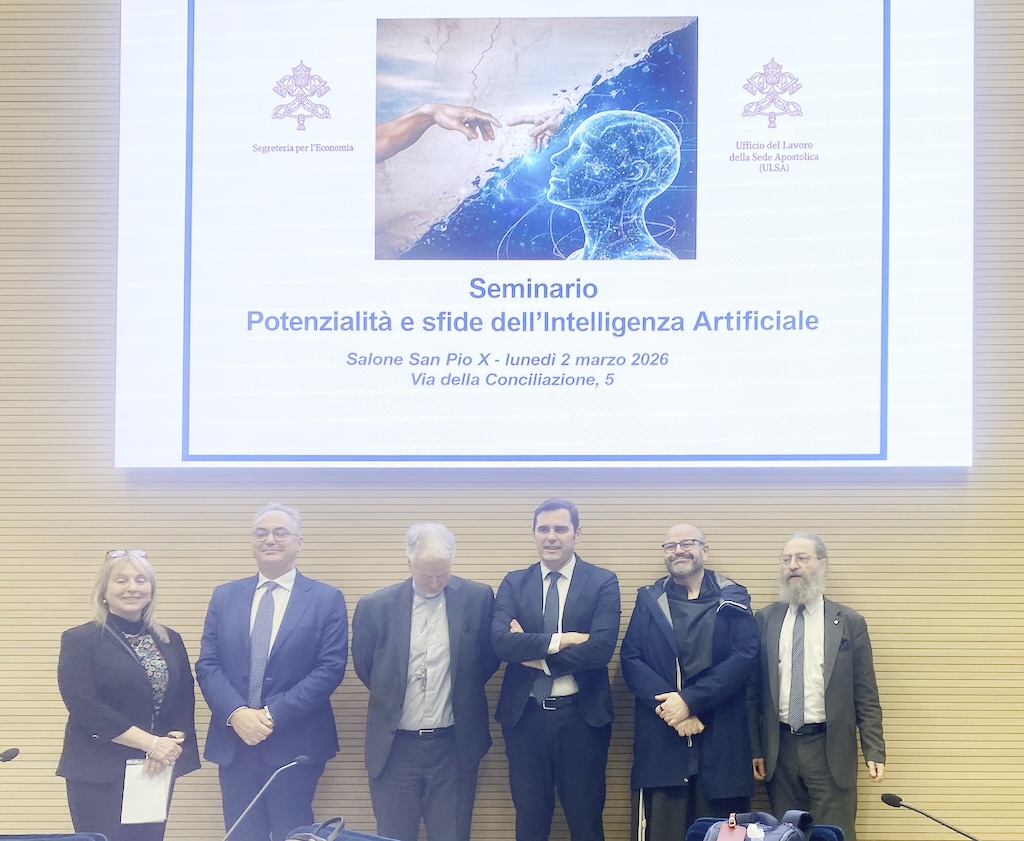
On 2 March 2026, in the San Pius X Hall on Via della Conciliazione in Rome, at the headquarters of the Labor Office of the Apostolic See (ULSA), a highly significant seminar on Artificial Intelligence was held. The event, organized by the Secretariat for the Economy in collaboration with ULSA, brought together experts of national and international standing to address one of the most pressing issues of our time: the potential and the challenges of AI in the cultural, technical, and ethical context.
The event—introduced by Professor Pasquale Passalacqua, Director of ULSA—was also attended by the Directorate of Telecommunications and Information Systems of the Governorate of the Vatican City State, together with numerous colleagues from the various services.
The event began at 9:00 a.m. Following the welcome, acknowledgments and introductions, the seminar proceeded with enthusiasm from both the speakers and from the many participants who completely filled the hall.
The cultural and theological perspective
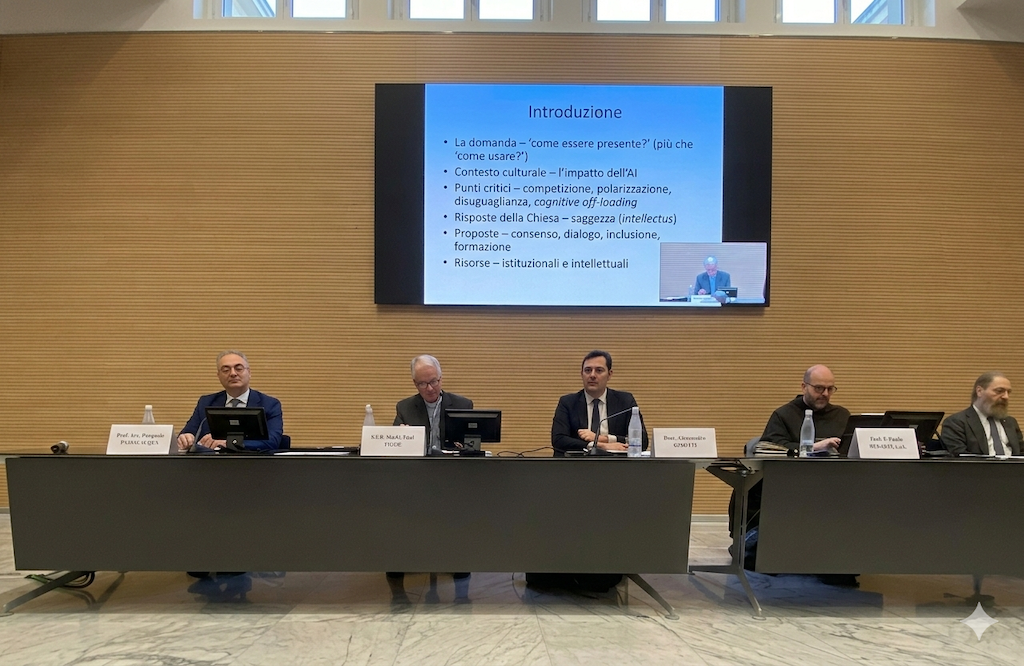
The first presentation was delivered by Bishop Monsignor Paul Tighe, Secretary of the Dicastery for Culture and Education, who clearly outlined what the appropriate approach should be toward a technology so powerful, unsettling and significant for human beings.
According to Monsignor Tighe, Artificial Intelligence is neither a tool to be feared nor one to be idolized. Although it is not neutral by definition, this technology can provide answers, assistance, and support across an extremely wide range of applications: from everyday work to private life, AI stands alongside human beings, who must nevertheless know how to manage and “steer” it with diligence and awareness.
The central message was the need for widespread awareness of the power and potential of such a tool—one capable of providing countless answers whose truthfulness must always be analyzed and weighed by human judgment. Moreover, those who use these technologies, while recognizing their potential, must resist the temptation to share and process every form of data—especially within organizations—thus exposing institutions to highly dangerous phenomena linked to “shadow AI.”
The presentation concluded with an encouraging invitation to not delegate the management of our lives to these tools and to remain vigilant against the process of “cognitive off-loading.” Monsignor Tighe encouraged confidence in the future, quoting the philosopher Karl Popper, who maintained that “the future is open and not predetermined.” He firmly opposed determinism (the idea that everything is already written) and historicism (the belief that history follows necessary and predictable laws), describing them as pseudoscientific and dangerous theories.
Monsignor Tighe’s final appeal was therefore to remain the primary actors and responsible agents in our own lives.
The technical perspective: what AI is—and what it is not
The second presentation was delivered by Professor Corrado Giustozzi, a prominent figure in both national and international levels in the field of cybersecurity. A computer scientist with more than thirty-five years of experience, he teaches Cybersecurity in the Master’s degree program in Intelligent Systems Engineering at Campus Bio-Medico University of Rome and also teaches in first- and second-level university master’s programs in Cybersecurity at LUISS, Campus Bio-Medico, Link Campus University, and the Italian Society for International Organization (SIOI). A registered journalist and member of the Italian Union of Scientific Journalists (UGIS), he has written more than one thousand articles on technical and scientific topics and authored four books. The University of Rome Tor Vergata awarded him an honorary Master’s degree in Internet Engineering and Information and Communication Technologies. He is also a member of the board of directors of Clusit and Founding Partner & Chief Strategist of Rexilience.
Professor Giustozzi focused his “telescope” not on what AI is, but rather on what it actually is not—and perhaps never will be. Through a historical overview that touched on pioneers of research—from Alan Turing to John McCarthy—up to a detailed review of contemporary developments, he emphasized that at the foundation of everything, including the inexplicability of certain processes generated by AI platforms, lie human decisions.
From the construction of algorithms to the design of reasoning and inference mechanisms, every choice is the result of human decisions—whether conscious or not. It is precisely in this context that an enduring question arises, one that has yet to receive a definitive answer: what do we truly mean by intelligence?
Professor Giustozzi’s message was to properly celebrate the creation of such a technology without burdening it with elements drawn more from narrative and cinematic contexts that depict imminent apocalyptic scenarios. The underlying point is that AI is not something self-determined: AI is something we have chosen. Something we wanted. Now, what remains to be done is to understand it and learn to use it responsibly and consciously.
Ethical challenges: a question of orientation
The final presentation before the question-and-answer session was delivered by Father Paolo Benanti, a Franciscan of the Third Order Regular (T.O.R.), theologian and philosopher. A professor at the Pontifical Gregorian University and at LUISS Guido Carli University, Father Benanti is one of the most prominent figures in the international debate on the ethics of Artificial Intelligence. In 2023 he was appointed by United Nations Secretary-General António Guterres as one of the 38 experts of the new United Nations advisory body on Artificial Intelligence, a role in which he represents Italy and the perspective of the Catholic Church. He is also a member of the Pontifical Academy for Life and the author of numerous monographs on bioethics, technology ethics, and artificial intelligence.
Father Benanti’s intervention focused mainly on the ethical dimension rather than on potential scenarios made possible—whether positively or negatively—by AI. Through various historical and cultural anecdotes, he explained how “the destiny of a technology” has rarely been accidental, but rather strongly oriented.
This observation served to emphasize once again that the most advanced technologies are highly oriented and polarized—intentionally designed so that only a small portion of humanity can easily access and benefit from them. A central concept in his speech concerned how technologies have been “redirected,” together with related notions such as use, abuse, and profit.
Father Benanti drew an illuminating parallel with the past: when a person owned a material good such as a horse, they were free to dispose of it according to their own needs—using it to plough fields, employing it in other ways, or deriving profit from it. In the contemporary technological context, this freedom no longer exists.
Consider modern automobiles, filled with components that we formally own but do not truly control. The updating of onboard software, for example, lies entirely at the discretion of the manufacturer, who can add new functions—or even remove them—at will. The issue becomes even clearer when we move to mobile phones: following the earlier comparison with the horse, we are little more than the “material possessors” of the device. Everything else within that parallelepiped of metal, silicon, and other materials belongs to the operator who determines its life and death according to their own “use.”
Father Benanti’s final question prompted deep reflection: in a context where such an intimate object as our smartphone were equipped with AI technology “guided” or “oriented” by producers according to their commercial interests, what would become of our freedom of choice—and that of our children?
He concluding by echoing the other speakers, to remain neither skeptical nor critical a priori, but rather to cultivate awareness and thoughtful criticism, evaluating case by case the new technologies that will increasingly shape and complement our lives.
Toward responsible governance of AI
What emerges from the three presentations, despite their different perspectives, is a coherent message: Artificial Intelligence is a reality with which we will have to live, but its trajectory is not predetermined. It reflects the choices, values, and interests of those who design and implement it.
The cultural and theological awareness of Monsignor Tighe, the technical clarity of Professor Giustozzi, and the ethical insight of Father Benanti converge on one fundamental point: it is we—as a society, as citizens, as consumers, and as believers—who must remain the active protagonists in guiding the development of these technologies toward the common good.
The event concluded at 1:20 p.m. with a lively question-and-answer session, leaving participants hopeful for a future meeting to further explore a topic that will be central to defining the future of human society.