

Updating, innovating, and strengthening infrastructure and networks is an absolute priority for the Directorate of Telecommunications and Information Systems of the Governorate. This commitment is pursued through significant human and financial resources.
The goal is to make the telecommunications and internet network within the State of Vatican City increasingly secure, reliable and efficient, in order to provide an indispensable service to the Pope, the Holy See and the Church.
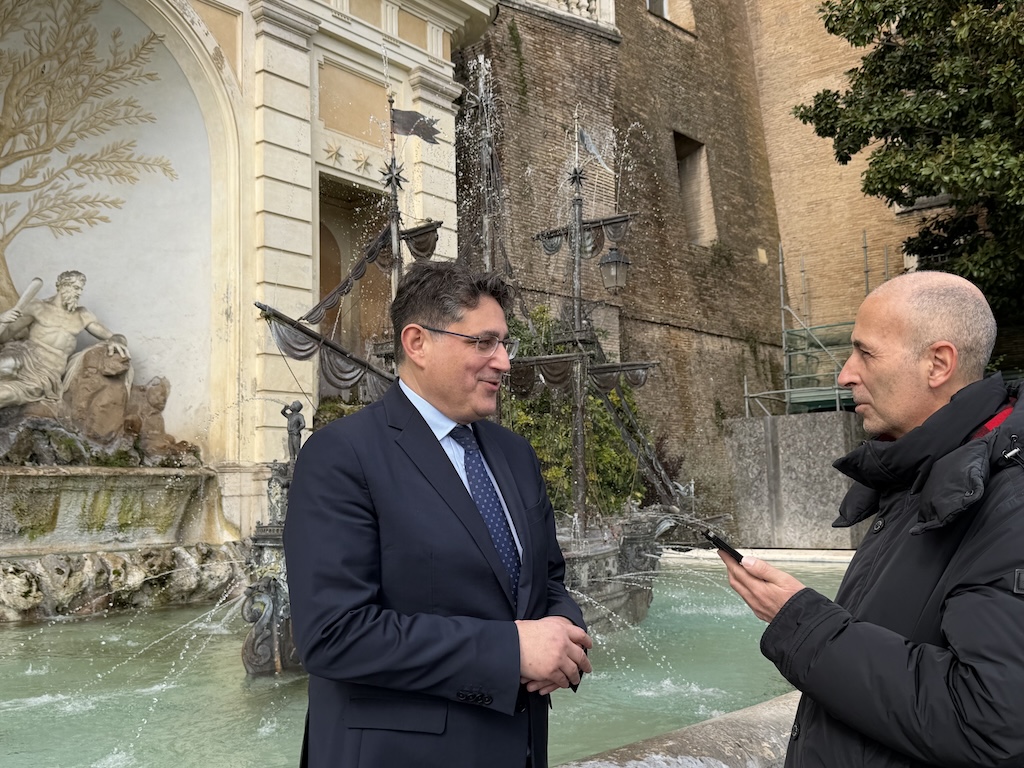
Engineer Antonino Intersimone, Director of Telecommunications and Information Systems of the Governorate, discusses this in an interview with www.vaticanstate.va.
What is the overall vision of the Directorate of Telecommunications and Information Systems for 2026?
Let us begin with data sovereignty. This topic has become particularly prominent in recent times, in this complex historical moment. For the Directorate of Telecommunications and Information Systems, this aspect has always been one of the main pillars of its strategy: data reside and are processed within the datacenters located inside the State territory.
The higher level—digital sovereignty, meaning the full ability to manage data and technologies entirely independently, without reliance on external factors—is naturally an unattainable goal for us. However, it remains a guiding reference for the individual choices we make.
With regard to security, the focus will once again be on a Zero Trust digital infrastructure, based on the assumption that no device and no individual is inherently trustworthy. In this context, the security framework will continue to be implemented so that everything accessing an IT resource is authenticated, authorized, and encrypted at various levels.
From an architectural perspective, areas of the datacenters will be engineered to be “AI ready,” capable of hosting market AI solutions.
The rollout of training courses identified by the Directorate continues with great satisfaction. These courses address training needs at various levels and are readily applicable in daily work. The training offer is updated annually to keep pace with highly topical issues, such as Artificial Intelligence courses.
The Directorate’s overall vision is rooted in the full awareness of being a key element of the Governorate of Vatican City, operating within the broader national and international telecommunications framework and placing all available resources at the service of the Supreme Pontiff, the Holy See, and the Church.
What interventions are planned for data networks, telephony and connectivity (LAN, WAN, Wi-Fi, 5G, fiber)?
The year 2026 represents a key milestone for strengthening the internal data network infrastructure. During the year, the new data backbone will be implemented, bringing into operation next-generation “best of breed” equipment capable of adequately supporting the service needs expected in the coming years.
Activities to modernize existing local networks will also continue, including the replacement of active equipment and the creation of new passive infrastructure. Significant work is planned in the Governorate building.
Regarding mobile connectivity, several initiatives are planned to extend Wi-Fi coverage to new areas and to upgrade certain already served areas by adopting the Wi-Fi 7 standard.
On the mobile telephony front, 5G coverage by TIM in Vatican territory was completed during 2025, while activities are currently underway to complete 5G coverage by Vodafone.
At the Pontifical Villas of Castel Gandolfo, design activities are ongoing which, if successful, will lead to the implementation of new mobile network coverage during 2026.
Are there upgrades planned in capacity, reliability or infrastructure redundancy?
Throughout 2026, strengthening projects will continue, particularly in the datacenter environment. The activation of additional server clusters across the three physical sites that form the backbone infrastructure for application service delivery is already planned. This will enhance dynamic workload management and consequently improve application resilience.
Are rationalizations or decommissioning of obsolete technologies planned?
Each year, the Directorate is strongly engaged in a continuous technological renewal process for IT equipment assigned to Governorate employees. This activity is carried out in close collaboration with the departmental offices where employees work, evaluating real operational needs in order to avoid waste or unjustified purchases.
In 2026, a significant intervention is planned on storage and switching components through the introduction of new solutions that will replace current technologies, reducing technological obsolescence and lowering maintenance costs.
What developments are planned for core IT systems in 2026?
In general, specific IT needs can be addressed in three main ways:
acquisition of off-the-shelf software solutions;
configuration or customization of software solutions or environments;
development of proprietary software.
Our Directorate has always followed an evolutionary path that leverages all three approaches, enabling constantly evolving needs to be aligned with strategic objectives. In this context, although more demanding, proprietary software development represents the preferred choice, particularly from the perspective of safeguarding data sovereignty, maintaining control over the tools that manage data, and ensuring the necessary levels of confidentiality.
During 2026, in particular, certain market applications that had been customized to meet specific vertical needs will be phased out in favor of solutions more consistent with the core architecture and overall IT systems evolution strategy.
Are new applications or reengineering of existing ones planned?
In 2025 alone, within the scope of proprietary software development, a total of 979 application releases were carried out, including both new versions of existing systems and entirely new applications.
For 2026, the action plan aims to exceed 1,000 releases. The most impacted areas will include management systems related to the Vatican Museums, Philatelic and Numismatic Commercialization retail operations, customs and international shipping processes, human resources and healthcare services.
For tablet and smartphone users, a recent development worth noting is that in early January 2026 the VaticanState App was released. It allows users to stay informed about Vatican State activities with up-to-date news and services. The App is available for Android and iOS systems and can be downloaded from Google Play and the App Store.
Which digital transformation projects are priorities for 2026?
Much has already been accomplished to reduce paper-based document flows, alongside the introduction of security and data validation systems. The steps of this evolution are clear and well defined.
However, I would like to highlight that the use of Digital Twin technology has become a priority for this Directorate. In broad terms, a Digital Twin is a virtual representation of an object or system designed to accurately reflect a physical object. In the Directorate’s activities, Digital Twin technology is used both for flexible design of wireless coverage needs in large spaces and for the access and sharing of environments that are not easily reachable.
What role will AI play in 2026?
Since the end of 2024, Vatican City has adopted specific “Guidelines on Artificial Intelligence,” and since early 2025 the Artificial Intelligence Commission has begun its work. Numerous studies and experiments have been conducted, testing certain solutions through specific proof-of-concept projects.
These activities have led to the engineering phase of systems equipped with adequate hardware computational capacity capable of hosting market AI solutions on-premise, thereby making the datacenters “AI ready.”
What are the main cyber threats considered in the 2026 planning?
Major information sources and sector studies confirm that ransomware—often attributable to organized cybercrime groups—will remain one of the most significant and concerning cyber threats in 2026. These attacks aim to compromise the availability and integrity of information systems, as well as to obtain financial gain through extortion and data theft.
Alongside ransomware, phishing and social engineering, cyber crimes are becoming increasingly sophisticated and enhanced by Artificial Intelligence, primarily aimed at credential theft and unauthorized system access.
In addition to technological measures already adopted or being implemented, and ongoing staff training, it must be considered that today all operational activities rely on digital tools and computerized processes. For this reason, in 2026, attention is also directed at the organizational level, with updates and strengthening of incident response procedures to effectively manage potential compromises and maximize overall system resilience.
Are staff training plans on digital security foreseen?
Absolutely. For the technical staff of the Directorate who have direct or indirect impact on cybersecurity matters, specific training pathways have been active for years, aimed at maintaining and constantly updating the skills necessary to prevent, detect, and counter evolving cyber threats.
For Governorate employees who use IT tools, a Basic Course on Digital Security is provided, structured into five modules: evolution of cybercrime, standards and regulations, major threats, operational best practices, and Artificial Intelligence as an emerging risk area. The course is delivered to small groups of up to twelve participants per session to ensure adequate depth and encourage interaction.
It is essential to remember that the human factor represents the most sensitive and essential element in the defensive chain. For this reason, continuous training is fundamental and constitutes a pillar of the digital security strategy.
I am grateful for this interview, which makes it possible to highlight the daily work carried out over time by the Directorate of Telecommunications and Information Systems, thanks to the commitment of all its employees in every field of application. Their dedication, individual talent and professionalism generates widespread satisfaction and the desire to approach these challenges with growing enthusiasm and success.