


20 November: Saint Edmund, King and Martyr
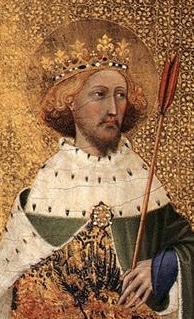

A model of a just and faithful ruler
Saint Edmund holds a special place in Christian memory as a courageous sovereign and an unshakeable witness to the faith. His story unfolds in the 9th century, when still very young, he became ruler over East Anglia, an English region shaken by the tensions and violence brought by Norse incursions.
Little is known with certainty about his birth or royal lineage: the traditions that depict him as the descendant of a Saxon king are considered unreliable by scholars, yet this has not prevented his figure from taking deep root in the collective imagination.
The kingdom entrusted to him was continually threatened by the Danes, who had evolved from simple raiders into conquerors aspiring to master the island. Under the leaders Halfdene, Hinguar, and Hubba, they alternated devastation and intimidation with demands for submission and tribute. The year 869 marked the point of no return: East Anglia was attacked, pillaged, and then “invited” to bow to the new power. Edmund offered a resolute refusal, faithful both to his people and to his faith. Defeated in battle and captured, he was offered his life on the sole condition that he renounce Christ and acknowledge Danish authority. His answer, repeated without hesitation, was that he would not yield.
Later accounts recount that he was pierced by a thicket of arrows, thus becoming a Christian martyr. Although historically fragmented, tradition helped shape Edmund into a model of a just and faithful ruler; indeed, even before the end of the 9th century, the coins minted under his reign were known as “St Edmund’s pennies,” a sign of popular veneration.
His relics found their permanent resting place in Beadoricesworth, today Bury St Edmunds, which became the centre of a devotion that crossed English borders and spread into various regions of France and Germany. Here religious institutions dedicated to him arose, including the Congregation of the Priests of Saint Edmund. In iconographic tradition he often appears with the crown and the arrows of his martyrdom, and over time he came to be recognized as the patron of rulers and of all who seek justice against the injustices they endure.
The Roman Martyrology preserves his memory as the king of the East Angles who, falling into the hands of pagan invaders, obtained the eternal crown through martyrdom.