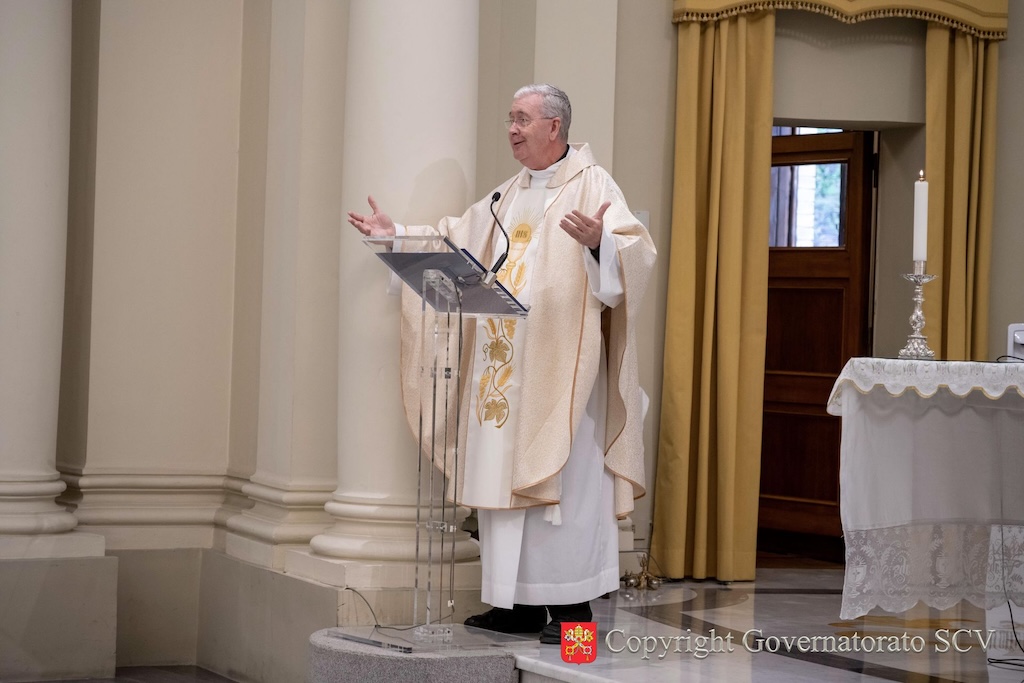


Monsignor Hogan, Coordinator of the Office for Relations with Patrons of the Arts in the Vatican Museums, speaks about the Florida Chapter’s contribution to the restoration of the Roman statues in the Atrium of the Quattro Cancelli.

A Mission in Service of Art and Faith
More than a simple contribution, the mission of the Patrons of the Arts in the Vatican Museums is a true vocation. Providing the opportunity to restore, recover, preserve, and perpetuate the integrity of the artworks housed in the Vatican Museums is both a challenge and a life choice that involves each and every donor personally. This is certainly the case for the members of the Florida Chapter of the Patrons, who recently contributed to the restoration of twelve Roman statues and two sarcophagi displayed in the niches of the Atrium of the Quattro Cancelli. We discussed this in an interview on www.vaticanstate.va with Monsignor Terence Hogan, Coordinator of the Office for Relations with the Patrons of the Arts in the Vatican Museums.
What inspired the Florida Chapter of the Patrons of the Arts in the Vatican Museums to generously support this restoration project?
The Patron Chapter and its members have a long history of supporting many projects within the Vatican Museums not only, but including the ancient works of the Pio Christian Museum, the Paoline Chapel, the Statue of Augustus of Prime Porta, the Display Cases of the Library Galleries in the Sala Paolina II, the Maintenance of the Sistine Chapel, and the Twelve Statues of the Quattro Cancelli. The Fourteen Statues reflect both the Chapter’s historical interest in the Museum’s dedication to Greco Roman sculpture captured by these various statues and sarcophagi, but is a testimony to the importance of the Quattro Cancelli as a point of reference introducing the visitor to the cultural heritage maintained by the Vatican Museums.
Why did the Chapter choose these particular works — the statues and the sarcophagi — as the focus of its contribution?
Choosing these particular works allowed individual members of the Florida Chapter to focus on a piece of idealistic art that was significant to them, such as Hercules, a barbarian warrior, an athlete, a Roman noble in a toga, or a sarcophagus with sacred ancient symbols. In this way, the importance of the Atrium of the Quattro Cancelli was restored in a classical manner signifying its importance.
How important is the preservation of artistic and cultural heritage for the Patrons?
For more than forty years, and through their financial commitment, The Patrons of the Arts in the Vatican Museums have been motivated to restore and conserve perhaps the greatest collection of art gathered in one place throughout the world. Their personal dedication of protecting centuries of artistic, religious and cultural treasures for the ages is critical to their mission which focuses not only on the past, but also toward the future, by conserving these treasures in the current day.
Did you follow the restoration process closely? If so, what was this experience like?
One is constantly amazed and inspired by the care and diligence of the curators and restorers whose life work it is to restore not only the Fourteen Statues of the Quattro Cancelli, but also the other works of art that they devote their lives to whether it be sculpture, painting, paperwork, mosaics as the list goes on and on.
Regular meetings and updates on each and every project that Patrons adopt for restoration are constantly held during the process and our Patron benefactors receive updates on the progress of their restoration project. If a donating Patron is visiting the Vatican, they are normally able to see the progression of their work.
Do you believe these works still convey something meaningful and relevant to today’s audience?
According to the Guidelines of the Patrons of the Arts in the Vatican Museums, their particular mission is “to restore and conserve the works of art of the Vatican Museums, promoting their cultural, spiritual and historic patrimony…” (PAVM Guidelines 2024) and for this very purpose, works such as the Atrium of the Quattro Cancelli, will continue to inspire as well as educate all those who view them when visiting the Vatican Museums. It begins a type of ‘conversation’ between the visitor and the Museums, that opens the door to history, art, religion and culture.
In what way do you think this act of generosity might inspire others to invest in culture?
Due to the immensity of the Vatican Museums’ collection, when visitors from around the world see the overwhelming number of galleries and exhibits, they are provided a description of the various works of art, but in addition we hope that as the visitor moves through the Museums, they note that every project for over forty years that Patrons have restored has a plaque or memorialization that recognizes the Patron Chapters and their benefactors who have restored the art. Oftentimes, this can inspire others to become a Patron and be a part of the Patron’s mission. We have learned over the years that many of our new Patrons have heard about the Patrons’ organization through the excitement of other Patrons, particularly those who have adopted projects for restoration.
Is the Florida Chapter considering supporting other similar projects in the future?
It is important to remember that each of the nearly twenty Chapters of Patrons from throughout the world are composed entirely of volunteers who are organized around a shared admiration and love of the conservation of art, particularly that which is found in the Vatican Museums. Each Chapter and its individual Patrons commit themselves to projects offered in the yearly Wishbook, a type of catalogue, that encompasses a variety of projects in the Vatican Museums that have been proposed for restoration. We are more than grateful for the financial support that each Chapter and its Patrons provide for the ongoing conservation work of the Vatican Museums. Not only the Florida Chapter, but all the other Patron Chapters, have continued their generosity over the years, as can be witnessed by the enormous number of plaques all throughout the Vatican Museums commemorating our Patrons’ financial support.
Is there a memory connected to this project that you will always carry with you?
In relation to the project of the Atrium of the Quattro Cancelli, the memory that clearly comes to mind was the day in 2024 that the Florida Chapter met in Palm Beach, FL for their annual gathering and how quickly the project of Fourteen Statues was adopted by its members. The excitement of these wonderful Patrons was unmistakable, because they wished, as do all Patron Chapters and donors, to continue to leave an amazing legacy of art, history, faith and culture found in the Vatican Museums, so that pilgrims, visitors both young and old, who come today and all who will visit in the future will be inspired, educated, and their spirits elevated by the great patrimony of the Vatican Museums that belongs to the ages.