


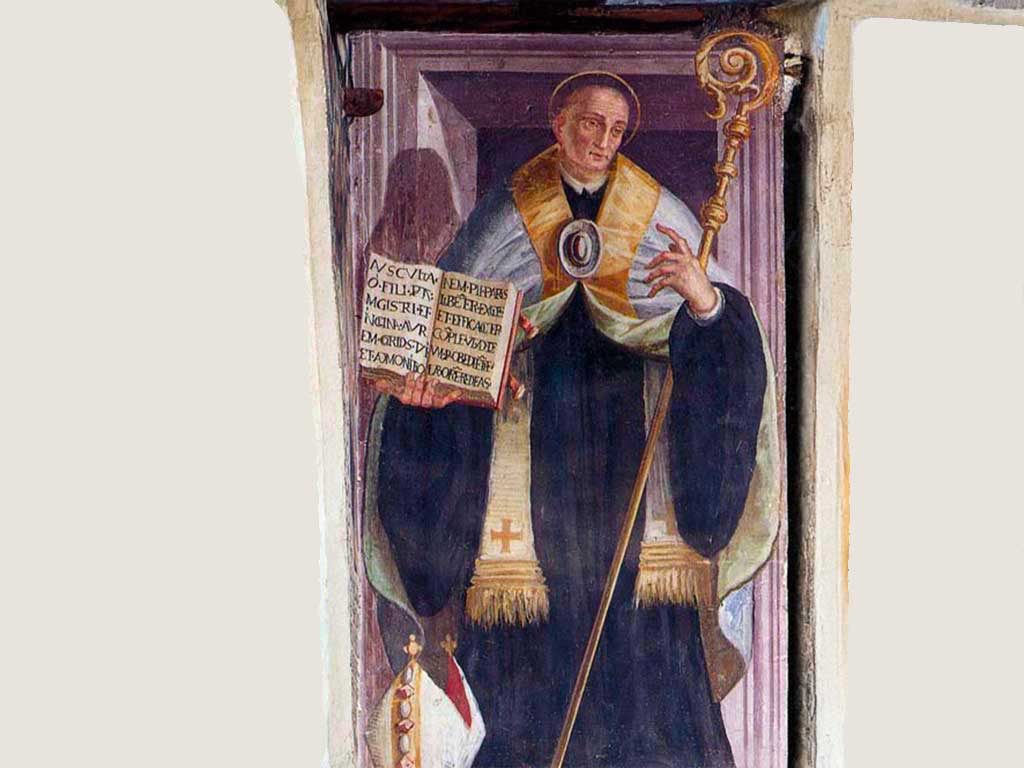
March 21: Passing of Saint Benedict of Norcia, Patron of Europe

Discovering Peace in Christ
According to Saint Gregory the Great, in Book II of The Dialogues, Saint Benedict died at the abbey of Montecassino after receiving Holy Communion, standing, with his arms raised in prayer, held by his disciples as he blessed and encouraged them.
It was March 21, 547, about forty days after the death of his sister, Saint Scholastica, with whom he was buried. Benedictine communities of men and women throughout the world celebrate the passing of their Founder on March 21, while the Church officially celebrates his feast on July 11, the day commemorating the translation of his relics, after Paul VI proclaimed him Patron of Europe on October 24, 1964. The Orthodox Church celebrates his commemoration on March 14.
March 21 is therefore a day of great celebration for us Benedictine nuns of the Mater Ecclesiae Monastery in the Vatican, as we remember our Father and Founder.
Gregory the Great describes Saint Benedict as a “bright star,” one that illuminates the history of Europe—a continent that, after the fall of the Roman Empire, found itself without political unity, exposed to the winds of division, violence, uncertainty, invasions of new peoples, and moral decline.
Benedict is not only a beacon of light for his native land, but for all of Europe and, by extension, for the whole world - to illuminate the darkness of those who walk in the shadow of death. Indeed, the communities he founded, and those inspired by his Rule, became—and still are today—a leaven of spiritual life, offering humanity the richness of the Christian faith.
Benedict had personally experienced the decline of the society of his time, marked by corruption, division, confusion, and oppression in daily life. Faced with this reality, the Saint proposes staking one’s life on Christ and invites others to follow Him. He does not point to a spirituality detached from reality, but to a charism capable of interpreting events in the light of God’s will.
Within this search for Christ lies the authoring of the Rule, intended to organize the life of monks and nuns and to guide their spirituality. Gregory the Great, in The Dialogues, emphasizes the moderation of the Rule, its concern not to demand anything excessive. One of Benedict’s aims is that the Abbot govern “in such a way as to stimulate the generous aspirations of the strong without discouraging the weak” (64:19).
Moreover, the Rule, besides concretely organizing monastic life, outlines the monastic virtues: obedience, humility, and a spirit of silence. It also regulates in detail the monastic liturgy, which Benedict calls the Opus Dei, the Work of God, the heart of the monk’s and nun’s life.
In this sense, Benedict assigns a fundamental role to the Abbot and the Abbess, who represent Christ in the monastery. He requires exemplary wisdom and teaching from them. For this reason, he entrusts them with responsibility for the obedience of their disciples. They must therefore devote all their care to guiding their disciples along the path of holiness, making themselves loved rather than feared.
Our community of Benedictine nuns within Vatican City places us within the heart of the Church and entrusts us with the mission of praying unceasingly for the Successor of Peter. We do so united with all contemplative communities throughout the world inspired by the Rule of Benedict.
The Rule is a literary work that must be meditated upon daily to fully grasp and deepen its salvific significance. In its 73 chapters, the Rule presents a path of life and happiness. It is like a compass that orients and shows the direction. Its aim is to help one walk the path of life. It accompanies the journey, not claiming to be exhaustive, but to free the energies each person possesses and channel them toward the search for God. Thus, the Rule makes us companions of Christ on the journey; it sets us in motion. It is a school for the service of the Lord. Each morning, the Abbot or Abbess reads and comments on a passage of the Rule so that it may be assimilated and “ruminated.”
Benedict defines monastic life as “a school for the Lord’s service” (Prol. 45) and asks that “nothing be preferred to the Work of God” (43:3). Yet he also warns that prayer is an act of listening (Prol. 9–11), which must then be translated into concrete action: “The Lord waits for us to respond each day with deeds to His holy teachings” (Prol. 35). In this way, the monk lives in harmony between action and contemplation, so that Ut in omnibus glorificetur Deus (“that in all things God may be glorified,” 57:9).
From this Vatican hill, we too wish to be for our brothers and sisters in the world a shining beacon of light, so that they may come to know Christ and draw from the richness of His mercy. With the certainty that Benedict accompanies us by the hand, even while living in the monastery, we are not indifferent to the sufferings of those who are oppressed or subjected to violence each day. For this reason, we bring before God all the intentions of those in need, with the certainty that the Lord always listens to His children and, like a loving Father, desires only their good.
Just as in the time in which Benedict lived, between the 5th and 6th centuries—when Europe was shaken by a profound crisis of values and institutions after the collapse of the Roman Empire—every age, including our own, has its share of wars, destruction, divisions, and calamities. In such a context, as daily reports of war around the world remind us, the example of Saint Benedict is a witness of peace, fraternity, and trust in the God of life. As he was able to transmit faith in Christ in the midst of a society undergoing complete transformation and in which essential values were despised and denied, so today his proposal is offered by the communities that follow his Rule and charism.
We hope that the feast of Saint Benedict may be an opportunity to rediscover the inner dimension and to find that peace which only Christ can offer.
Mater Ecclesiae Monastery