


The President of the Governorate at the Presentation of the Book "Economics for Ecclesiastics. A Guide"

Economics at the Service of the Person
An economic dimension “essentially understood as being at the service of the person, and thus directed at meeting his or her needs, rather than at the rationalization of scarce resources,” and making economic choices as “integral tools of the Church’s missionary action, through which the evangelical word can be concretely manifested” realizing that spirit of solidarity which breaks with the throwaway culture promoted by the ‘technocratic paradigm.’
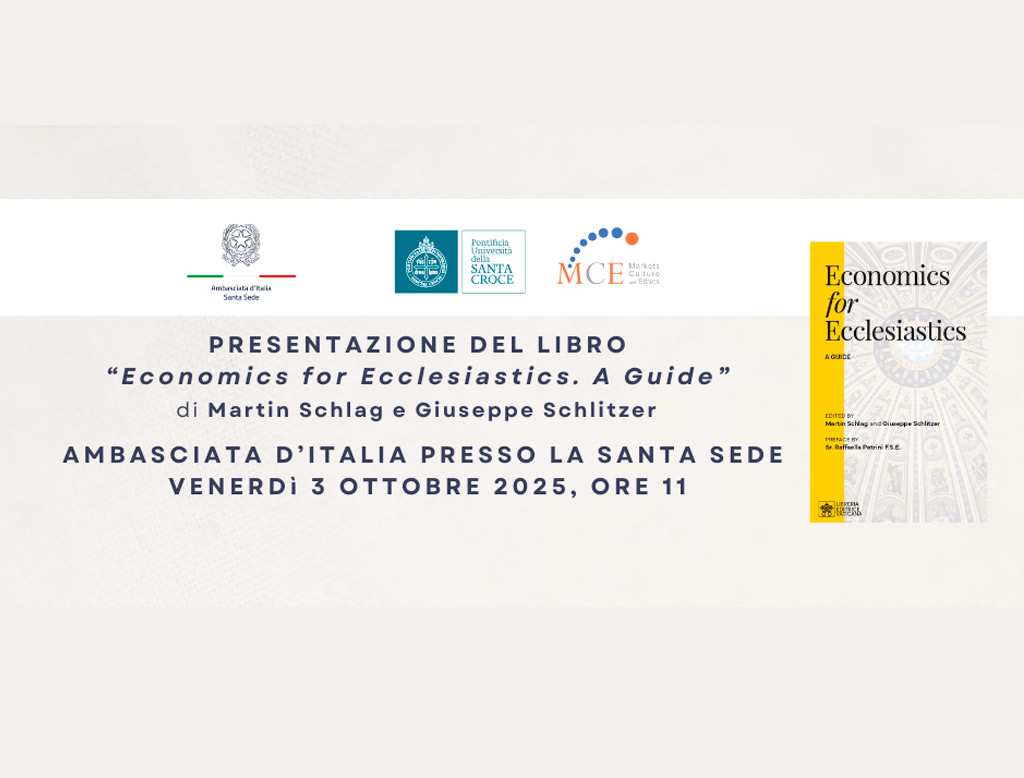
These are the two guiding principles that inspired the book entitled Economics for Ecclesiastics. A Guide, by Monsignor Martin Schlag and Professor Giuseppe Schlitzer, published by the Libreria Editrice Vaticana [Vatican Publishing House]. These principles were highlighted by Sr. Raffaella Petrini, President of the Governorate of Vatican City State, in presenting the volume on Friday morning, October 3, at the Embassy of Italy to the Holy See, in Palazzo Borromeo, Rome.
The event—moderated by journalist Fabio Bolzetta, President of the Association of Italian Catholic Web Journalists—included interventions by the authors and by Professor Francesco Bonini, Rector of LUMSA University in Rome. Among those present were the Ambassador of Italy to the Holy See, H.E. Mr. Francesco Di Nitto, Archbishop Emilio Nappa, and Giuseppe Puglisi-Alibrandi, Secretaries General of the Governorate.
In addition to the editors, various Catholic experts and academics, both Italian and foreign, contributed to the preparation of the volume, paying particular attention to the role that the Church’s Social Doctrine contributes in interpreting major developments in globalized markets and in managing ecclesiastical goods according to the principles of the “good father of a family.”
The final chapter of the volume contains a detailed overview of the process of reform of the Vatican’s economic-financial system, from the Monetary Agreement with the European Union in 2009 up to 2024. The book is intended to serve as a guide for ecclesiastics to better understand economics and to provide principles for its sound management, since the Church’s Social Doctrine can contribute to the interpretation and resolution of even complex economic issues.
Below is the presentation by the President of the Governorate:
I am deeply grateful to Ambassador Francesco Di Nitto for the invitation and for allowing this event to be held within the splendid Palazzo Borromeo. My heartfelt thanks go also to Professor Giuseppe Schlitzer and Professor Rev. Martin Schlag for involving me in the completion of the book we are presenting today, via a brief introductory Preface.
Economics for Ecclesiastics. A Guide makes a significant contribution within the broader context of reflection on economic matters that has developed, including in the academic field, over the past decade, especially following the 2008 financial crisis and, later, the global pandemic, with particular reference to the reform of the Roman Curia initiated by Pope Francis.
The thread linking the contributions gathered by Professors Schlitzer and Schlag unfolds, in my view, along two main lines, which provide the background for the entire volume, even if addressed by the authors from different perspectives.
On the one hand, the text is rooted in an economic dimension essentially understood as being at the service of the person, and thus directed toward meeting his or her needs, rather than toward the rationalization of scarce resources aimed at maximizing individual results, as traditional mainstream economic theory has long maintained.
For those familiar with Catholic Social Thought, it is easy to discern the roots of this reflection in the rich Magisterium developed above all through the social encyclicals, in particular, from Populorum Progressio (1967) to Centesimus Annus (1991), from Caritas in Veritate (2009) to Laudato Si’ (2015). In these, the Popes have clearly outlined this necessary transition from a “mechanistic” and reductive vision of the economy—focused on the pursuit of individual actors’ interests—to a vision that includes a social purpose, linked to the production and distribution of public wealth, where reciprocity and virtues also find their place, and where gratuitousness can effectively and legitimately stand alongside profit and contractual negotiation. Confirmed also by the work of many “secular” economists, this broader perspective on the economy implies a conception of the market as a space for the exchange of goods and services, in which production, consumption, and distribution are processes determined not only by material variables but also by immaterial ones, such as trust, transparency, and fairness. The spirit of the market—its ethos—is therefore considered just as important as the economic mechanisms that regulate its daily functioning.
The second guiding line of the book is based on the premise that economic choices are integral tools of the Church’s missionary action, through which the evangelical word can be concretely manifested and that spirit of solidarity realized which breaks the throwaway culture promoted by the “technocratic paradigm.”
The practice of the evangelical counsels in consecrated life, as well as the promises of ordained ministry, is expressed by acting as enlightened stewards of what has been received, not only in terms of the Spirit’s gifts but also in temporal goods, cultivating relationships founded on justice and charity, and thus contributing to the building up of the Church.
The ecclesiastical administrator is therefore called to care for and safeguard with particular prudence what has been entrusted to him, exercising the principle of the “diligence of a good father of a family.” In this perspective, oversight and accountability can no longer be perceived as limitations on autonomy or the effectiveness of service, but as necessary instruments of co-responsibility. Following Christ also manifests itself in the coherence of economic choices detached from a proprietary conception of goods, open to the needs of the most vulnerable, attentive to sustainability, and to the pursuit of a just balance that values both the human person and the (generally scarce) resources available.
Today the Church is experiencing—at every level—a profound review of the ways in which it manages its economic resources, in light of the demands arising from its openness to a globalized and interconnected reality. In this reality, it is called to interact with various actors who, in turn, constantly engage with one another through legally, socially, and economically defined modalities. Transparency, in this sense, proves to be a conditio sine qua non for dialogue and collaboration with this diverse range of interlocutors.
In this regard, the book provides a dedicated tool for the formation of clerics and religious preparing to address economic and financial matters, who are therefore called not only to develop adequate professional skills but also to acquire a broader vision of these subjects, exercising teamwork, drawing on others’ competencies and directing them toward the pursuit of the common good.
From the various contributions that enrich the publication - by complementing one another’s perspectives - it clearly emerges that, even in the concreteness of daily life, discernment in the management of goods and financial resources must remain centered on a conception of the economy founded on the human person, and on an instrumental view of such goods and resources—one that never loses sight of the primary purpose of fidelity to Christ “poor,” and therefore always nourished by a healthy sense of sobriety and careful attention to sustainability.
Thank you.