


March 15: Saint Louise de Marillac
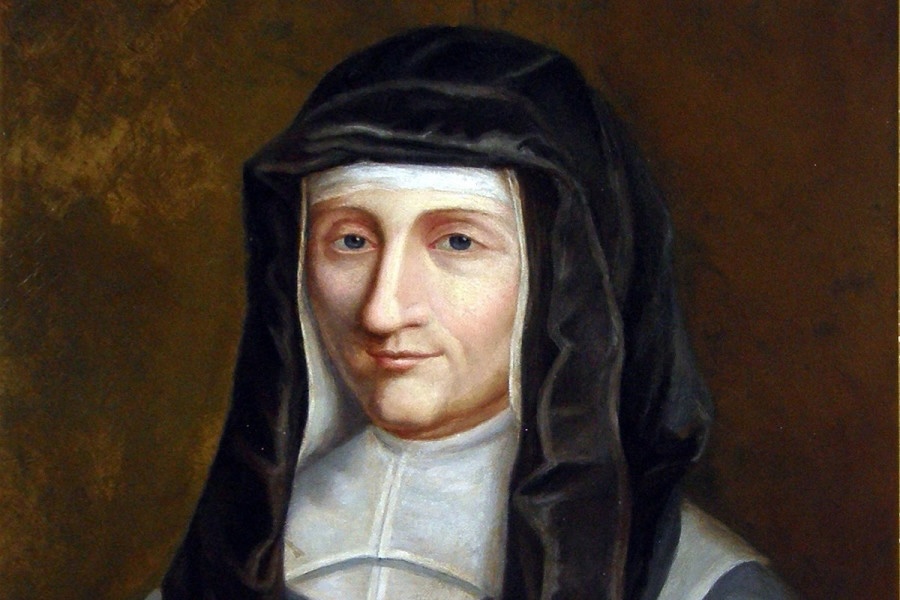

Placing the poor before all else
Mother, widow, teacher, social worker, nurse, and founder, Louise de Marillac embodied every state in a woman’s life.
Born on August 12, 1591, in Paris, she was an illegitimate child and never knew the identity of her mother. Her father, Louis de Marillac, a member of the nobility, officially recognized her. When he remarried, Louise was entrusted to the Royal Dominican Convent of Poissy, where her aunt was a nun. This experience deeply nurtured her spiritual journey. When her father died, she was thirteen years old and her uncle Michel became her guardian. She left Poissy and enrolled in a girls’ boarding school, where she had the opportunity to acquire many domestic skills and develop strong organizational abilities.
At the age of fifteen, she felt called to become a nun in a strict order such as the Capuchines, but the monastery’s spiritual director refused her because of her fragile health. She was deeply disappointed but accepted the decision.
In 1613, she married Antoine Le Gras, a squire and secretary to the Queen of France, with whom she had a son. In 1622, her husband fell ill and family life became difficult. During this period, Louise experienced deep interior conflicts: she had not kept her promise to God to become a religious sister, and now her husband was gravely ill. She went through periods of depression and anguish, struggling with many doubts about her faith.
On Pentecost in 1623, in her parish of Saint-Nicolas-des-Champs in Paris, she received an illumination from God that freed her from her doubts. While praying, she understood that her place was beside her husband and that God was present in her marriage. She realized that one day she would live in a community devoted to serving others, “coming and going” — an unimaginable form of religious life at a time when all nuns lived in cloister.
In this vision, a priest also appeared to her, whom she later identified as Saint Vincent de Paul, her future confessor and collaborator in service.
In December 1625, Antoine died and Louise was left a widow with limited financial resources and forced to move. Vincent de Paul lived near her new home and thus became her spiritual director. In 1629, he, who had founded the Congregation of the Mission (the Lazarists), invited Louise to assist him in the Confraternities of Charity, which were active in parishes throughout France. Louise devoted herself full-time to this new mission, making numerous visits to ensure the quality of services, review financial records and administrators’ reports, and encourage volunteers to see Christ in the people they served. She realized, though, that the Ladies of Charity could not manage everything on their own.
Then came the turning point. Around 1630, a peasant woman, Marguerite Naseau, offered her help to assist the Ladies. Other peasant women followed. Saint Vincent entrusted Louise with the practical and spiritual formation of these young women. After a long period of reflection and prayer, on November 29, 1633, the Company of the Daughters of Charity was founded.
Louise died on March 15, 1660, a few months before the death of Saint Vincent. Pope Pius XI canonized her in 1934. On February 10, 1960, Pope John XXIII proclaimed her “Patroness of all those engaged in Christian social works.”