


28 March: Saint Stephen Harding, Abbot
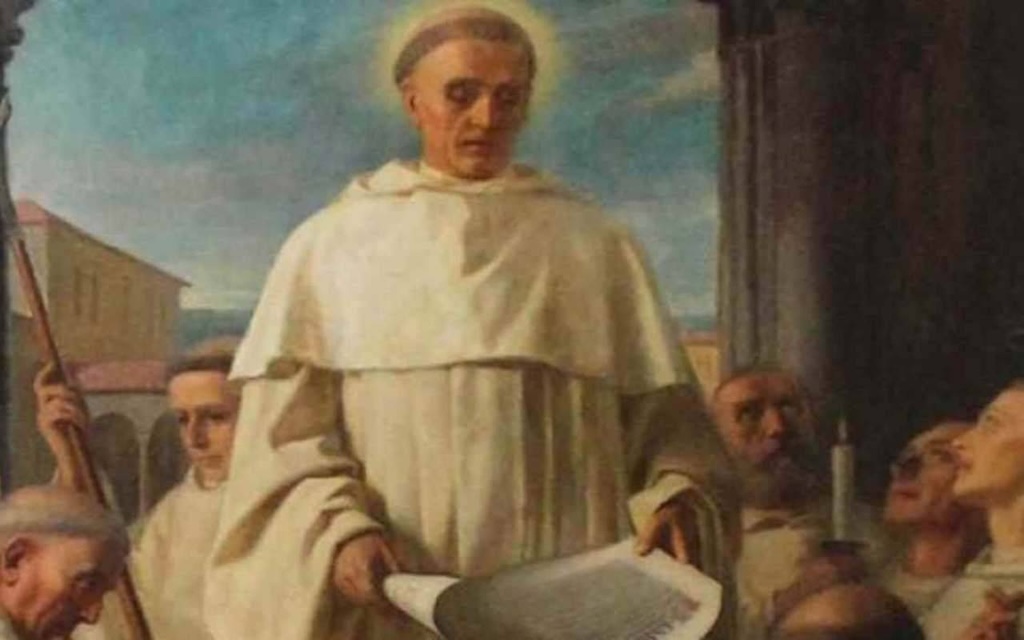

One of the three Founders of the Cistercian Order
“Alberic was succeeded by Stephen, English by birth, a most ardent lover and a most faithful example of piety, poverty, and regular discipline. His life confirmed how true it is what is written: The eyes of the Lord are upon the righteous, and His ears are attentive to their cry for help” (Exordium Cistercii, II).
Thus it is written in the origins of Cîteaux about Saint Stephen Harding, the third Abbot of the Novum Monasterium, to which he gave solid foundations through the famous Carta Caritatis (Charter of Charity), one of the statutes of the Cistercian Order. The Charter—whose aim was to establish bonds of charity and unity among the abbeys—defined the relationships between the various monasteries: mother houses and their respective daughter houses, and prescribed that all abbots of the different foundations should meet once a year at Cîteaux.
Stephen, born in a noble Saxon family in Merriot, a small village in the county of Dorset in southern England, in 1059, entered the Benedictine Abbey of Sherborne.
After the Norman Conquest, he left the abbey and withdrew to Scotland. He later moved to Paris for his studies. On his return from a pilgrimage to Rome, he stopped at the Abbey of Molesme in Burgundy, attracted by the monks’ poor way of life. It was the cenobium that Saint Robert had reformed, giving it a more austere character. Over time, however, the economic prosperity and numerous daughter houses of the abbey caused the disappearance of its original austerity. For this reason, Abbot Robert, together with some monks—including Stephen—left Molesme and founded a new monastery. The choice fell on Cîteaux, a place about twenty kilometers from Dijon. With the approval of the Bishop of Lyon, Hugh of Romans, Stephen, together with Robert and Alberic, founded the new monastery, called Our Lady of Cîteaux.
However, Robert’s departure from Molesme caused many difficulties and provoked conflicting reactions. The monks therefore asked Pope Urban II to have their abbot return. Thus, in 1099, Robert left Cîteaux and went back to Molesme. Alberic was chosen in his place as abbot of the new monastery, remaining in office until his death in 1109, when Stephen was elected.
During his time as abbot, Stephen promoted the reform of the liturgical books and had his monks replace the black habit of the Cluniac Benedictines with a white habit in honor of the Virgin Mary. Devotion to Mary was also expressed through the dedication of most new monasteries to her and through the recitation of particular prayers. Continuing the austerity introduced by Saint Robert, he extended this spirit also to the abbey buildings and churches, requiring the monks to support themselves through their labor.
In 1112, Saint Bernard, together with about thirty companions—brothers and relatives—entered the new monastery, giving great impetus to the Cistercian Order and leading to the foundation of the monastery of Clairvaux in 1115.
In that same year, Stephen also initiated the female branch of the Cistercian Order by sending the statutes to a group of nuns at Jully-les-Nonnains near Dijon. He died on 28 March 1134 at Cîteaux, where he was buried in the abbey church. At the time of his death, the Order counted seventy-five monasteries.