


February 1: Saint Verdiana, Virgin

Recluse for the Love of Christ
Verdiana was born in Castelfiorentino (province of Valdelsa in Tuscany), a commune recently named by the Bishop of Florence. Historical sources place her birth in 1178 and popular tradition describes her as a young servant in the household of the Attavanti family.
This period was marked by strained political tensions: the Valdelsa region was drawn into conflicts against German imperial power. It was precisely in Castelfiorentino, in the parish church of San Ippolito, that on December 4, 1197, the alliance of the Tuscan Guelph League against the Emperor Frederick Barbarossa was sealed.
During her childhood Verdiana led a simple life, tending flocks, when popular tales of wondrous events regarding her began to spread. As the years passed, she was taken permanently into the Attavanti household, where one of the most famous episodes connected with her occurred: the so-called miracle of the beans. It is said that Jacopo Attavanti had stockpiled legumes in order to resell them at a high price during a period of severe famine following an epidemic. However, when the buyer arrived to collect the goods, the storehouse was inexplicably empty, for Verdiana had distributed everything to the needy. Faced with the head of the family’s anger, the young woman asked only that he wait one day: after twenty-four hours, the harvest reappeared intact, as a sign of divine reward for the charity she had shown.
In adulthood Verdiana set out on pilgrimages as an act of penance, whereby she experienced spiritual turning points. She reached the tomb of the Apostle James in Santiago de Compostela, and perhaps also Rome, where she venerated the tombs of the martyrs. Upon her return to Castelfiorentino, her outward journey was transformed into a radical choice to turn toward a reclusive inner life.
The townspeople had a small cell built for her near the Elsa River, beside the oratory of Saint Anthony Abbot, a building also used as a place of isolation for plague victims. Verdiana entered it on the first Sunday of Advent in 1208 and remained enclosed there for thirty-four years, leading a life of total seclusion. Through a tiny opening she followed the Mass, spoke with those who sought her out, and received the little nourishment she was allowed.
According to tradition, it was through that same opening that she also met Saint Francis of Assisi while he was passing through the Valdelsa; it is certain, however, that before her death she was able to see the new Franciscan church rising not far away. She also maintained a close relationship with Ardingo, Bishop of Florence and a leading figure in an important work of ecclesiastical renewal, who listened to her words and counsel until the end of his pastoral life.
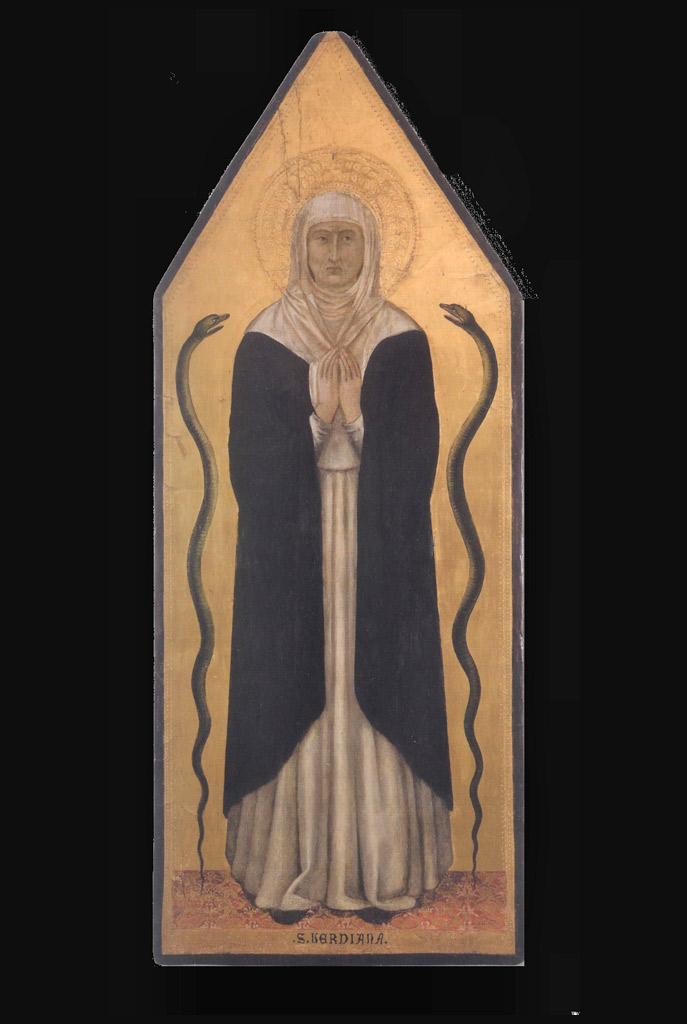
In her final years Verdiana is said to have silently endured a harsh trial: living together with two snakes in her cell, a presence she never wished to reveal to anyone.
She died on February 1, 1242. Tradition recounts that the news of her death was announced by the spontaneous ringing on their own of the town’s bells.