


January 29: Saint Sulpicius Severus, Bishop
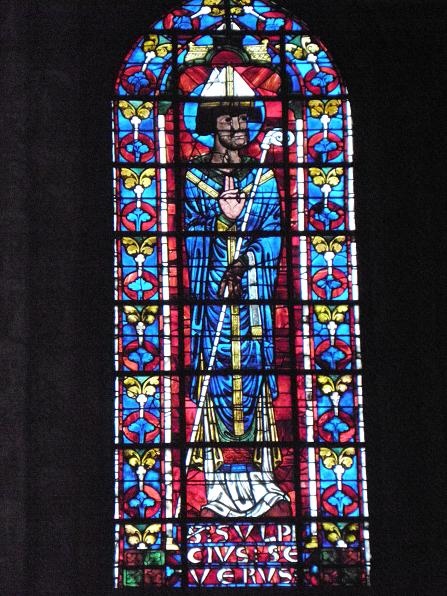

A life given entirely to the Church
Sulpicius Severus was born in Aquitaine around the year 350 into a family of high rank. Like many young men of his time, he initially pursued a career in law, considered the quickest path to prestige and honors.
Gifted with great eloquence, sharpness in business matters and strong argumentative skills, Sulpicius soon distinguished himself among his contemporaries, standing out for his rigorous judgment and his ability to use legal subtleties. His talent would have opened the doors to the highest public offices and his reputation soon spread beyond the borders of the region.
Absorbed by wealth and worldly prospects, he married the daughter of a consul and seemed destined for a future filled with honors. However, fate reserved for him a sudden trial: the death of his wife struck him deeply and plunged him into a period of profound sorrow. Rather than being overwhelmed by grief, Sulpicius found consolation in faith and piety. Providence granted him new graces, including friendship with Saint Martin, Bishop of Tours, and the opportunity to devote himself entirely to God, gradually renouncing his material possessions. Following the example of Saint Ambrose, he transferred his properties to the Church, reserving for himself only their usufruct—an action that provoked his father’s disapproval and the sardonic detachment of his former friends. Despite two serious illnesses, his spiritual determination and divine grace enabled him to overcome every trial.
Sulpicius is remembered above all as the historian and biographer of Saint Martin. Many details of the saint’s life were recounted to him directly by the bishop himself, while others were transmitted by the clergy of Tours or by the monks of Marmoutier. Gregory of Tours, a friend and correspondent of Sulpicius, portrays him in his works as a man of great nobility, generously devoted to works of charity and to the construction of churches and monasteries.
At the court of King Guntram, Sulpicius held high civil offices when he was summoned to Bourges to succeed Bishop Remigius at a time of grave emergency caused by a fire that had devastated the city. Ordained first a priest and then a bishop, he abandoned his worldly responsibilities and consecrated his life to the Church, displaying a rigorous monastic and prayerful spirit. He established a canonical refectory within the domus ecclesiae where prayer was continuous. Gregory of Tours emphasizes his prudence and firmness in civil affairs, his ability to deal with kings, and his skill in managing crises such as famines, unjust taxation, or fires.
During his episcopate, which probably began after 584, he presided over the Second Council of Mâcon in 585 and organized a synod at Clermont to resolve issues of jurisdiction among bishops. He never resorted to violence in converting Jews, preferring prayer and fasting instead. He died in 591, probably at an advanced age, and was initially buried in the Basilica of Saint Julian in Bourges; later his remains were translated to the church of Saint Ursinus. His cult, commemorated in the martyrologies on January 29, became partly confused with that of Sulpicius the Pious, his successor, and the popular devotion associated with the saint today likely reflects the influence of both. His reputation for holiness attracted numerous pilgrims and made it necessary to build a basilica and shelters for the faithful drawn by the wonders said to have been worked at his tomb.