


13 February: Blessed Christina of Spoleto, Augustinian

Prayer, penance and charity toward the poor
Christina of Spoleto’s life changed radically when, around the middle of the fifteenth century, she chose to break with her past. At a very young age—probably shortly after 1450—she left her family to receive the religious habit and enter the order of Secular Augustinians. Until then, very little was known about this young woman named Christina, who wished to follow Christ without reservation. From that moment on, her existence was marked by continual journeys, without a permanent home, in search of God.
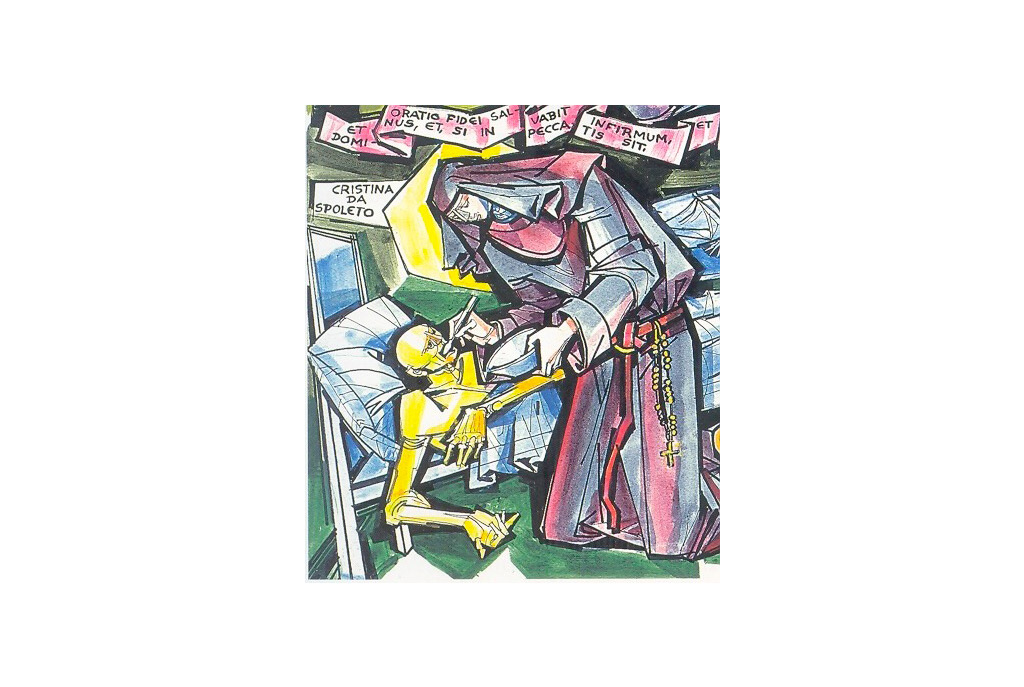
Living in various settings connected with the Augustinian Order, she never remained long in any one community. She devoted herself intensely to prayer, penance, and charity toward the poor and the suffering; but whenever she realized she was drawing the attention of others, she would move on to another place. With the intention of going to Assisi and Rome, and then continuing the pilgrimage to the Holy Land, she arrived in Spoleto together with another tertiary. There she dedicated herself to caring for the sick housed in the city hospital.
After several years of intense living following Christ, she died in 1458, probably not yet thirty years old. On these fundamental points, the hagiographical tradition agrees. There are few certain details about her life prior to her decision to “flee from the world while remaining in the world,” as her choice was described. Precisely because of this lack of information, her figure has been identified with different names and origins.
According to some hypotheses, Christina belonged to a noble family—such as the Visconti of Milan or the Semenzi of Calvisano in the Brescia area—and her flight was prompted by the refusal of an imposed marriage. Other accounts, instead, call her Agostina and place her near Lake Lugano, born between 1432 and 1435, the daughter of a physician. Married very young, she would soon have been widowed; she is said to have had a relationship from which a child was born who died in early childhood; after a second marriage, to have lost her husband, killed by a soldier who had become infatuated with her.
What is certain is that Christina was buried in the Augustinian church of San Niccolò in Spoleto. Immediately after her death, her reputation for holiness spread, nourished by numerous episodes considered miraculous and attributed to her intercession. This spontaneous devotion, which grew over time, received official recognition in 1834, when Pope Gregory XVI confirmed her beatification.