


January 10: Saint Gregory of Nyssa, Father of the Church
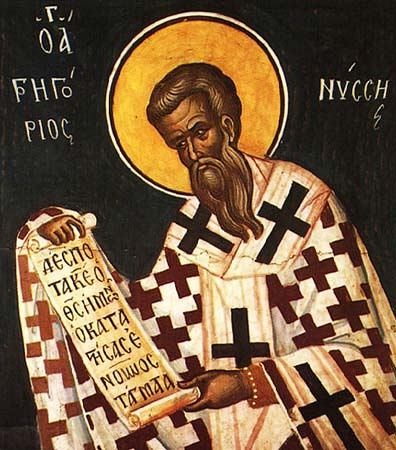

One of the Great Cappadocian Fathers
Gregory of Nyssa, a leading figure of fourth-century Christianity, was born in Cappadocia between 335 and 340 into an extraordinarily rich family of religious personalities. The younger brother of Basil of Caesarea, he was above all deeply influenced in his spiritual formation by his elder sister Macrina.
Despite this, Gregory did not immediately embrace the ascetic lifestyle of his relatives: after receiving baptism and the ministry of lector, he was drawn to classical culture, devoting himself to the study of rhetoric, to teaching, and to a secular life that also culminated in marriage.
The death of his wife marked a decisive turning point. Encouraged by his brother Basil and by his friend Gregory of Nazianzus, Gregory gradually abandoned worldly interests and spent a period of retreat in the monastery founded by Basil along the Iris River. Although he retained a strong love for philosophical reflection and the art of discourse, in 371 he was called to assume the office of Bishop of Nyssa, with the task of opposing the spread of Arianism.
His episcopate was not easy: lacking strong administrative and political skills, Gregory became a target of pro-Arian factions, who succeeded in accusing him of financial mismanagement. In 376 he was therefore deposed and exiled by order of the emperor Valens, a supporter of Arianism. Only after Valens’ death in 378 was he able to return to Nyssa, where he was welcomed with great enthusiasm by the people.
The death of Basil, at the beginning of 379, marked Gregory’s assumption of an even more significant role in the life of the Church. Regarded as his brother’s spiritual and doctrinal heir, he took an active part in synods and councils convened to heal internal divisions and to consolidate Nicene orthodoxy. His theological and philosophical expertise earned him the title “pillar of orthodoxy,” bestowed on him by the Conciliar Fathers. He played a leading role at the Council of Constantinople in 381, which definitively clarified the doctrine concerning the divinity of the Holy Spirit.
Alongside his ecclesial commitment, Gregory pursued an intense intellectual activity. He received official commissions from Emperor Theodosius I, delivered solemn homilies and funeral orations, and composed numerous works. His theological reflection, deeply influenced by the thought of Origen and by Neoplatonism, is distinguished by its original integration of Christian faith and classical philosophy, which he regarded as an educational tool capable of guiding the soul toward virtue.
More than a mere speculative exercise, Gregory’s theology was the expression of a profound spiritual experience. In his ascetical and mystical writings—such as On the Human Image of God and The Life of Moses—he outlined humanity’s journey toward God as a dynamic and never-ending process of inner growth. For this reason, he is remembered as one of the great Fathers of Eastern Christian mysticism.
He also distinguished himself in the production of encomiastic and hagiographical texts, dedicated to the celebration of the saints and to the narration of their lives; among these stands out the biography of his sister Macrina. Gregory took part in another synod in Constantinople in 394 and probably died shortly thereafter, around 395.
Venerated as a saint by both the Catholic Church and the Orthodox Church, Gregory of Nyssa remains one of the most original and profound minds of ancient Christianity: a contemplative thinker, open to the culture of his time, capable of uniting intellectual rigor, spiritual sensitivity, and fidelity to the tradition of the Church.