


January 14: Saint Felix of Nola, priest
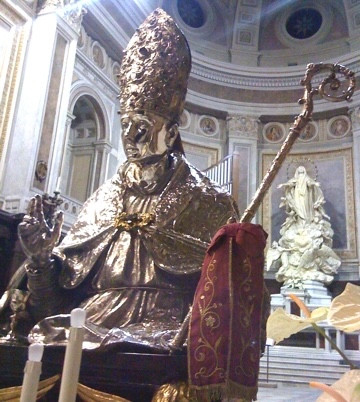

Unfettered devotion to charity
An example of fidelity, humility, and Christian witness lived to its utmost consequences, yet without the martyrdom of blood. The figure of Felix of Nola is known to us almost exclusively through the poetic compositions of Saint Paulinus of Nola, who between the late 4th and early 5th centuries committed to writing oral traditions still alive in the Nola region. These poems represent the earliest historical testimony to the life of the saint, whose memory has remained deeply rooted in the Christianity of southern Italy.
Felix was born in Nola in the second half of the 3rd century into a well-to-do family: his father, of eastern origin, had settled in Italy for work-related reasons. From a young age Felix embraced ecclesiastical life, receiving priestly ordination and becoming a close collaborator of Bishop Maximus, who held him in high esteem for his fidelity and even indicated him as a possible successor.
During the persecutions against Christians, Maximus was forced to flee the city and hide in an isolated place, leaving Felix to guide the community. He too, however, was arrested and subjected to harsh tortures. According to tradition, his release occurred in a miraculous way: an angel is said to have freed him from prison and led him to Bishop Maximus, who was by then gravely ill. Felix cared for him and brought him back to Nola, entrusting him to the assistance of an elderly Christian woman.
The respite was brief. With a new wave of persecutions, Felix once again had to evade capture. He remained hidden for about six months inside a now-dry cistern, surviving thanks to the discreet help of a devout woman. Only with the Constantinian peace of 313 was he able to return freely to the city. Upon the death of Bishop Maximus, the community proposed Felix as his successor, but he refused the office out of deep humility, promoting instead the election of another priest, Quintus.
From that moment on, he chose a radically poor way of life: he renounced reclaiming the property that had been confiscated from him and spent the rest of his days working with his own hands and devoting himself without reserve to charity and the service of others. The exact date of his death is unknown, but it probably occurred shortly after 313.
Although he was not killed, Felix was soon venerated as a martyr because of the sufferings he endured with faith and serenity. He was buried in the necropolis of Cimitile, near Nola, one of the most important early Christian complexes in southern Italy. His tomb became a destination for pilgrimages and was considered a place of particular efficacy against false testimony, so much so that it was called the Ara Veritatis. Saint Paulinus of Nola dedicated as many as fourteen poems to him, contributing decisively to the spread and enduring presence of his cult. His liturgical memorial is celebrated on January 14.