


January 11: Saint Paulinus of Aquileia, Bishop
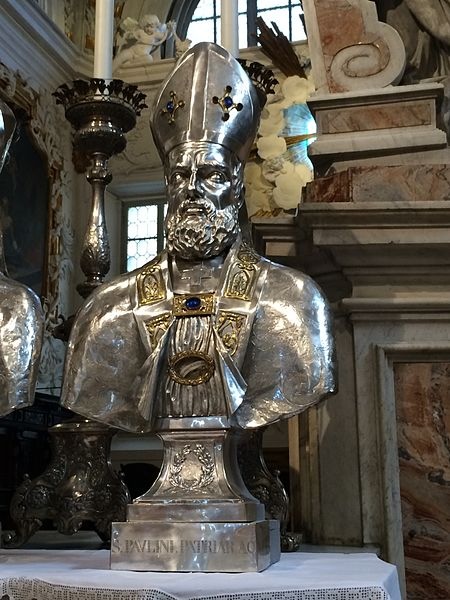

Zealous Shepherd of his Flock
Paulinus of Aquileia was born in the territory of the Lombard Duchy of Friuli, at Premariacco, near Cividale. We possess no certain information about his childhood and youth, but it is plausible that he received a thorough education, both in secular disciplines and in theological studies, perhaps within the local episcopal environment, where his priestly vocation also matured.
After the conquest of Friuli by Charlemagne, Paulinus entered the cultural circle of the Carolingian Empire and was taken to France, where he became a teacher of grammar at the Palatine Academy. Introduced into the most prestigious intellectual circle of the time and known by the symbolic name of Timothy, he forged relationships with the most prominent figures of the age, above all with Alcuin of York, who deeply appreciated his moral and intellectual stature, regarding him not only as an excellent educator but also as a spiritual guide.
In 787 Charlemagne appointed him Patriarch of Aquileia, entrusting him with one of the most important ecclesiastical sees of northeastern Italy. His ecclesiastical jurisdiction included the Friulian plain, while his metropolitan authority extended over a vast territory that encompassed the Venetian area, Istria, and the regions of Lombard Austria, recently integrated into the empire after the defeat of the Avars. Paulinus devoted himself with great energy to the reorganization and renewal of the Church entrusted to him, promoting disciplinary and liturgical reforms, as attested by the acts of the Council of Cividale of 796 and by the reordering of the ancient Aquileian liturgy.
Alongside his pastoral activity, Paulinus distinguished himself through intense cultural and theological work. He composed liturgical hymns intended for the principal celebrations of the Christian year, such as Christmas, Easter, the feast of the Apostles Peter and Paul, and the dedication of churches, showing great concern for the spiritual formation of the people. Indeed, he did not confine his efforts to debates among specialists, but sought to make the truths of the faith accessible to ordinary believers, also composing a catechetical Profession of Faith.
Paulinus also intervened in the discussion on the Filioque, supporting the addition of the expression according to which the Holy Spirit proceeds from the Father “and from the Son” in the Nicene-Constantinopolitan Creed.
Thanks to his moral authority, theological depth, and ability to unite culture and pastoral care, Paulinus occupied a leading place in the intellectual and religious life of Carolingian Europe. He died in Cividale on January 11, 802, and was buried in the city’s Cathedral, where his remains are still preserved today.