

January 15: Saint Maurus, Abbot

When obedience works miracles
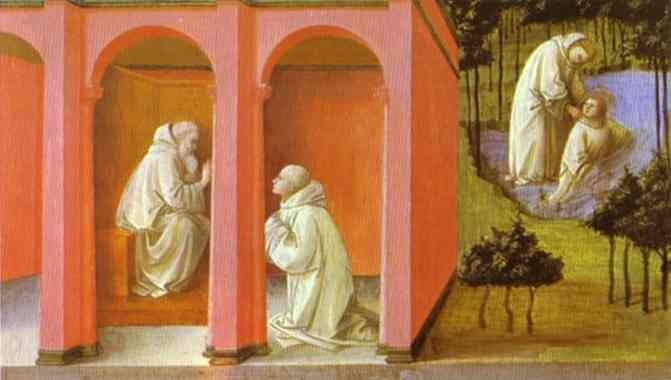
Maurus, the son of the Roman patrician Eutychius, entered the monastic world at a very young age when his father entrusted him to Saint Benedict, who at that time was shaping his communal experience at Subiaco. Along with him also received was Placid, the son of another nobleman, Tertullus. The two boys, noted for their docility and goodness of heart, soon became especially dear to the founder of Western monasticism; Maurus, being the elder, quickly assumed a position of trust beside his master.
The earliest tradition, attested with certainty in the Dialogues of Saint Gregory the Great, attributes to Maurus a deep spiritual maturity. In a symbolic episode, he is said to have perceived the action of the evil one during communal prayer, seeing an invisible force distracting a monk from his meditations. But the event that has forever fixed his memory in the history of Christian spirituality is the one linked to absolute obedience.
One day, Saint Benedict noticed that Placid, while drawing water from a lake, had fallen in and was being carried away by the current. Without hesitation he ordered Maurus to run to his aid. The young monk obeyed immediately and, focused solely on the command he had received, went beyond the shore, grasped the boy, and brought him safely back. Only afterward did he realize that he had walked on the water without sinking—a sign that the power of the miracle lay less in the prodigy itself than in the promptness of obedience.
Everything that is recounted later about the life of Maurus—his role at Monte Cassino, miraculous healings, his journey to France, prophecies, and numerous extraordinary deeds—comes from a late and apocryphal biography, composed in 863 by Abbot Odo of Glanfeuil and mistakenly attributed to a disciple of Benedict named Faustus. According to this unverifiable account, Maurus would have been prior at Monte Cassino, performed many miracles, spread the Benedictine Rule beyond the Alps, and founded monastic communities in French territory.
Although these narratives lack historical confirmation, they had a great influence on the saint’s devotional following: the monastery of Glanfeuil took the name Saint-Maur-sur-Loire and, many centuries later, the famous Congregation of the Maurists (1618) arose in France, drawing ideal inspiration from his figure. Devotion to Saint Maurus spread especially through the Cluniacs and took deep root in southern Italy. Beyond the later legends, his figure remains inseparably linked to the teaching of Saint Benedict: obedience lived as a privileged path of faith.