


February 28: Blessed Antonia of Florence, Abbess
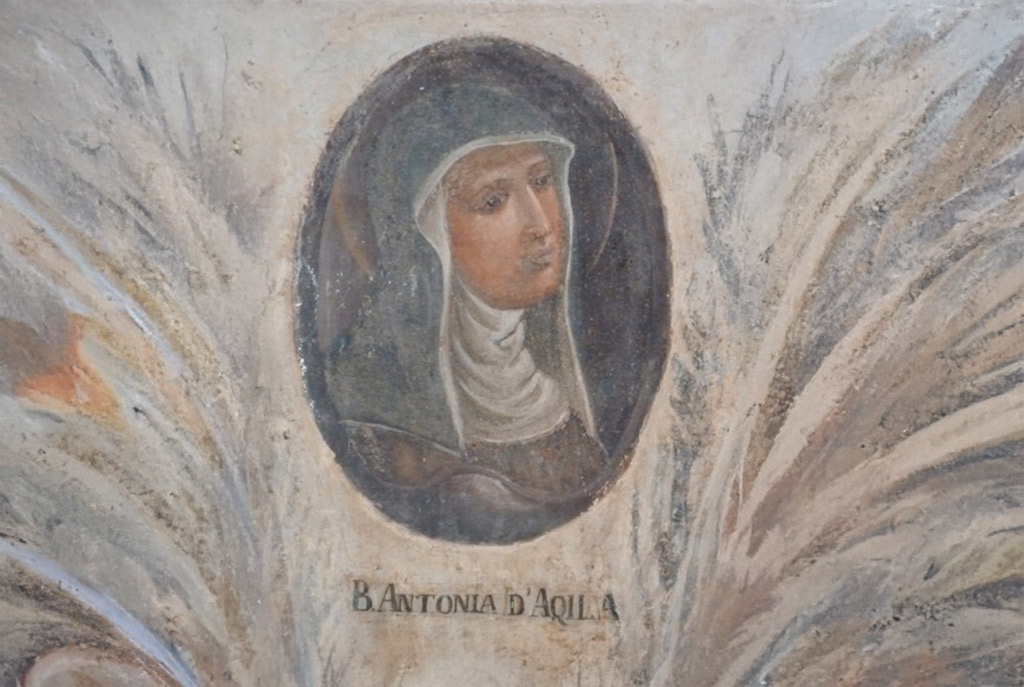

In the Spirit of Saint Clare
A radiant witness of evangelical poverty, lived hidden and with radical commitment—this is what shines forth from the life of Blessed Antonia of Florence. Born in the Tuscan capital in the early years of the fifteenth century, she married at a very young age. Widowed shortly afterward and mother of a son, she courageously faced her new condition, dedicating herself to raising her child. Yet within her heart a deeper desire was slowly maturing, leading her to refuse remarriage despite social pressures.
A decisive encounter with Franciscan preaching of her time definitively opened her life to a radical choice. Realizing she was called to total consecration, she responded promptly and generously. After entrusting her son to the care of relatives, she entered the Third Order Regular of Saint Francis, beginning her religious journey at the monastery of Sant’Onofrio in Florence, which followed the charism of Blessed Angelina of Marsciano, regarded as the founder of the Franciscan Third Order Regular.
Antonia’s spiritual and human gifts soon became evident. Her constant prayer, combined with strong leadership skills and an evangelical way of life, quickly made her a point of reference. For this reason, she was entrusted with positions of responsibility in several communities, first in Foligno and later in other cities of central Italy, where she helped to strengthen and guide new foundations of Franciscan tertiaries.
In 1433 she was called to L’Aquila to lead a recently founded monastery dedicated to Saint Elizabeth. She arrived with several companions, initiating a period of deep renewal. For more than a decade she guided the community with balance and wisdom, fostering both its numerical growth and its spiritual development.
Despite her intense activity, Antonia sensed that her journey was not yet complete. A desire for a more withdrawn and contemplative life led her to look with increasing interest to the Rule of Saint Clare, which in those years was being rediscovered in its most authentic form through the Observant reform movement. Supported by Saint John of Capestrano, she decided to embark on this new important step.
In 1447, accompanied by several sisters, she began a new monastic experience marked by the most radical poverty, settling in a monastery that soon became known for its evangelical rigor and the intensity of its contemplative life. Antonia served as Abbess for several years, imprinting upon the community a style characterized by silence, constant prayer, and total trust in Divine Providence.
Although living in enclosure, her reputation spread quickly, attracting many young women eager to share that form of life. Antonia always chose the lowest place, kept for herself what others discarded, and cared for the more fragile sisters with an authentic maternal spirit.
After completing her term of governance, she devoted herself entirely to contemplation of the mystery of Christ crucified. She died on February 29, 1472, surrounded by her sisters. Her death was accompanied by events that deeply moved both the community and the city, giving rise to widespread popular veneration. Several instantaneous healings were reported, including that of Zingarelli of L’Aquila, who suffered from severe edema, and of Sister Innocenza, a Poor Clare freed from numerous sores over her body.
In the following decades, during official examinations, her body was found incorrupt on several occasions, and many healings were attributed to her intercession. On July 28, 1848, Pope Pius IX declared her Blessed.