


January 19: Saints Marius, Martha, Audifax, and Abachus, martyrs

Witnesses of Christ to the sacrifice of their lives
Saints Marius, Martha, Audifax, and Abachus are remembered by the Catholic Church as martyrs of the early centuries of Christianity, and their liturgical memorial falls on January 19. The information concerning them is scarce and fragmentary and comes mainly from ancient hagiographical texts, in particular from a Passio dating to Late Antiquity, which was reworked in subsequent centuries with edifying aims.
According to the most widespread tradition, Marius—sometimes also referred to as Maris—came to Rome together with Martha and two young men, Audifax and Abachus, identified as his sons. The earliest sources present them as a family, although modern scholarship does not exclude the possibility that they were instead a group of Christians bound together, as often occurs in hagiographical accounts of the early centuries.
The group is said to have settled in the outskirts of Rome, along the Via Cornelia, in an area corresponding to the imperial villa of Lorium, where many Christians lived and worked. Here Marius and his companions distinguished themselves by an act of great courage: the burial of the bodies of numerous believers killed because of their faith and left dishonored in the countryside. This act of Christian piety made them suspect in the eyes of the authorities.
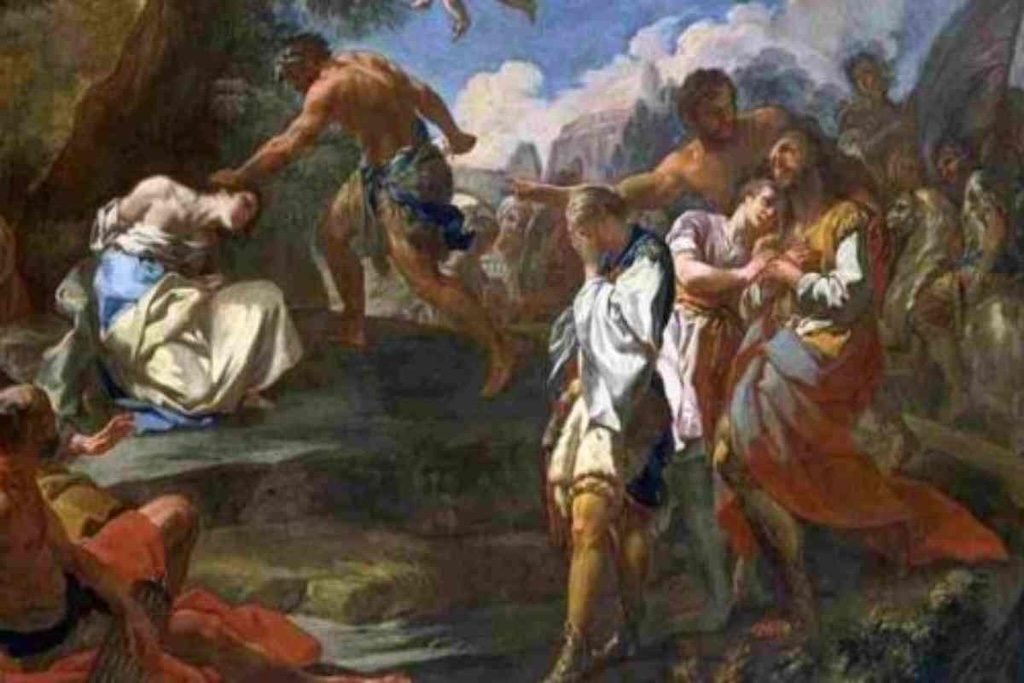
Discovered while honoring the martyrs, they were arrested and subjected to interrogation. The accused were required to perform an act of pagan worship as a sign of submission to imperial authority. Their refusal condemned them to death. The men were executed along the Via Cornelia, while Martha suffered martyrdom nearby, close to a body of water. The exact dating of these events remains uncertain: today they are generally placed at the beginning of the fourth century, probably in the context of the persecutions ordered by Diocletian (303–311), although in the past an earlier period had been proposed.
A Christian matron named Felicitas is said to have provided for their burial on her property, also along the Via Cornelia, at the thirteenth mile from Rome. A place of worship soon arose there, which was already a destination for pilgrims in the early medieval period. The remains of this ancient church are still visible in the area now known as the Tenuta Boccea. Over the centuries, as the population increased, a new church was built and inaugurated in 1789 at the behest of Pope Pius VI.
The martyrs’ relics underwent several translations over time: some were transferred to churches in Rome, such as Sant’Adriano and Santa Prassede, while others were sent in the ninth century to Germanic lands, where Einhard, biographer of Charlemagne, placed them in the monastery of Seligenstadt. Today the bodies of Marius and Martha are kept in a single urn beneath the high altar of the church of San Giovanni Calibita on Tiber Island.
The most popular account of their story was revived in the modern period by a narrative circulated in the nineteenth century, made especially well known through Don Bosco, who drew on earlier materials contained in the Acta Sanctorum. These texts, while blending historical and legendary elements, preserved the memory of a group of Christians martyred in the northwestern area of Rome, contributing decisively to the spread of their cult.
Over time, Marius and Martha have been invoked as protectors of the family, to the point that they are also mentioned in the Litany of the Saints in the marriage rite.