


January 16: Saint Marcellus I, Pope
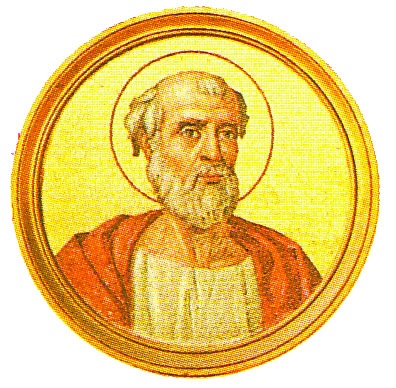

Impeccable Shepherd
The memorial of Pope Marcellus I, commemorated by the Roman Martyrology on January 16, belongs to one of the most complex phases in the history of the early Church. The sources that mention him are few and often conflicting, so that his figure emerges more through fragments than through a linear narrative. What is certain is that he was Bishop of Rome at the beginning of the fourth century, that his pontificate was brief, and that he was buried along the Via Salaria, in the Cemetery of Priscilla, after dying while away from the city.
According to the Liberian Catalogue, Marcellus was Roman by birth and was elected Pope around 308, during the reign of Emperor Maxentius. At the time of his election he found a community deeply marked by the consequences of the Great Persecution: places of worship confiscated, cemeteries taken from the Church, liturgical life disorganized, and above all strong internal tensions. Many Christians who had renounced the faith under the threat of persecution now demanded readmission without any path of penance, appealing to the long vacancy of the Apostolic See.
Marcellus confronted the situation with determination. He initiated a reorganization of the Roman Church, which later tradition attributed to him in particular. His name was linked to the division of the city into twenty-five Tituli, entrusted to presbyters responsible for catechesis, the administration of the sacraments, penitential discipline, and the care of burial places. He was also credited with the foundation of a new cemetery on the Via Salaria, known as that of Novella, intended to receive the burials of the faithful who were not martyrs. Modern scholars believe that these reforms may have been the result of a broader process, retroactively attributed to Marcellus by the Liber Pontificalis.
His pastoral commitment, however, clashed with the most delicate issue of the time: that of the lapsi. Marcellus, faithful to traditional discipline, firmly maintained that a return to ecclesial communion had to pass through sincere penance. This rigorous stance provoked strong reactions: hostile groups formed, disorders and violence broke out, and civil authority intervened. Maxentius, attributing responsibility for the unrest to the Pope, had him removed from Rome and condemned to exile in a place that remains unknown.
An epitaph later composed by Pope Damasus I presents Marcellus as an inflexible shepherd, who became the target of hatred precisely because he recalled the faithful to the necessity of conversion. His pontificate would not have lasted more than a year and a half.
Alongside this historical reconstruction, another account of a hagiographical nature circulated, handed down by a fifth-century Passio. According to this narrative, Emperor Maxentius demanded that Marcellus renounce his episcopal dignity and sacrifice to the pagan gods. When the Pope refused, he was condemned to humiliating labor at an imperial posting station, where he was forced to care for horses like a slave. Temporarily released, he was arrested again for consecrating a private house as a place of worship and finally died after further hardships and privations. This version seems intended to explain the origin of the title of Saint Marcellus “in catabulo” from which derives the saint’s patronage of grooms and horse breeders.
Whatever reconstruction is closest to reality, Marcellus was soon venerated as a martyr—not so much for a violent death as for the sufferings endured because of his fidelity to his pastoral role. His remains were brought back to Rome and laid to rest in the Cemetery of Priscilla; today they are preserved in the church of San Marcello al Corso, in an ancient urn of green basalt.