


February 9: Saint Apollonia, Martyr
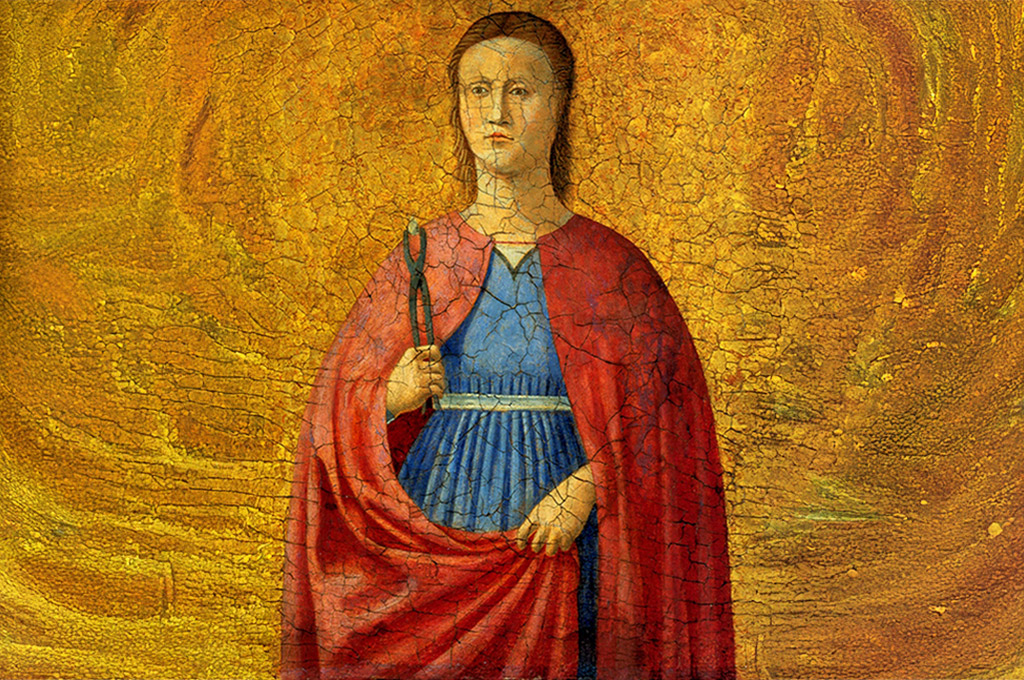

A faith that flames stronger than fire
The story of Apollonia is known thanks to an indirect testimony handed down by Eusebius of Caesarea, who lived between the 3rd and 4th centuries. In his work, he refers to a letter written by Bishop Dionysius of Alexandria and addressed to Fabian, Bishop of Antioch. The text describes details of what happened to Apollonia, of which the author claims to have been a direct witness.
During the reign of Emperor Decius, in Alexandria of Egypt, a violent repression against Christians broke out. A pagan soothsayer, full of hatred and fanaticism, fueled superstition and incited the population against the Christians. The crowd, in a state of mass hysteria, turned on them: some were scourged, others mutilated and then expelled from the city.
At that time, there lived in Alexandria an elderly woman, Apollonia, distinguished by her irreproachable life. When popular fury descended upon the homes of Christians, destroying everything, Apollonia was dragged before the judges. She did not renounce her faith and accepted to face torture, offering her life to God.
The persecutors began by breaking her teeth; then they prepared a large pyre, threatening her with death in the flames if she did not deny her faith. But when the fire was lit, Apollonia, after a brief moment of recollection, managed to free herself and voluntarily threw herself into the blaze so as not to lose her chastity and not to commit sin. It was around the year 249. She is venerated as a saint also by the Orthodox Church and is the patron saint of dentists, dental hygienists and dental technicians.