

17 December: Saint John de Matha
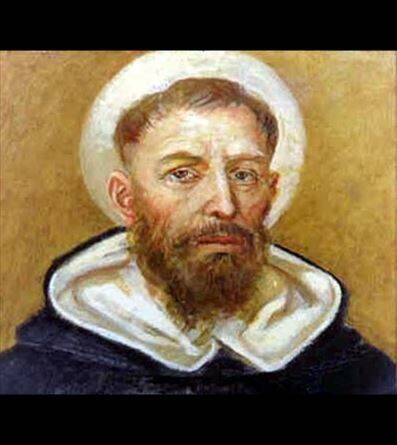

Founder of the Order of the Most Holy Trinity
Saint John de Matha, founder of the Order of the Most Holy Trinity, was born in Faucon—a small Alpine settlement in Provence and a fief tied to the Counts of Barcelona—around the middle of the 12th century, according to sources on 24 June 1154, and according to others on 23 June 1160.
Coming from ancient military nobility, he was early directed toward study: first in Aix, then Marseille, and later in Paris, the intellectual capital of Christian Europe. There he deepened his knowledge of theology with such success that he came to be called magister, and he began teaching at the Cathedral School. Yet the university environment did not extinguish in him the desire to consecrate himself entirely to God. Ordained a priest by Maurice de Sully, the great Bishop who initiated the construction of Notre-Dame, he celebrated his first Mass in 1193—according to other chronicles, in November 1192—asking the Lord for a sign to definitively guide his life.
It was during that very celebration that the decisive episode occurred: at the moment of the elevation, John saw the glory of God and two chained captives, one “black and deformed,” the other “white and emaciated,” upheld by the hands of the Lord. This vision, reported by an anonymous writer of the 13th century and confirmed by subsequent tradition, was interpreted as a divine mandate to free Christian slaves held in Islamic territories. John had the scene depicted on the mosaic above the portal of the Roman hospital of San Tommaso in Formis, which would become the heart of his future work.
Desiring to discern how to carry out this mission, John withdrew for a time into the quiet of Cerfroid in Picardy, a wooded place where a few hermits dedicated to prayer lived. Among them was Felix of Valois, who shared his spiritual intuition and helped him structure the first nucleus of a fraternity dedicated to the redemption of captives. Benefactors soon gathered around the two men—such as Countess Margaret of Blois, Robert de Planels, and Maria Panateria—offering land, houses, and churches to support the nascent community.
With a rule of life still in development, John traveled to Rome in 1198, where he met, newly elected, his former fellow student: Lotario dei Conti di Segni, now Pope Innocent III. The Pontiff welcomed the project with interest but requested further verification, inviting John to return to Paris to refine the normative text of the Order. Back in France, John and his companions drafted a rule expressing the evangelical spirit, the way of life, the redemptive mission, and the fraternal identity of the new religious family.
When presented again to the Pope, the rule was approved between 1198 and 1199. Innocent III officially recognized the Order of the Most Holy Trinity and of the Captives, granting it the ability to collaborate with lay faithful in the work of liberation. On 8 March 1199 he even sent a letter of recommendation to the King of Morocco, asking him to favor the Trinitarians’ mission.
Immediately after the papal recognition, John organized the first redemption expedition, probably participating in it personally. He established a house in Marseille, which became the preferred port for the redemptors’ crossings and the place of return for freed captives. He later traveled to Aragon and Provence, where new supporters—such as Pedro de Belvis, the Counts of Orange, and the Lords of Baux—provided protection for his religious and their goods. With extraordinary conciliatory skill, John resolved local disputes, secured political support, and opened houses in many cities of Spain, including Toledo, Segovia, and Burgos.
The Order’s network grew rapidly, requiring a stable center. Returning to Rome, John obtained from Innocent III the perpetual possession of the hospital of San Tommaso in Formis, which became the Order’s principal headquarters and his personal residence. In this place—where tradition holds that Saint Francis of Assisi also passed—John exercised the service of “minister,” guiding the expansion of the Trinitarians and supporting further ransom operations in Europe and Africa. He also took part in a papal legation to Dalmatia to bring certain heretical groups back to the unity of the Church.
Worn out by his labors, John de Matha died in Rome on 17 December 1213. His body was laid to rest in San Tommaso in Formis until, on the night of 19 March 1655, it was secretly transferred to Madrid. Alexander VII officially recognized the devotion to his memory.