


19 December: Saint Anastasius I, Pope
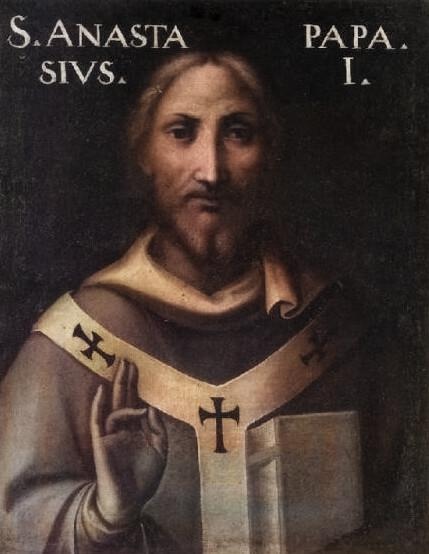

Defender of the True Faith
Anastasius, Roman by birth and son of a man named Maximus, bore a name which in Greek means “risen.” He was elected Pontiff at the end of 399, after the death of Pope Siricius, and remained at the head of the Church for just two years, until 19 December 401. Despite the brevity of his pontificate, his governance was remarkably intense. He is credited with the construction of the Basilica Crescenziana—identified by tradition with the present-day San Sisto Vecchio—and with a constant work of doctrinal vigilance in years when ancient controversies periodically returned to shake ecclesial unity.
His attention was first directed to heretical movements that were still troubling North Africa: Donatism, which challenged the legitimacy of certain bishops and the sacraments they administered, and the last remnants of Manichaeism. Anastasius confirmed the decisions of the Council of Toledo of 400 and showed himself resolute against every form of division, while in Rome he personally uncovered Manichaean groups that had remained hidden. At the same time, he firmly opposed Arian influences that survived in certain regions of the Empire and was a strong supporter of the rights of the Western Patriarchate over the provinces of Illyricum.
The episode that most marked his pontificate, however, was the great Origenist controversy. The doctrines attributed to Origen, often transmitted through a Neoplatonic lens and at times interpreted in a dualistic or Gnostic sense, provoked lively disputes in monastic circles both in East and West. In 399, friends and disciples of Saint Jerome urgently requested an official position from Anastasius. These appeals were joined by the solicitations of Theophilus of Alexandria, eager to obtain Roman support in the dispute. The Pope examined a series of propositions taken from Origen’s Peri Archon—a work that Rufinus of Aquileia had recently translated and “corrected”—and declared them blasphemous. Rufinus, irritated, sent him an Apology to clarify his own faith, but Anastasius preferred not to engage with the question of his personal intentions. He confined his intervention to the condemnation of doctrinal errors and addressed several letters to the bishops of the West and to the Eastern Churches; one of these was sent to Venerius of Milan.
Alongside these controversies, there were also cordial and personal relationships with the spiritual figures of his time. Particularly well known is his friendship with Paulinus of Nola: Anastasius publicly praised his way of life and invited him to Rome for the anniversary celebration of his own consecration, an honor usually reserved only for bishops. Paulinus, who was not yet a bishop, was unable to attend, but the Pope kindly accepted his letter of apology. Only a small part of their correspondence survives today, although it is known that from the Lateran the Pontiff wrote frequently to many regions of the Empire.
His death occurred on 19 December 401, a date confirmed by studies of the Liber Pontificalis. He was buried along the Via Portuensis, between the basilicas of Saint Candida and of Saints Abdon and Sennen. Jerome, who held him in high esteem, went so far as to suggest that his premature death had been almost a grace, sparing him from witnessing the humiliation of Rome during the sack of 410. Devotion to Anastasius spread rapidly: his name already appears in the Martyrologium Hieronymianum by the middle of the fifth century.