


23 March: Turibius of Mogrovejo, Archbishop of Lima
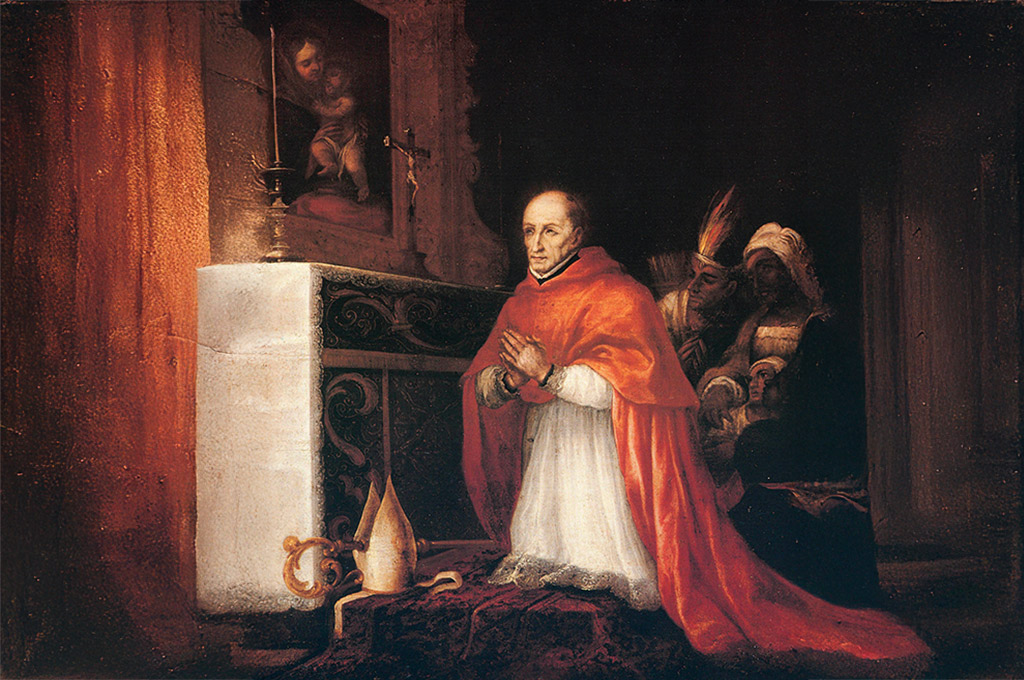

Defender of the Indigenous Peoples
He was still a layman when he was appointed Archbishop of Lima, and at the time he was already a renowned jurist. Originally from Spain, his life was radically changed when he set out for the New World. His name was Turibius, a member of the noble Spanish Mogrovejo family.
He was born in Mayorga (Valladolid) in 1538. After studying law, he became a well-known expert in Canon Law and taught at the University of Salamanca. The King of Spain chose to send Turibius to Peru as Archbishop of Lima, which at the time of its foundation, on January 18, 1535, was called Ciudad de los Reyes (“City of the Kings”), because it was founded close to the date of January 6, the feast of the Epiphany, when the Magi Kings are commemorated.
It was 1580 when Turibius accepted the king’s invitation and, in a short time, as a layman he received all the sacred orders up to the episcopate. The new mission awaiting him was not simple. He knew very well that he would have to confront the local lords who dominated Peru. Indeed, when he arrived in 1581, he realized the dramatic situation of poverty and exclusion in which the indigenous people lived. Thus, his intervention in their favor challenged the privileges of the Spanish conquistadors, who reacted against him.
On the other hand, Turibius spared no effort and began traveling throughout his diocese—extending for thousands of kilometers—even on foot, in order to reach the most distant villages of the indigenous people. He began reforming the clergy, above all through his own example of life, and required priests to study the languages of the indigenous, Quechua and Aymara, just as he did himself. He printed the Catechism of the Catholic Church in the indigenous languages, and thanks to his knowledge of the local languages, he succeeded in converting thousands.
During his episcopate he opened about one hundred parishes, convened a pan-American council, two provincial councils, and twelve diocesan synods. During an outbreak of the plague he placed himself at the service of the sick, offering them everything he had.
He died in 1606 while traveling, in the town of Sanna. Pope Benedict XIII canonized him in 1726, and in 1983 John Paul II proclaimed him Patron of the Latin American Episcopate.