


April 24: Saint Fidelis of Sigmaringen, Martyr
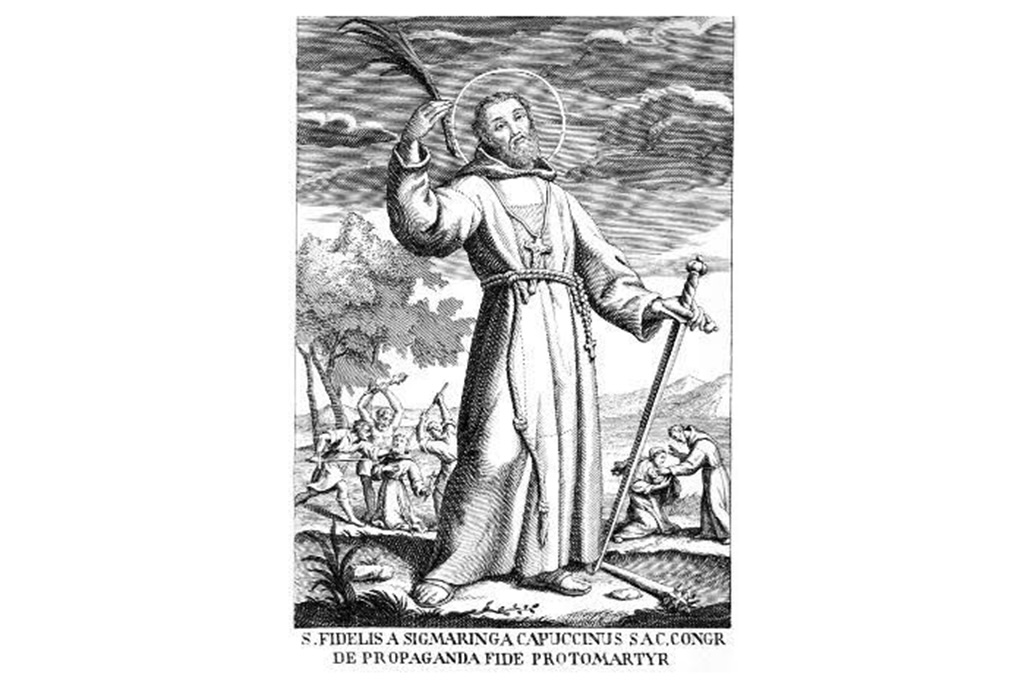

Apostolic missionary amid adversity
He is the protomartyr of Propaganda Fide, belonging to the Order of Friars Minor Capuchin, killed at only 44 years of age. He is Fidelis of Sigmaringen, born in 1578 in Sigmaringen, in what was then the Principality of Hohenzollern, into a well-to-do family. His father was John Roy, who died in 1591, and his mother was Genoveffa Rosenberger.
At baptism he was given the name Markus. To pursue higher studies, he moved to the Jesuit College in Freiburg im Breisgau, where in 1601 he obtained a degree in philosophy. Until 1604 he attended courses in law. Before completing his studies, he accompanied, as a guide, university students from noble families to visit the provinces of the Netherlands, France, and Italy. He experienced this journey as a pilgrimage.
After returning to Freiburg in 1611, he graduated in canon and civil law in Willingen. In the city of Ensisheim, he was appointed assessor of the supreme tribunal and opened a practice as an attorney. He behaved with great fairness toward everyone, especially the poor. Faced with the corruption among his colleagues, who handled cases in order to earn more money, he began to consider religious consecration. In June 1612 he asked the minister of the Swiss Capuchin province to enter the Order, but the superior first asked him to be ordained a priest. In September he received priestly ordination and was admitted to the novitiate in Freiburg im Breisgau on October 4, 1612, taking the name Fidelis. Before making his vows, on October 4, 1613, he wrote his will, in which he established scholarships for poor Catholic youths of the Roy family or other relatives.
In 1618 he was appointed guardian of the convent of Rheinfelden, and the following year he was transferred as superior to the convent of Feldkirch, where he converted Protestant soldiers. In 1621, in addition to his role as superior, he was also entrusted with the spiritual care of the soldiers, for whom he did not hesitate to risk contracting typhus in order to assist them during an epidemic. His style of preaching aimed first at bringing reform leaders back to the Catholic faith and then the populace.
In 1611, the Mission in Rhaetia had been established by Propaganda Fide. Between February and April of that year, at the request of the Apostolic Nuncio in Lucerne and his provincial minister, he beca,e an apostolic missionary in the region of Prättigau, near Chur, where the population had largely embraced the reform of Zwingli. That territory belonged to Austria, so Archduke Leopold V had the region occupied by the army, provoking a popular uprising. In this situation, he continued to preach despite the threats.
On April 23, Fidelis celebrated Mass in the church of Grüsch. The following day, he was invited to preach in Seewis, but it was a trap to eliminate a formidable preacher. As he began the sermon, shouting and threats arose against him. He then descended from the pulpit and left the church to return to Grüsch, but he was stopped by a group of rebels who asked whether he was willing to accept the Reformed faith. Fidelis replied that he had come to bring the people back to the Catholic faith. They then struck him on the head with a sword. Mortally wounded, he said: “Jesus, Mary. Come to my help, O God!” They fell upon him with unheard-of violence.
On February 16, 1771, his feast was extended to the universal Church. He is the patron saint of the Hohenzollern region and of jurists.