


April 8: Saint Julie Billiart
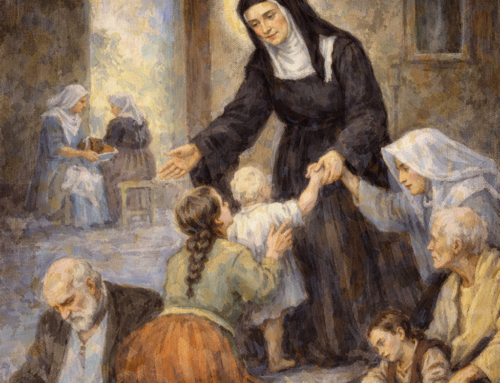

Educating young people for a better future
Marie-Rose Julie Billiart was born on July 12, 1751, in Cuvilly, north of Paris, France. She was the seventh of nine children, many of whom died at a young age. From childhood, she felt called by the Lord to follow him. One event marked her for life: in 1774, her father survived an attempted murder. This was followed, in 1782, by a medical error that caused paralysis in her legs.
She was confined to bed, but instead of remaining isolated, she became a point of reference for many women who sought her spiritual guidance. With the outbreak of the French Revolution in 1789, the government imposed the Civil Constitution of the Clergy, which required priests to take an oath against the faith. Among the non-juring priests—those who refused to swear—was Julie’s parish priest of Dangicourt. She secretly hid him to protect him from retaliation. Julie’s friends, who belonged to the nobility, helped her protect these priests.
The situation became increasingly dangerous, and Julie moved with her niece Félicité to the castle of Madame de Pont-l’Abbé in Gournay-sur-Aronde. They remained there for a year until, in 1792, revolutionaries surrounded the castle. Julie and her niece were forced to flee, hidden in a hay cart, and took refuge in Compiègne. In that city, occupied by revolutionary troops, her desolation was complete. There, Julie also lost the ability to speak, but she had a vision: several women stood around a cross, while a voice said, “These are the daughters I will give you in an institute that will be marked by my cross.”
In October 1794, she went with Félicité to Amiens at the request of another friend, Countess Madame Baudoin, who wanted her close to cope with the loss of her father and husband, both guillotined. In Amiens, she became friends with Viscountess Françoise Blin de Bourdon, who discovered the depth and authentic spirituality of this suffering woman. During this time, Abbé Thomas, who carried out his ministry in secrecy in Amiens as well, began visiting Julie to provide spiritual support and bring her the Eucharist.
In 1799, Julie, Félicité, Françoise, and Abbé Thomas fled Amiens for Bettencourt. On August 5, 1803, the small community found lodging on Rue Neuve in Amiens. Julie was entrusted with the care of several girls, and it became necessary to find young women to help educate and care for them. On February 2, 1804, three women—Julie, Françoise Blin de Bourdon, and Catherine Duchâtel—made a commitment to God with a vow of chastity and dedicated themselves to the care and education of young girls. Thus, the Sisters of Notre Dame of Amiens were founded in France.
After 22 years of illness, Julie was miraculously healed following a novena to the Sacred Heart of Jesus at the end of May 1804. In the following years, she founded communities and schools for girls who had previously lacked access to education. In 1809, the sisters left Amiens for Namur, in Belgium, and the congregation became the Sisters of Notre Dame of Namur. In Belgium, Julie established schools to prepare poor children for life. She regarded education for all as a fundamental human right and teaching as “the greatest work on earth.”
She died on April 8, 1816, and was canonized on June 22, 1969, by Pope Paul VI.