


May 29: Saint Bona of Pisa
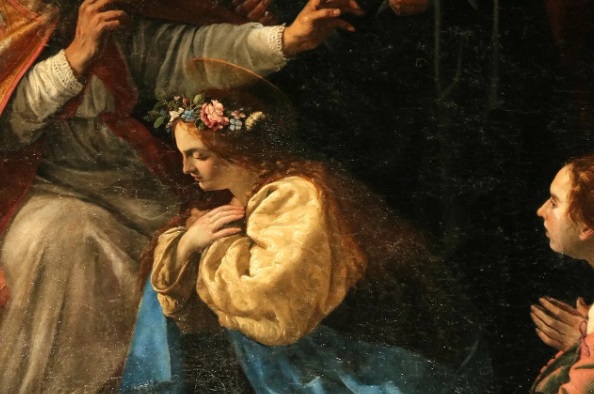

The pilgrim in search of God
She made pilgrimage to Santiago de Compostela no fewer than nine times and spent ten years in the Holy Land. She became a hermit and later an oblate, eventually becoming a spiritual point of reference for the entire city. Her name was Bona.
She was born in Pisa in 1155, in the district of Kinzica, a cosmopolitan area where merchants from all over the world stayed. Her father, Bernardo, a merchant of Eastern origin, had a relationship with Berta, who was of Corsican origin, and Bona was born from this union. After only three years, her father returned to the East, leaving his daughter with her mother, who raised her in the Christian faith.
At the age of seven, the mystical experiences that would accompany her throughout her life began. She made pilgrimage to Santiago de Compostela nine times, stopping at Sainte-Maries-de-la-Mer in Provence, where the Three Marys are venerated.
At the age of ten, Jesus appeared to her, asking her to follow Him more closely. Bona then spoke with the prior of the Augustinian Canons Regular of San Martino, but because of her young age, she was not allowed to enter the Order. She therefore decided to depart for the Holy Land, where she would remain for ten years.
When her father Bernardo learned that Bona was in the Holy Land, he set out to find her, but she avoided him. She was even kidnapped by relatives of her father who were hostile to her and was wounded. She took refuge with Ubaldo, a hermit who received her as a disciple.
After returning to Italy, she went to visit the cave at Monte Sant’Angelo, where the Archangel Michael appeared. There she met the Pulsanese monks, founded by Saint John of Matera in 1129 at the Abbey of Santa Maria di Pulsano on Mount Gargano. She lived for a time in a hermitage near the monastery. Upon returning to Pisa, she was received as an oblate at the monastery of San Martino.
Desiring to help pilgrims, she sought to build a church-monastery with a hospital and enlisted the help of the Pulsanese monks. She entrusted the project to Simone, Abbot of San Michele degli Scalzi. Thus, the hospital monastery of San Jacopo de Podio was built just outside Pisa.
Gradually, Bona became a point of reference for the entire city. Many monks and lay faithful turned to her for discernment, advice, and assistance.
In 1207, she wished to undertake one final pilgrimage to Santiago de Compostela. However, due to her fragile health, the prior of San Martino was not in favor of the journey. He granted permission only on the condition that a knight accompany her and bring her back at the first sign of fatigue. Tradition recounts that, as soon as she arrived at the monastery of San Jacopo de Podio, Bona convinced the knight to wait for her. Then Saint James appeared and, carrying her through the air, took her to Santiago de Compostela for the last time and brought her back within an hour.
She died in Pisa on May 29, 1207, and was buried in the church of San Martino in Kinzica. In 1962, Pope John XXIII declared her the patron saint of flight attendants and tourist guides.