


June 3: Saint John Grande
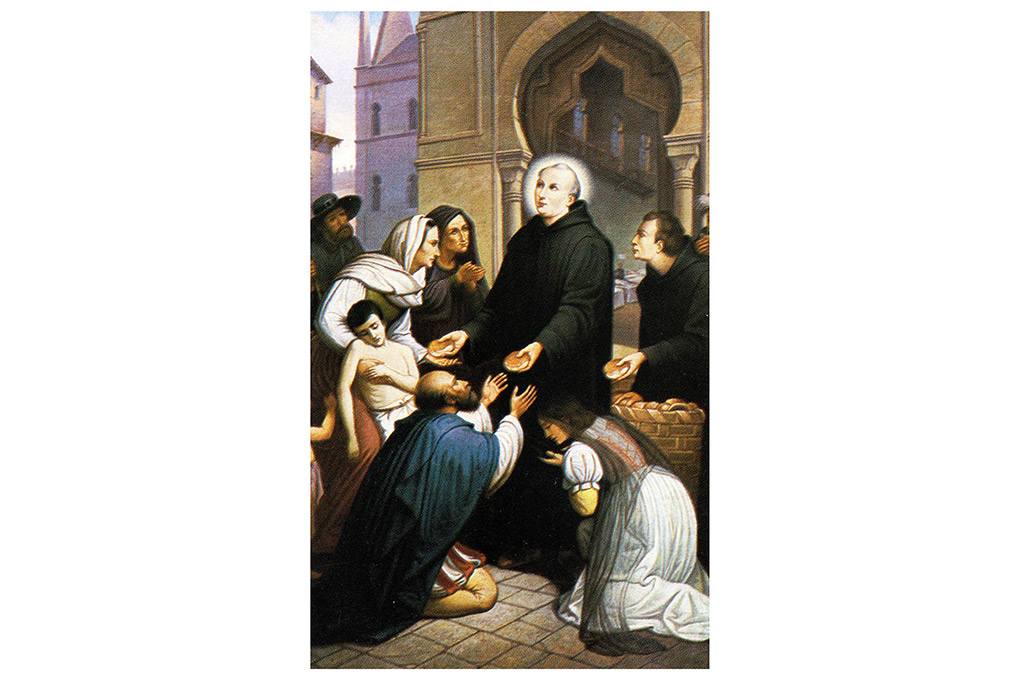

Devoted entirely to the sick and the poor
He called himself “John the Sinner.” He gathered abandoned sick people, begged alms for the poor, and died while practicing charity toward plague victims, from whom he contracted the disease himself. He is Saint John Grande, born in Carmona, Seville, Spain, on March 6, 1546. His father, a blacksmith, died when he was eleven years old, and his mother Isabel remarried.
He spent four years in Seville in deep reflection, realizing that being a cloth merchant was not his true calling, even though he enjoyed the great esteem of the shop owner, who wished to keep him there. His mother called him back home and, unwilling to part from this unusual son, provided him with fabrics to sell in the streets of the town, but all was in vain. Within him, an irresistible vocation had begun to grow. He did not hesitate long: he left his family and the business and withdrew to the hermitage of Saint Olalla in Marchena, near his native town, where he devoted himself to intense prayer. From this prayer emerged the clear determination that would shape his entire life.
He had no doubt that God was calling him to give himself completely to Him. After begging to assist the poor, he renounced marriage and clothed himself in a humble garment, adopting the surname “the Sinner”. Caring for an elderly abandoned couple whom he sheltered and begged alms for, made him realize that this was the apostolic path he was meant to follow. It was the beginning of a life filled with works of mercy.
God pointed him toward the town of Jerez de la Frontera so that he could continue serving the needy and the sick. He was nineteen years old when he departed for that city. There, John the Sinner—like the other Saint John of God, whom he did not yet know—gathered the first abandoned sick people in 1565 and begged alms to relieve the suffering of the poor. At the same time, he attended the church of the Franciscan Fathers and received spiritual guidance from one of the friars. Into that vast heart, shaped by intense prayer and unwavering trust in Divine Providence, fell the friar’s exhortation to make the poor the concrete object of his charity. Thus John welcomed misguided women, placing them in Christian homes, as well as fugitives, prisoners of the “Royal Prison,” and every person in need.
One day Christ appeared to him wounded and directed him toward the path of caring for the sick. He then took charge of a small hospital called “Our Lady of Remedies,” where he welcomed convalescent and incurable patients. The needs he witnessed were so many that he wished to found another hospital. However, numerous difficulties prevented him from completing the project, and he accepted instead the offer of the Sebastián Hospital, which entrusted him with two infirmaries.
Soon the people of Jerez grew deeply attached to him, witnessing his heroic self-giving, the fruit of his rich interior life. His actions during the epidemic of 1574 were especially memorable. Distressed at seeing so many sick people abandoned in the streets without assistance, he urged the local authorities to act quickly. Realizing that he alone could not meet such overwhelming need, and with the consent of the Brotherhood of Saint John Lateran, he founded his own hospital in 1572 on land donated to him, expressly dedicating it to Our Lady of Candlemas.
That same year, having heard of the work being carried out in Granada by John of God, he visited the institution founded there and joined it, accepting its rules, which he then applied in his own hospital. Later he transferred his foundation to the Hospitaller Order of Saint John of God, in which he professed vows and received the habit in 1576. His companions who assisted him did the same. From then on, he expanded his charitable work to other towns in Cádiz, founding new houses in Medina Sidonia, Puerto de Santa María, Sanlúcar de Barrameda, Arcos de la Frontera, and Villamartín.
He was an exceptional novice master, teaching both by word and example: he slept on the floor, was extremely frugal in food, and dedicated almost all the hours of the day to prayer and charity. He healed both body and soul. He opened his doors to everyone without distinction, practicing all the works of mercy in a sublime way.
However, the assistance available in Jerez for sick people without resources was gravely inadequate. Moreover, the authorities decided to suppress several hospitals, including John’s. He therefore prepared a precise report (Memorial) describing their work in these terms: “with diligence, care, and great charity, doing much good work and service to God Our Lord, because he and his brothers in habit are virtuous men and profess this charity of caring for poor sick people.” He wrote it at the request of the Archbishop of Seville, Cardinal Rodrigo de Castro, who, concerned by the authorities’ decision, had entrusted him with this mission.
With all the sorrow of his heart, yet showing great virtue, John Grande faced the planned reduction of hospitals, offering his trials and sufferings to God. Surely he was also comforted by the presence of his mother, who spent the final years of his life with him. In 1600 a violent plague broke out in Jerez. Having become infected, the saint died on June 3 of that year, a martyr of charity.
Pope Pius IX beatified him on November 13, 1853, and Pope John Paul II canonized him on June 2, 1996.