


July 9: Saint Veronica Giuliani, Abbess, Poor Capuchin Clare
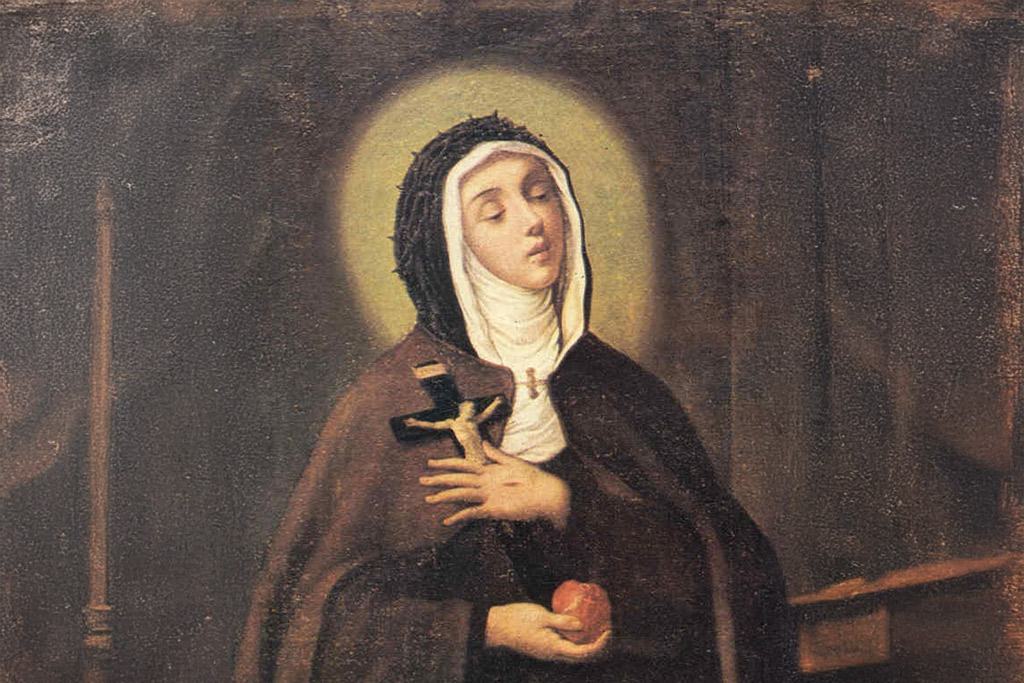

The Bride of the Crucified
She experienced mystical phenomena, had visions of Hell and Purgatory, and even received the stigmata—so much so that the Inquisition became suspicious. After a thorough investigation, however, they confirmed the authenticity of her experiences.
This is Saint Veronica Giuliani, who lived for 50 years in the strict closure of the Capuchin Poor Clare monastery in Città di Castello. A life that may have seemed monotonous and far removed from the world, yet it was fully embedded in the life of the Church and deeply connected to every human being struggling in the battle against evil.
Orsola Giuliani was born on December 27, 1660, in Mercatello sul Metauro, in the Marche region of Italy, the seventh daughter of Francesco Giuliani and Benedetta Mancini. After her mother died, she moved to Piacenza, where her father had found work. Three years later, she returned to Sant’Angelo in Vado, staying with a paternal uncle. At the age of seventeen, in 1677, she finally overcame her father’s last objections and entered the Capuchin Poor Clare monastery, where she received the name Veronica.
One year after entering the monastery, Veronica made her solemn religious profession, thus beginning a spiritual journey that would lead her to become more and more like Christ. She lived this path through intense penances, great sufferings and mystical experiences connected to the Passion of Jesus—such as the crowning of thorns, the mystical marriage to Christ, the wound in her heart, and the stigmata.
She spent the night hours immersed in prayer for the conversion of sinners. The Crucifix before which she prayed came to life and embraced her, as she herself recounts in her Diary:
"My Spouse," the crucified Christ whispered to me, "I am pleased with the penances you do for those in disgrace before me... Then, loosening one arm from the cross, He motioned for me to come close to His side... and I found myself in the arms of the crucified Christ. What I felt in that moment I cannot describe: I would have wished to remain forever on His most holy side."
She was in deep union with Jesus, who often spoke to her through special signs and the daily liturgy, the psalms, prayer, and the sacraments—especially Confession and the Eucharist, which she longed for intensely, even though at that time it was not possible to receive it every day.
In her Diary, we see her deep unity with Jesus, her total self-giving, to the point of becoming a missionary and an intermediary—a bridge between God and people. Even though she lived in cloister, she was close to the pain and needs of the world, offering herself spiritually to help those who suffered. Her heart, though within the monastery walls, was open to all humanity with the same mercy as God’s.
In 1716, at the age of 56, she became abbess of the monastery in Città di Castello and remained in that role until her death in 1727, after 33 days of prolonged agony. Despite the pain, Veronica died with a heart full of joy. Her final words were:
"I have found Love, Love has let Himself be seen! This is the cause of my suffering. Tell everyone, tell everyone!"
It was July 9, 1727. She was 67 years old, 50 of which she had spent in the monastery. She was canonized on May 26, 1839, by Pope Gregory XVI.