


July 10: Saints Rufina and Secunda, Martyrs
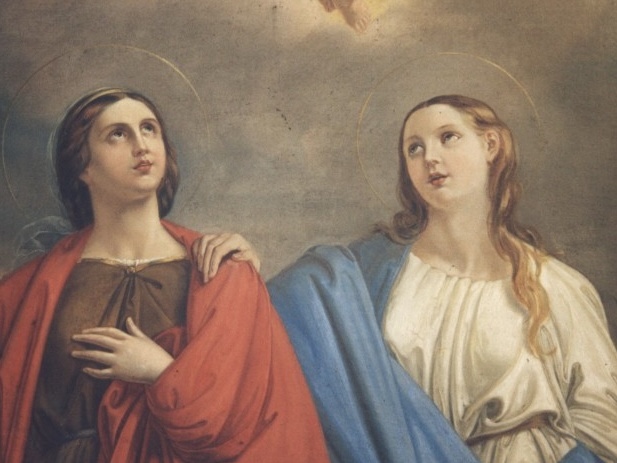

Saints Rufina and Secunda were two Christian martyrs born in Rome, whose lives and martyrdom are documented by numerous authoritative sources, including the Martyrologium Hieronymianum, various Roman pilgrim itineraries, the Notitia Ecclesiarum by William of Malmesbury, and above all, the Roman Martyrology, which commemorates them on July 10. They were martyred near Rome in a place called sylva nigra (“dark forest”) around the year 260.
The account of their passion and martyrdom (passio), written in the second half of the 5th century, places their story during the persecutions under Emperors Valerian and Gallienus. This narrative—rich in detail and still resonant today—describes the plight of two young Christian women confronted by the weakness of their non-believing fiancés in a time of great danger for the faith. After being abandoned by their betrothed, Armentarius and Verinus, who renounced the faith to save themselves, Rufina and Secunda chose to consecrate themselves to God with a vow of virginity.
Unwilling to accept the sisters’ decision to dedicate their lives to God and reject marriage, the two young men did everything they could to persuade them to renounce their Christian faith. But when the sisters firmly and definitively refused, the men’s love turned into hatred, and they ultimately denounced them to Count Archesilaus.
Archesilaus immediately began searching for them and eventually found them at the fourteenth milestone of the Via Flaminia, as they were leaving Rome in an attempt to escape persecution. The sisters were captured and handed over to the Prefect of the City, Junius Donatus. Like many Christian martyrs of that time, Rufina and Secunda were subjected to violent pressure to force them to deny their faith.
Since they stood firm with courage and resolve, the prefect ordered their execution. Count Archesilaus took them to the tenth milestone of the Via Cornelia—an area that roughly corresponds to today’s Via Boccea—to a place called Buxo. There, Rufina was beheaded, and Secunda was beaten to death.
Their bodies were left unburied, meant to be devoured by wild animals. However, a Roman matron named Plautilla, who had recently converted after dreaming of the two martyrs pointing out the place of their death, gathered their remains with reverence and buried them with honor at the same site.
The place of their martyrdom, then a dense forest known as sylva nigra (“dark forest”) due to its thick vegetation that barely let sunlight through, was often used for secret and brutal executions. Other martyrs were also killed there, including Marcellinus and Peter, and Marius with his wife Martha and their sons Audifax and Abachum.
After the martyrdom of Rufina and Secunda, however, the forest’s name was changed to sylva candida (“bright forest”) because their death brought light and sanctity to the place. At that location, Pope Julius I (341–353) built a small basilica in honor of the two saints, which was later restored by Pope Hadrian I (772–795) and enriched with votive offerings by Pope Leo IV (847–855).
Starting in the 5th century, the area became the seat of an autonomous diocese, whose bishop signed official documents as Episcopus Sylvae Candidae (“Bishop of the Bright Forest”) and later as Episcopus Sanctae Rufinae (“Bishop of Saint Rufina”). Finally, in the 12th century, due to depopulation in both dioceses, Pope Callistus II (1119–1124) merged the Diocese of Santa Rufina with that of Porto, giving rise to the current Diocese of Porto–Santa Rufina.