


April 6: Saint Peter of Verona, Martyr
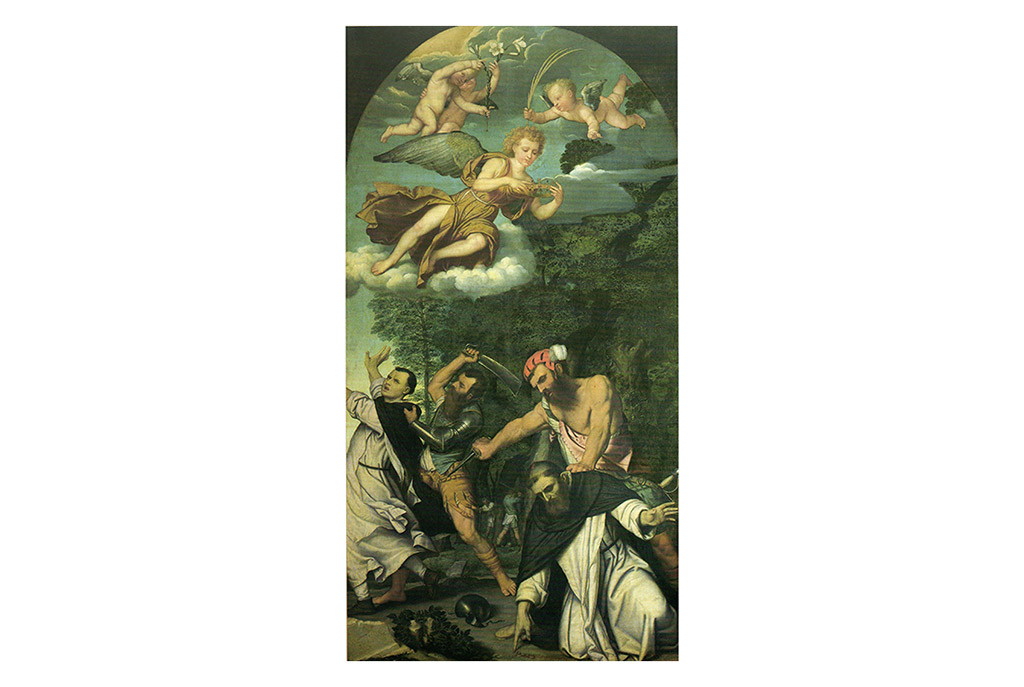

Apostolic missionary in the fight against heresy
Peter Rosini was born in Verona around 1205 into a well-to-do family. It is possible that some of his relatives had embraced the Cathar heresy, which was widespread at the time. His father sent him to study at the University of Bologna, where he came into contact with the environment of the Domenican Friars of the Order of Preachers. He personally met Saint Dominic, who, in 1221, admitted him into his Order.
In 1232, Pope Gregory IX sent him to Lombardy, where the Cathar heresy was very widespread. His task was to preach as an apostolic missionary in order to bring the population back to the true faith.
He settled in the convent of Saint Eustorgio, where he founded an association called the “Society of the Faith” or “the Faithful,” dedicated to combating heresy. He also founded another confraternity, the “Society of the Virgin,” to oppose the Cathar doctrine that denied the perpetual virginity of Mary. Peter led an ascetic life. At dawn, he would go to confession and celebrate Mass, then dedicate many hours to hearing confessions. He practiced many penances and ate only one meal in the evening. After a brief rest at night, he devoted himself to prayer and study in order to refute Cathar teachings.
In 1234, he succeeded in having Pope Gregory IX’s decree against heretics included in the statutes of Milan. In 1240 he was elected Prior of the convent of Asti, and in 1242 Prior of the convent of Piacenza, where he promoted the study of Scripture.
Around the middle of 1244, Pope Innocent IV sent him to Florence to assist, through preaching, the efforts of Bishop Ardingo against the Patarine heretics.
That same year, at his request, the Podestà of Florence had the square in front of the Dominican convent of Santa Maria Novella enlarged to facilitate preaching to the people. During this period, he examined the life and rule of the Servants of Mary, founded in 1233 by seven Florentine merchants, and defended them before Pope Innocent IV.
In 1249 he worked for peace in Rimini. In 1251 he was sent as Prior of the convent of Como and to combat heresy in Cremona. Innocent IV appointed him Apostolic Inquisitor for Lombardy.
On Palm Sunday of 1252, he urged some suspected heretics to convert, then returned to the convent of Como. On April 6, Holy Thursday, despite suffering from quartan fever, he insisted on going to Milan for apostolic duties. His fellow friars tried to persuade him not to leave, but in vain. He was accompanied by Brother Dominic, and the two set out along a road surrounded by woods, where there was a risk of encountering heretics.
Two assassins, Pietro da Balsamo, called Carino, and Albertino Porro of Lentate, were waiting for him in the thicket of Farga, near the Seveso. He was struck by Carino on the shoulder and head with a falcastro, a kind of reversed sickle. Falling to the ground with his skull split open, Peter said, “Father, into your hands I commend my spirit,” and began to recite the Creed. As soon as he finished, he was killed with a stab to the chest. The two assassins also wounded Brother Dominic.
When the incident was discovered, the faithful carried Peter’s body in procession to Milan and placed it in the Abbey of San Simpliciano, as he had foretold. The following day he was buried in the Saint Eustorgio convent. Pope Innocent IV canonized him in Perugia on March 25, 1253, less than a year after his death.