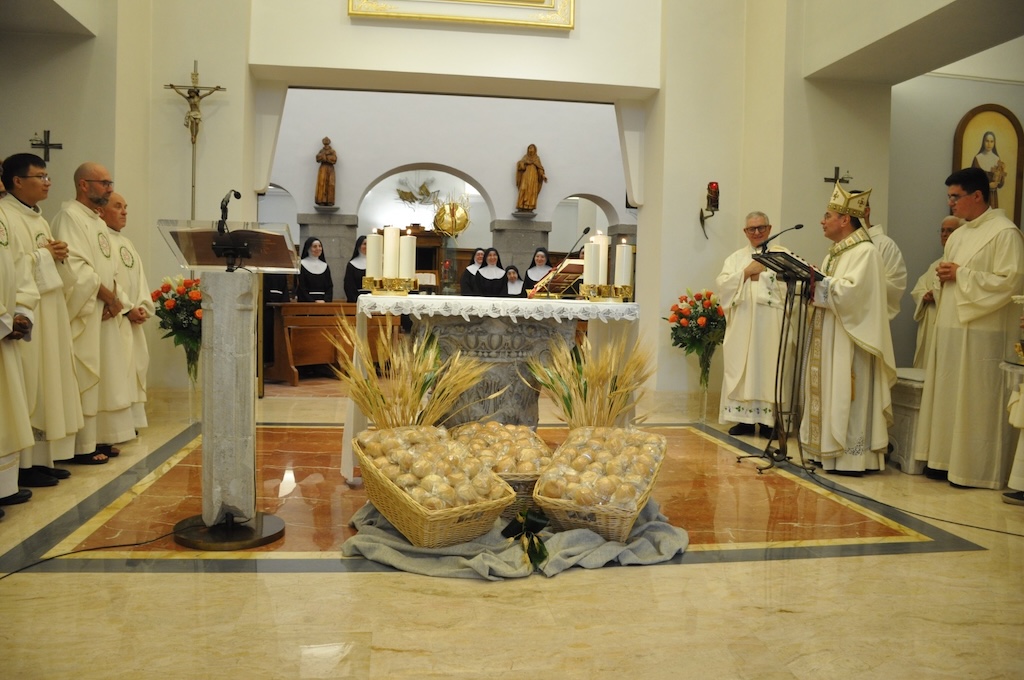


Bishop Vincenzo Viva presides over the Solemnity of Saint Clare of Assisi at the Poor Clare Monastery in Albano
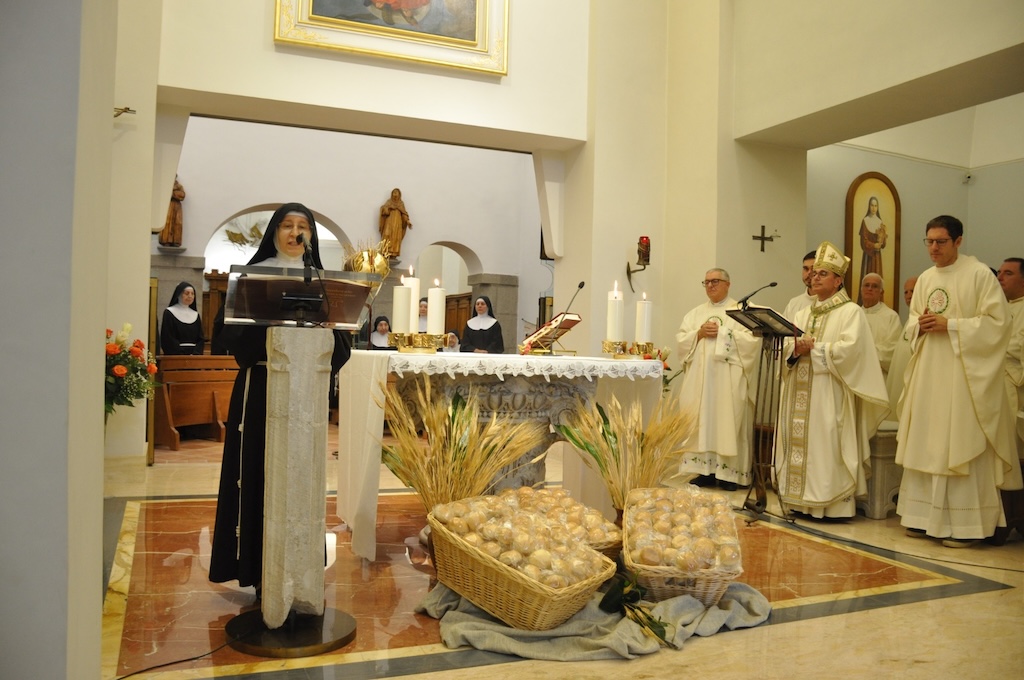

Poverty lived with joy
“The acceptance of frailty as an instrument for personal sanctification and as a means through which God can act had, for Clare, a very precise name: poverty lived with joy.” With these words, Bishop Vincenzo Viva of Albano presided over the concelebrated Eucharist on the feast day of Saint Clare of Assisi on Tuesday afternoon, 11 August, at the Poor Clares’ Monastery of the Immaculate Conception, located within the territory of the Pontifical Villas in the town of Albano.
At the end of Mass, Bishop Viva blessed the “Bread of Saint Clare,” which was then distributed to the faithful. The distribution of the blessed bread recalls a famous miracle of the Saint. When there was only one loaf of bread in the monastery to feed fifty nuns, Clare prayed to Providence. She then asked one of the sisters to cut the loaf and send half of it to the friars. She ordered the remaining half to be cut into fifty slices, one for each nun. To the sister’s great amazement, the necessary slices multiplied, providing enough for the entire community. So on the feast of Saint Clare, the Poor Clares perpetuate the tradition of sharing small loaves of bread with the poor, in remembrance of the intervention of Providence through the intercession of Saint Clare.
The feast at the monastery in Albano was preceded by a solemn Triduum preached by Friar Rino Bernardini of the Order of Friars Minor, from Saturday, 8 August, to Monday, 10 August. On Sunday, 9 August, during the 6:00 p.m. Eucharistic Celebration, the Poor Clares renewed their monastic vows. The Triduum concluded on Monday, 10 August, with the commemoration of the Transitus of Saint Clare.The Poor Clares of the monastery also contributed to the new “Saint Francis and Saint Clare” nursery school inside the Vatican by creating handmade wooden decorations to embellish the facility.
Following a longstanding tradition, they handcraft various objects from olive wood, including pendants, ribbon bracelets, elastic bracelets with wooden beads, key rings, pens, pencil sharpeners with erasers, bookmarks, pencils, table and wall clocks, as well as keepsakes for baptisms, First Holy Communions, Confirmations, weddings, summer camps and other occasions.
We publish below the homily of the Bishop of Albano:
“And You, O Lord, be blessed, for You have created me” (Process of Canonization of Saint Clare III, 20). These were the last words uttered by Saint Clare on her deathbed on 11 August 1253, after nearly 29 years of illness, in a room at San Damiano. The sources also tell us that, already close to death, on the very day before she died she had received the parchment sent from Rome containing the approval of her Rule, signed by Pope Innocent IV, and had kissed it devoutly.
These words of Clare—a prayer of thanksgiving to God at the end of her earthly life—and the image of the body of a frail woman, weakened by illness but, above all, tested by so many difficulties and tribulations, shed, I believe, a very clear light on what the Word of God seeks to communicate to us on this Solemnity of the Saint, which we joyfully celebrate with our dear Poor Clare sisters, both in the second reading we have heard (cf. 2 Cor 4:6-10, 16-18) and in the Gospel (cf. Jn 15:4-10).
We heard the Apostle Paul say in 2 Corinthians: “We have this treasure in earthen vessels, so that it may be made clear that this extraordinary power belongs to God and does not come from us” (2 Cor 4:7). It is a beautiful metaphor, used by Saint Paul to describe what he himself personally experienced: the disparity between his own being and the treasure of grace. A poor earthen vessel is called to contain a priceless treasure, Christ himself: why does God decide to place such a great treasure in such a fragile vessel? Indeed, the text seems to suggest a conviction that the Apostle gradually came to understand and that goes even further: God not only decides to place his treasure within human frailty, but actually chooses to act precisely through that frailty, within our limitations.
So often we are concerned with eliminating our limitations and presenting an ideal image of ourselves; we hide our frailties, we are ashamed of them, and readily project onto others what we are unable to accept in ourselves. Yet God chooses precisely what is fragile and poor, what is imperfect, in order to accomplish his plan in history. It is precisely clay that God seems to prefer when he wishes to act, because it makes evident the disproportion between the vessel and the treasure it is called to contain.
I believe that Clare understood this very well. She had seen it and admired it in Saint Francis and therefore made it her own, for herself and for her sisters. The acceptance of frailty as an instrument for personal sanctification and as a means through which God can act had, for Clare, a very precise name: poverty lived with joy. “Holy poverty” was not merely a religious vow, but an attitude toward life—indeed, a personified reality, an elder sister to be loved and embraced with joy. Writing to Agnes of Prague, she celebrates it as a paradox: poverty is what makes us rich; renunciation is what enables us to possess (cf. First Letter to Agnes of Prague, 15-17).
For God to fill us with his treasure, we must “become clay”; we must empty ourselves of everything that is not God. But if our lives are filled with ourselves, with concern for possessing and appearing; if they are filled with preconceptions and presumptions, how can they ever contain the treasure of God?
Surely each of us knows the clay of which we ourselves are made, as well as the clay of which our communities are made, even though we struggle to accept it and offer it to the Lord so that he may use it for our good and for the manifestation of his glory. Thus, all too often, we think we can live out our baptismal, religious or ministerial consecration without truly offering our poverty to the Lord, hiding from ourselves and, ultimately, even from God.
How many psychological inconsistencies do we carry with us? Flaws of character that we are unable to correct; moral and spiritual poverty; a body that we often do not like—whether when we are young and pursue unattainable ideals of beauty (consider how greatly this dynamic is amplified today by social media), or when we grow old and struggle to accept the loss of our autonomy and physical abilities.
The limitations and the clay of which we are made are therefore constitutive elements of the human person; they are part of who we are, part of the Church and of every community, including religious communities. And the temptation is always the same: to think that this is the part of ourselves that disqualifies us, the obstacle preventing us from truly serving, the thing that must be fixed before we can begin.
Saint Paul, drawing on his personal experience (certainly the fruit of a painful inner process), tells us exactly the opposite. It is precisely there, in the clay of our individual and communal existence, that God has chosen to reveal something of himself.
This also allows us to view differently—and certainly in a more Christian way—the inevitable tribulations and difficulties of our personal life of faith and of our communal journeys, especially when times of great trial or genuine existential catastrophes arise.
When the Apostle says that the disciple of Christ is “afflicted, but not crushed; perplexed, but not driven to despair; persecuted, but not forsaken; struck down, but not destroyed” (2 Cor 4:8-9), he does not diminish the weight of reality or the drama of the blows we endure. Rather, he reminds us of a fundamental truth: tribulations do not have the last word. Indeed, even while we are experiencing them, the glory of God is being revealed.
It is the Paschal logic reproduced in the life of Christians and ecclesial communities, where suffering out of love and with love becomes a place of God’s revelation and a way of participating in the death and Resurrection of Christ. In Christian life, especially in our relationships, the dying of Jesus is thus made present, and there his grace is revealed (cf. 2 Cor 4:10-11).
Christian spirituality, therefore, is not about gritting our teeth and forcing a smile, nor is it about denying reality. The Christian way is something else, and Clare expresses it clearly in her letter to Agnes: “If you suffer with Him, you will reign with Him; if you weep with Him, you will rejoice with Him; if you die with Him on the cross of tribulation, you will possess with Him the heavenly dwelling places in the splendor of the saints” (Second Letter to Agnes of Prague, 21).
It is beautiful to notice how often the words “with him” recur. Christian suffering is never solitary. It is not a burden placed upon our shoulders, nor a price we are called to pay. Indeed, if we reflect carefully, suffering is not even something good in itself or something to be sought. But when it comes, it must be accepted and discovered as a form of companionship, in which the center must not be pain, but love.
In the spirituality of Clare of Assisi, the sequela Christi along the way of the Cross is always present, but it bears none of the marks of sadness. At its center is not pain, but love and the need for a profound existential and affective communion with the Lord, the beloved and the Bridegroom. This makes the Cross glow with love and already shine with glory.
There is also the strength of fraternity: monastic life is nourished by mutual prayer, by being together, by trust placed in one’s sisters and by loving service.
From where, then, can we receive the strength to pass through our limitations, our frailties and our adversities? We can say that this strength comes to us from a verb that also seems central to me in the spirituality of Saint Clare. It is the verb repeated no fewer than nine times in the Gospel just proclaimed (cf. Jn 15:4-10): “Abide in me,” Jesus says. “Just as the branch cannot bear fruit by itself unless it abides in the vine, neither can you unless you abide in me” (Jn 15:4).
I believe we can rightly say that Saint Clare built her entire life upon this verb, and in her letters to Agnes she even left us its grammar, expressed in three steps that we find developed in various spiritual traditions, from Saint Bonaventure to Saint Ignatius of Loyola.
The verb “abide” is conjugated through three stages, three other verbs. The first is “see”: “Look upon Him who became contemptible for you, and follow His example” (Second Letter to Agnes of Prague, 19). It always begins with our gaze fixed upon the concrete Jesus—the Jesus of the Gospels, the one who became poor—not an abstract idea of God, but a face, a relationship to be sought.
The second is “consider”: to look more deeply, to enter into dialogue, allowing ourselves to be drawn into this love, examining and considering how Jesus revealed himself (cf. Fourth Letter to Agnes of Prague).
This leads to the third stage, “contemplate,” where the transformation of the self into the image of the Son of God takes place (cf. Third and Fourth Letters to Agnes of Prague). Now, contemplari, literally, means “to take up one’s dwelling with someone; to dwell permanently with.” This is precisely the “abide in me” of John’s Gospel. Clare unites herself with Christ, her mystical Bridegroom: looking upon him, considering him and contemplating him, finding in him her dwelling place and her true peace.
But take care: “abiding in Christ” does not mean remaining still in a false peace. It means allowing ourselves to be transformed. It means gradually becoming like the One upon whom we gaze: it is the gradual transformation of the person.
Today, on this feast, I would therefore like to pray first of all for myself, for our Poor Clare sisters and for each one of us, asking three things of the Lord through the intercession of Saint Clare: (1) that we may not be ashamed of our clay, but may see it, accept it and entrust it to the Lord; (2) that we may pass through our trials not alone, but with the Lord and with the strength that comes to us from fraternity in Christ. Thus, may we look upon adversity not as a time when we feel abandoned by God, but as a time in which we discover that God speaks to us and visits us in a different way; and finally, (3) that each day we may return to that mirror which is the face of Jesus, so that our own face, our way of thinking, feeling and acting, may increasingly conform to God’s way of thinking, feeling and acting.
If we live according to this dynamic, we will be on the path that also led Clare of Assisi to holiness. Amen.