

In the Vatican Gardens a Mosaic Dedicated to Our Lady of Gietrzwałd is Unveiled and Blessed

In Commemoration of the 150th Anniversary of these Marian Apparitions
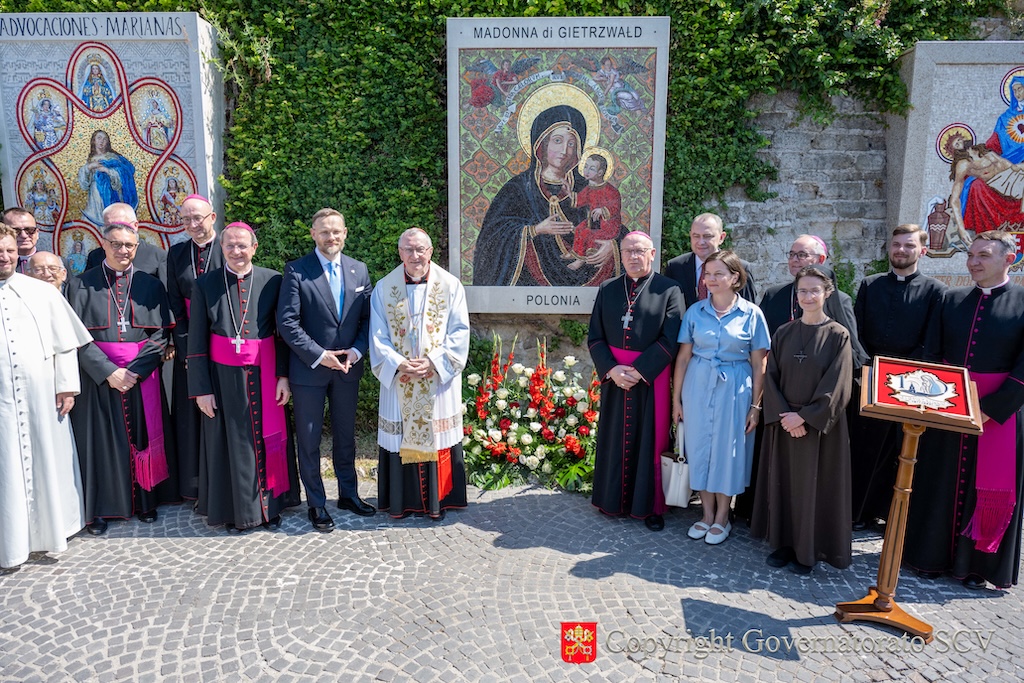
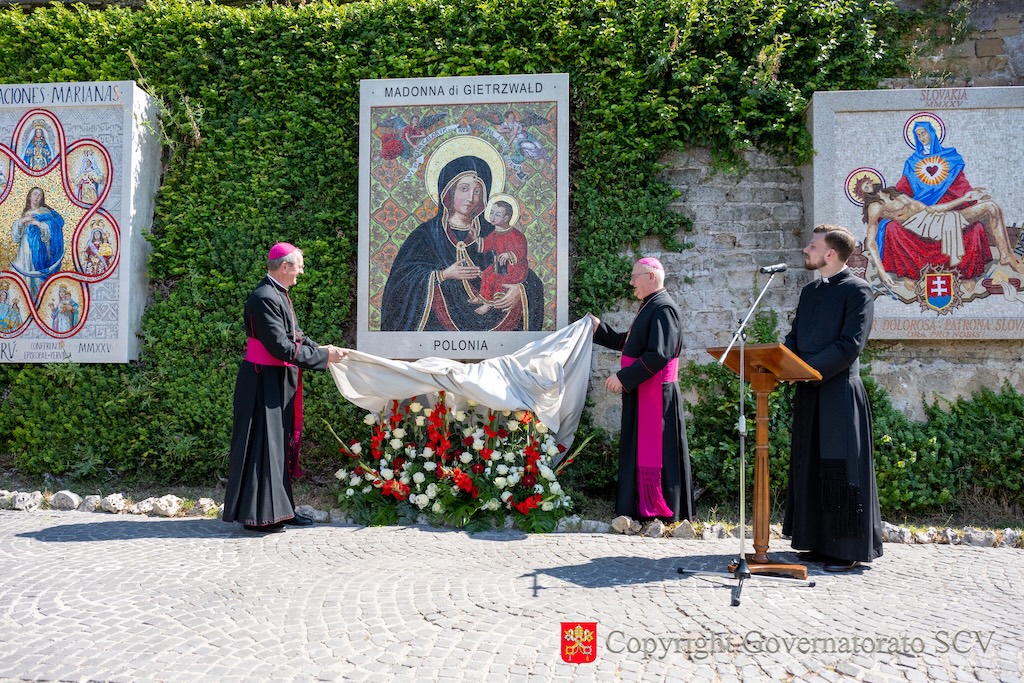
A sign of filial affection for Pope Leo XIV and of the prayers that the Polish people offer to the Blessed Virgin Mary for the Successor of Peter, accompanying him in his ministry at the service of the universal Church. This is the significance of the new Marian mosaic installed on Tuesday morning, 30 June, in the Vatican Gardens.
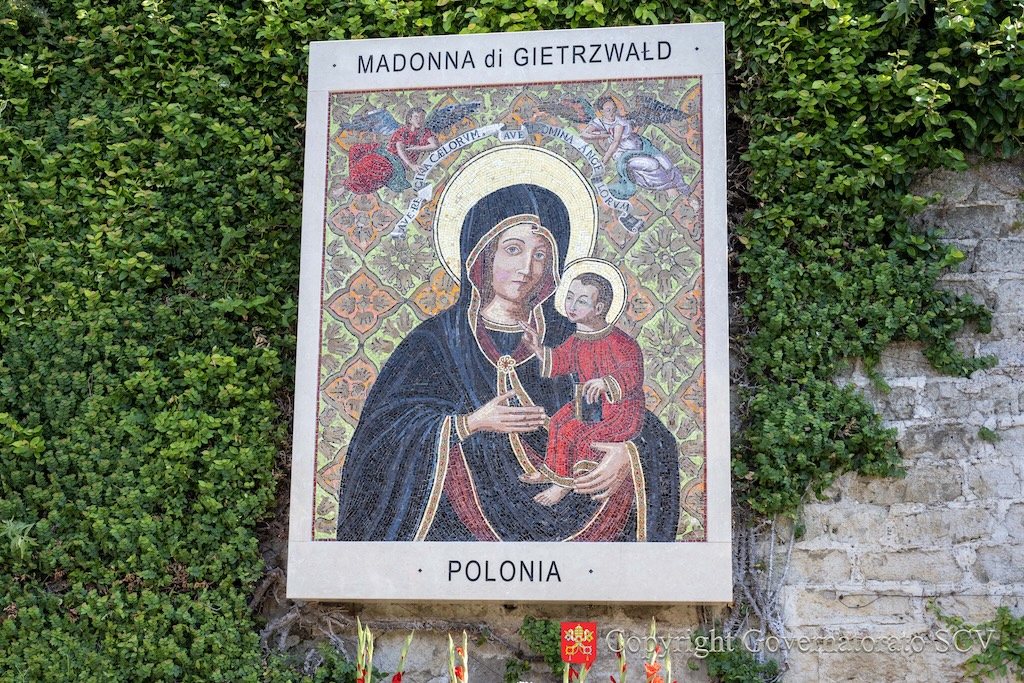
The mosaic depicts the image of Our Lady of Gietrzwałd, a village in the north-east of present-day Poland, whose Marian apparitions will mark their 150th anniversary next year. The mosaic is a gift from the Polish Bishops’ Conference and, in particular, from the Archdiocese of Warmia.
Following an introduction by Father Marcin Sawicki, spokesperson for the Archdiocese of Warmia, remarks were delivered by Sister Raffaella Petrini, President of the Governorate of Vatican City State; His Excellency Mr Zbigniew Bogucki, Head of the Chancellery of the President of the Republic of Poland, who read a message from the President of the Republic of Poland, His Excellency Mr Karol Nawrocki; and Archbishop Tadeusz Wojda, Metropolitan Archbishop of Gdańsk and President of the Polish Bishops’ Conference.
Cardinal Pietro Parolin, Secretary of State, then blessed the mosaic, praying:
"Holy Father, hear the prayer of your faithful, who present to you this image of the Blessed Virgin, so that, strengthened by her protection, they may impress upon their hearts the image they contemplate. Grant them unfailing faith, steadfast hope, generous charity, and sincere humility. Make them strong in suffering, dignified in poverty, patient in adversity, generous in prosperity, workers of justice and builders of peace, so that, having completed their earthly pilgrimage in love for you and for their brothers and sisters, they may enter the eternal city, where the Blessed Virgin intercedes for us as Mother and shines forth as Queen."
Afterwards, Archbishop Józef Górzyński, Metropolitan Archbishop of Warmia, and His Excellency Mr Adam Kwiatkowski, Ambassador of the Republic of Poland to the Holy See, expressed their gratitude to all those who had contributed to the initiative. Cardinal Parolin then imparted the final blessing.
Also present at the inauguration, among others, was Archbishop Emilio Nappa, Secretary General of the Governorate.
The original image of Our Lady is enshrined on the high altar of the Basilica of the Nativity of the Blessed Virgin Mary in Gietrzwałd. It depicts the Virgin dressed in a red gown and covered with a dark blue mantle, holding the Child Jesus in her left arm. In the upper part of the painting, two angels hold a scroll bearing the inscription: Ave Regina Caelorum, Ave Domina Angelorum.
The installation of the mosaic was made possible through the collaboration of the Embassy of the Republic of Poland to the Holy See, the Le Musa workshop in Castel Gandolfo, and the staff of the Governorate’s Events Coordination Office and Directorate of Infrastructure and Services.
Address by the President of the Governorate
First of all, I greet Cardinal Pietro Parolin, Secretary of State;
Archbishop Tadeusz Wojda, Metropolitan Archbishop of Gdańsk and President of the Polish Bishops’ Conference;
Archbishop Józef Górzyński, Metropolitan Archbishop of Warmia, together with all the Polish Bishops;
Archbishop Emilio Nappa, Secretary General of the Governorate;
His Excellency Mr Adam Mariusz Kwiatkowski, Ambassador of the Republic of Poland to the Holy See;
His Excellency Mr Zbigniew Bogucki, Head of the Chancellery of the President of the Republic of Poland;
and all of you gathered here today.
It is with great pleasure that we inaugurate a new Marian mosaic in the Vatican Gardens. It depicts Our Lady of Gietrzwałd, whose apparitions will celebrate their 150th anniversary next year.
"I wish you to pray the Rosary every day." These were the words spoken by the Blessed Virgin Mary during her apparition to Justyna Szafryńska and Barbara Samulowska, aged thirteen and twelve respectively, on 27 June 1877, in Gietrzwałd, a village in the north-east of present-day Poland.
Our Lady appeared daily to the two girls until 16 September 1877, at a particularly difficult time for the region of Warmia-Masuria. At that time the territory was under Prussian rule, whose authorities were especially hostile toward the deeply Catholic population.
From 1873 onward, the use of the Polish language in schools had also been prohibited and, in accordance with anti-clerical legislation, religious congregations were suppressed, with the exception of those devoted to the care of the sick.
It was precisely in this difficult historical context that the Blessed Virgin Mary intervened. She not only comforted the faithful by assuring them that the persecution of the Church would come to an end if they persevered in prayer, but also exhorted them to pray the Rosary with devotion.
As we gather here today in the Vatican Gardens, we cannot fail to recall that numerous Popes throughout history have recommended the prayer of the Rosary.
Saint John Paul II, who dedicated an Apostolic Letter to the Rosary and introduced the Mysteries of Light, stated that this prayer occupied an important place in his spiritual life, accompanying him in moments of joy as well as in times of trial.[1] He described it as his "favourite prayer," "marvellous in its simplicity and in its depth," confiding that he had entrusted many of his concerns to it and had always found comfort through it.
Pope Benedict XVI regarded the Rosary as "a school of contemplation and silence," "a precious spiritual means for growing in intimacy with Jesus" and for learning from Mary "always to accomplish the divine will."[2]
Pope Francis emphasized that the Rosary "does not distance us from the concerns of daily life"; rather, "it calls us to become immersed in everyday history so that we may recognize the signs of Christ's presence in our midst."[3]
Pope Leo XIV, elected to the Chair of Peter on 8 May 2025, the day of the Supplication to Our Lady of Pompeii, entrusted his new mission to the Blessed Virgin, recommending the recitation of the Rosary for communion within the Church and for peace in the world, asking Mary, "the first of the disciples," for "the gift of a listening heart," and for "compassion toward every brother and sister who suffers and for all creation."[4]
Just as Mary assured the faithful at Gietrzwałd that through the Rosary they would obtain the graces they needed, so too do we embrace her invitation, together with that of Pope Leo XIV and his predecessors. May everyone who contemplates this image be encouraged to respond to Mary's call to a more intense life of prayer, learning to contemplate the beauty of Christ's face and to experience the depth of His love.
For this reason, we are deeply grateful for the gift offered by the Polish Bishops’ Conference and, in particular, by the Archdiocese of Warmia. It is intended as a sign of filial affection for the Holy Father and as a testimony of the prayers that the Polish people raise to the Blessed Virgin Mary for the Successor of Peter, accompanying him in his ministry at the service of the universal Church.
Once again, I thank all of you present here today, as well as everyone who contributed to the realization of this initiative, especially the Embassy of the Republic of Poland to the Holy See, the Le Musa workshop in Castel Gandolfo, and the staff of the Governorate’s Events Coordination Office and Directorate of Infrastructure and Services.
Se desideri, posso anche preparare una versione con uno stile ancora più vicino all'inglese utilizzato dall'Ufficio Stampa della Santa Sede, rendendola meno letterale e più idiomatica.
[1] Giovanni Paolo II, Lettera Apostolica Rosarium Virginis Mariae, 2.
[2] Benedetto XVI, Recita del Santo Rosario in occasione della Visita Pastorale al Pontificio Santuario di Pompei, 19 ottobre 2008.
[3] Francesco, Veglia Mariana in occasione del Giubileo Straordinario della Misericordia, 8 ottobre 2016.
[4] Leone XIV, Veglia di preghiera e Rosario per la pace, 11 ottobre 2025.