


August 11: Saint Clare of Assisi
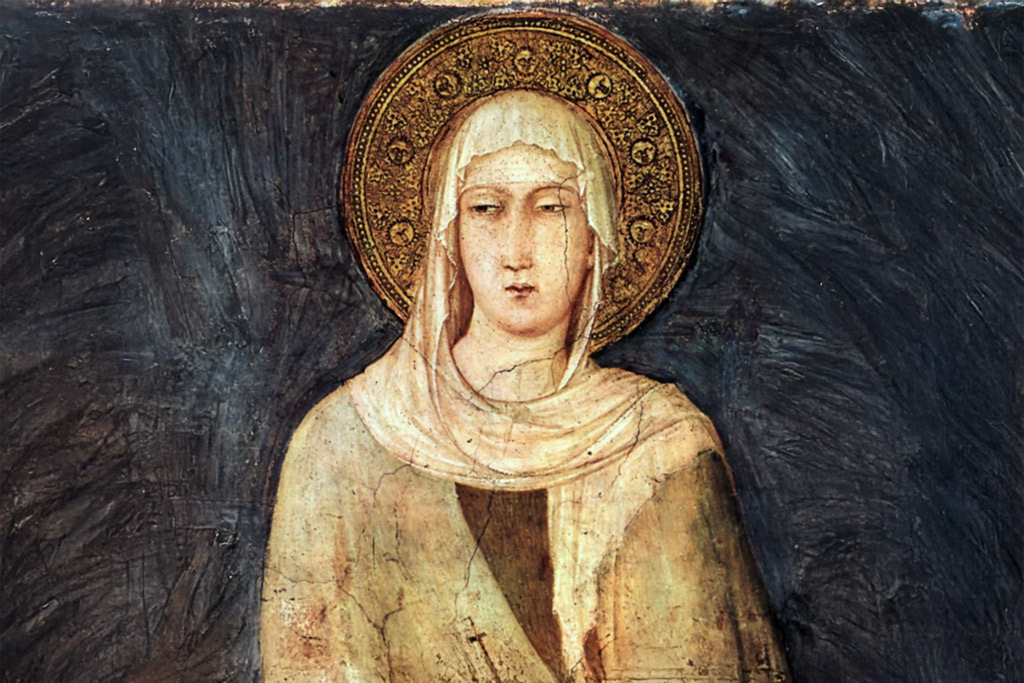

In Poverty, Freedom
An unbreakable bond, sealed in life and continued into eternity, united Francis and Clare of Assisi. Clare, who called herself Francis’ “little plant,” embraced Lady Poverty following his example.
Clare was born in Assisi in 1193 into the noble family of the Favarone degli Offreducci. She was still a child when a conflict broke out in her city between the nobility and the emerging bourgeois class. To stay safe, her family took refuge in Perugia, where she lived until her adolescence.
Upon returning to Assisi, Clare felt a deep calling to dedicate her life solely to Christ. Moved by Francis’ example, on the night of Palm Sunday in 1212, after attending Mass in the Cathedral and receiving a palm branch from the Bishop, Clare fled her home and went to the Porziuncola, where Francis and his friars were waiting for her.
There, Francis cut her hair and gave her a simple habit to wear. Clare thus offered her life completely to the Lord. Her journey of discipleship began—a path of poverty and humility to faithfully follow in Christ’s footsteps.
Her uncle Monaldo, who had become her guardian after her father's death, tried in vain to bring her back home by force.
Clare was initially welcomed into the Benedictine monastery of Bastia, and later transferred to the more secure monastery of Sant’Angelo in Panzo. Following Francis’ advice, she eventually settled in San Damiano, near the small church that Francis himself had restored. There, he gave her a “form of life” and the invitation to remain faithful to holy poverty.
She was soon joined at San Damiano by her sister Agnes, later by her younger sister Beatrice, and by their mother Ortolana. Other young women, inspired by Clare’s example and the ideal of evangelical life she embodied, also joined them.
This group of women became known as the Poor Sisters or the Poor Ladies of San Damiano, later called the Poor Clares. Clare and her companions chose to live in absolute poverty, remaining faithful to the way of life received from Francis, despite pressures from Church authorities and even some Franciscan friars. Through this humble and laborious life, Clare drew ever closer to the mystery of God.
In 1228, Pope Gregory IX granted Clare an important privilege: the privilegium paupertatis—permission to live without owning anything. This right to absolute poverty was later included by Clare in the Rule she wrote for her sisters, which was approved by Pope Innocent IV on August 9, 1253. Clare was the first woman to write a Rule an emerging Religious Order.
At the age of thirty, Clare became seriously ill. Despite her illness, she continued to be a loving mother superior, a wise guide, and a model of true evangelical life for her Sisters.
She died at San Damiano on August 11, 1253. Before her death, she joyfully praised the gift of life, thanking God with these words:
“Go forth in peace, my blessed soul, for you have a good guide for your journey! He who created you has made you holy. He has always loved you, as a mother loves her child. And You, Lord, be blessed, for You have created me.”
Clare left behind important writings: the Rule, her Testament, her Blessing, and four Letters addressed to Saint Agnes of Prague.
Immediately after her death, she was venerated as a saint by the people, and two years later, she was canonized in Anagni by Pope Alexander IV.