


August 28: Saint Augustine, Doctor of the Church
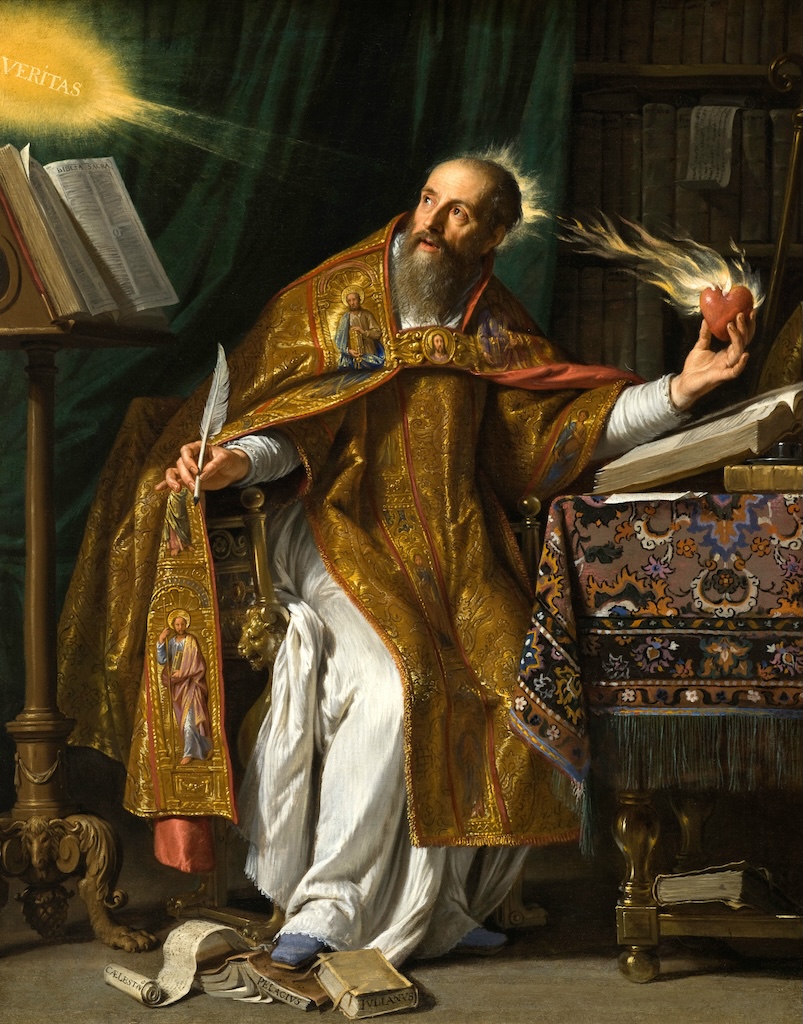

One Heart and One Soul
In the Golden Legend by Jacobus de Voragine, there is an episode testifying to the numerous conversions brought about by Saint Augustine and his decisive victory against heresy. According to the account, some Christians invited him to publicly debate matters of faith with a Manichaean priest named Fortunatus, who at that time was preaching in Hippo.
Augustine accepted the challenge and, during the debate, managed to defeat the heretic, who was unable to respond effectively to his arguments. Cornered and incapable of defending his theses, Fortunatus was forced to withdraw. This is only one of the many episodes that have reached us about the life and work of Saint Augustine, Doctor of the Church.
His full name was Aurelius Augustine. Born on November 13, 354, in Tagaste (present-day Souk Ahras, Algeria) of Berber origins, he grew up with his mother Monica, a deeply devout Christian, and his pagan father, Patricius, a municipal official of Tagaste. His parents, aware of their son’s extraordinary intellectual gifts, ensured he received the best possible education for the time.
Augustine began his elementary studies in Tagaste between the ages of 6 and 13 (361–367), then studied Grammar in Madaura (367–370). After a forced year-long pause due to financial difficulties, he continued with Rhetoric studies in Carthage (371–374). Upon returning to Tagaste, in 374–375 he taught grammar and among his first students was Alypius, who became his lifelong friend and companion.
As a young man, he led a disorderly life and, at 17, moved to Carthage to study, where he indulged in worldly pleasures. During this time he met a woman with whom he had a long relationship lasting fifteen years and from whom he had a son, Adeodatus.
At age 19, a work by Cicero awakened in him a deep interest in philosophy. Later, he was drawn to the Manichaean religion, which was based on an absolute opposition between Good and Evil.
From 375 to 381 he ran a school of rhetoric in Carthage. However, the atmosphere among the students was turbulent, and Augustine himself felt restless and dissatisfied. In search of stability and personal growth, he decided to move to Rome.
In 383 he opened a new school of rhetoric in Rome, but with little success. Yet it was there that an important opportunity presented itself: he won a public competition for the chair of Rhetoric at the Imperial Court of Milan. Thus, in 384, he moved to Milan. He had reached the peak of professional success, but inwardly he was still tormented and searching for truth.
His encounter with Saint Ambrose, at the time Bishop of Milan, the reunion with his mother Monica (who had arrived from Africa in 385), the influence of Neoplatonic thought and the letters of Saint Paul - together with the grace of God - marked a decisive turning point in his life: he converted to Christ. In the summer of 386, he renounced teaching and abandoned his career to devote himself fully to his new faith.
In 386, deeply moved by the story of the conversion of two Roman citizens, he had an intense mystical experience in a garden in Milan, where he heard a voice saying: “Take and read.” This was the decisive moment: he converted to Christianity, abandoning teaching. After a period of spiritual retreat in the countryside, he received baptism together with his son Adeodatus.
Wanting to live as a Christian in a radical way, he was baptized by Saint Ambrose on the night of April 24, 387. He returned permanently to Africa, where he founded a new form of communal life. At 37 he was ordained a priest, and at 41 he was consecrated Bishop of Hippo (present-day Annaba, Algeria), a role he held until his death on August 28, 430, at the age of 76. He wrote numerous works in which he refuted the heresies of his time, managing to reconcile faith and reason in a profound way. He also composed many sermons and homilies and left a vast collection of letters, a testimony to his thought and pastoral activity. Among his most famous works: On Free Choice of the Will, On the Holy Trinity, The City of God, Confessions.
The form of communal life associated with him follows a Rule. The fundamental principles that form the basis of the Rule of Saint Augustine, as it was officially formulated in the 13th century, partly date back to some writings attributed to Augustine himself, composed around 388–389. In twelve brief chapters, the great Church Father lays out the cornerstones of religious communal life, founded on values such as poverty, fraternal love, obedience, prayer, reading of the Bible, work, and apostolic commitment.
The spirituality of the Augustinian family, in addition to Augustine’s teachings and writings, also draws from the eremitic-contemplative experience of various religious groups that arose in the 12th and 13th centuries, during a period of spiritual renewal and fervor in the life of the Church. These communities, which chose to live according to the Augustinian Rule, established their hermitages not far from inhabited centers and led lives of prayer, penance, and sharing with the people, though without directly engaging in pastoral activities.
In 1256, Pope Alexander IV (pontificate: 1254–1261), called the representatives of all these monasteries and smaller institutes to gather in Rome at the church of Santa Maria del Popolo. They agreed on the Pope’s proposal to unite into a single religious family, thus giving birth to the Order of the Hermits of Saint Augustine. From that moment, the Augustinian Order was officially recognized by the Church as one of the mendicant Orders, alongside the Franciscans and Dominicans, which had already been founded and approved in the preceding decades.