


September 25: Saint Firmin, Bishop and Martyr
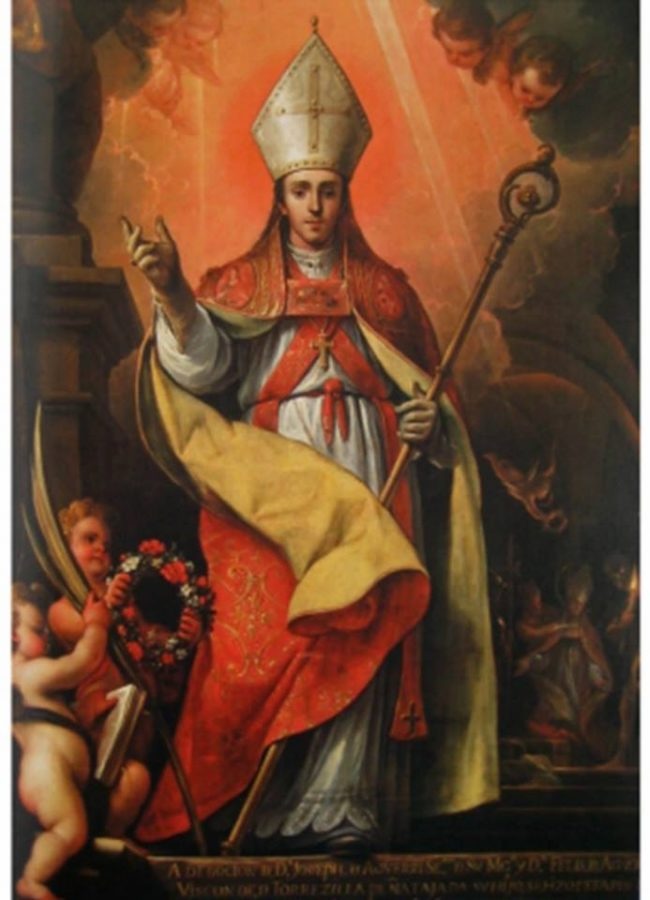

In the context of the early centuries of Christianity, in an era dominated by the Roman Empire and marked by severe persecutions against the disciples of Christ, the figure of Saint Firmin emerges, venerated as both Bishop and martyr. His memory is particularly rooted in Spain and France where his example has nourished the faith of entire generations. The account of his life lies between tradition and historical reality, sketching the portrait of a steadfast man, animated by unshakable faith and a profound missionary spirit.
According to tradition, Firmin was born in the city of Pamplona around the 3rd century, into a noble pagan family. It was through the influence of Saint Saturninus, the first Bishop of Toulouse and a prominent figure in the evangelization of the Pyrenean region, that Firmin came to embrace the Christian faith. The charisma of Saturninus deeply moved the young man, who decided to receive baptism and embark on a path of total dedication to the Church.
After completing his formation, Firmin was ordained a priest and departed for Gaul, a region still largely attached to pagan beliefs. In this hostile territory, he devoted himself with great fervor to proclaiming the Gospel. His ministry led him to Amiens, in northern France, where he founded a Christian community and became its first Bishop. His life was marked by prayer, charity, and tireless preaching. Tradition holds that he performed miracles and healings, inspiring conversions and strengthening the Christian presence in the region.
The growing number of Christians drew the attention of the imperial authorities, who regarded Christianity as a threat to public order. Firmin was arrested and, for refusing to renounce his faith, subjected to violence and eventually condemned to death. It is said that he was beheaded in Amiens, probably in the year 303, during the persecutions ordered by the emperor Diocletian. His sacrifice was perceived by the faithful as a sign of spiritual heroism and devotion to him quickly spread.
Amiens recognized him as its patron saint and preserved his relics in its Cathedral. Pamplona, the city of his origins, also keeps his memory alive with the famous Feast of San Fermín, which, although today is best known for the running of the bulls, has deep religious roots linked to the veneration of the saint.
The figure of Saint Firmin stands as an ideal of integrity and love for the faith, lived out in a time of great danger. His life, marked by determination and courage, continues to be a source of inspiration for all who recognize themselves in the Christian message.