


August 10: Saint Lawrence, Deacon and Martyr
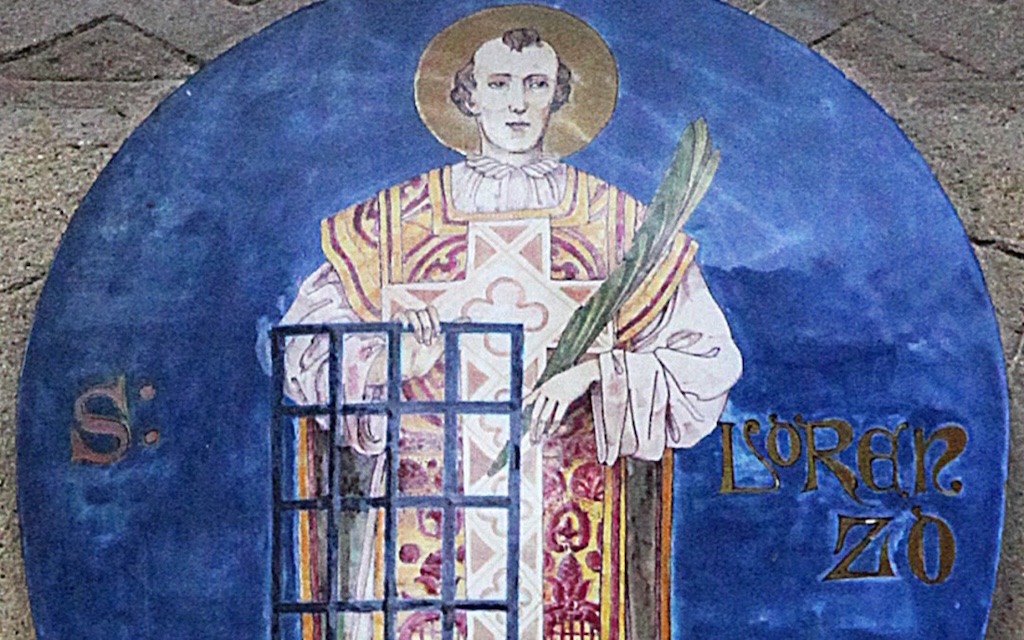

The Poor Are the Treasures of the Church
Lawrence was born in 225 AD in Osca (modern-day Huesca), Spain. As a young man he moved to Rome where he became known for his piety, charity toward the poor and moral integrity.
After receiving his early education in his hometown, he moved to Zaragoza to pursue further studies. At the city’s renowned university, he quickly distinguished himself and was regarded as the best student. During this time, the Bishop of Zaragoza, impressed by the purity of his life, conferred on him the minor orders of porter, lector, and exorcist.
At that time, Sixtus—future Pope Sixtus II and then archdeacon of the Church of Rome—was also in the Iberian Peninsula. Upon hearing of Lawrence's virtues, he invited him to Rome and personally oversaw his formation.
At age 17, due to his academic and spiritual merits, he was ordained an acolyte by Pope Fabian; six years later, he became a subdeacon and then, at the age of 27, a deacon.
In 258, when Sixtus II was elected Pope, Lawrence was appointed archdeacon of the Roman Church—a role of great responsibility. He was entrusted with overseeing charitable works: he administered church property, collected offerings, and aided the poor, orphans, and widows. Through this role, he became a prominent figure in the Roman Christian community.
During the reign of Emperor Valerian, edicts were issued against Christians. The first, not particularly harsh, allowed Sixtus and Lawrence to continue their work for a time. But in August 258, a new decree ordered the immediate execution of bishops, priests, and deacons, as well as the confiscation of church property.
On August 6, Pope Sixtus was beheaded along with six deacons. Lawrence was arrested and placed under the guard of the centurion Hippolytus, who imprisoned him in an underground cell. There, Lawrence met another prisoner, Lucillus, who was blind. Lawrence comforted him, taught him the Christian faith, and baptized him using water from a spring that flowed inside the prison. After the baptism, Lucillus regained his sight.
Hippolytus, witnessing the miracle and moved by the prisoners’ serenity, converted to Christianity and was baptized by Lawrence. When his conversion was discovered, he was martyred—tied to horses and dragged to death.
Lawrence was offered his life in exchange for handing over the “treasures of the Church” within three days. When the deadline arrived on August 10, he presented himself accompanied by the poor, sick, and needy whom he cared for daily, declaring, “Here are the true treasures of the Church—eternal riches that only grow.”
For this, he was sentenced to death. According to the most well-known tradition, he was burned alive on a gridiron, although some historians believe he may have been beheaded. His body was buried in the Verano Cemetery, in the Catacombs of Saint Cyriaca.
Emperor Constantine later had a basilica built on the site, which was expanded over the centuries by Pope Pelagius II and later by Pope Honorius III. In the 20th century, after severe damage caused by the Allied bombing of Rome on July 19, 1943, the basilica was restored.
Saint Lawrence is the patron saint of Rome (alongside Saints Peter and Paul), as well as of Grosseto, Perugia, Rotterdam, and Amaseno. He is the protector of firefighters, cooks, grill chefs, glassmakers, and all those who work with fire.