


25 November: Catherine of Alexandria, Virgin and Martyr
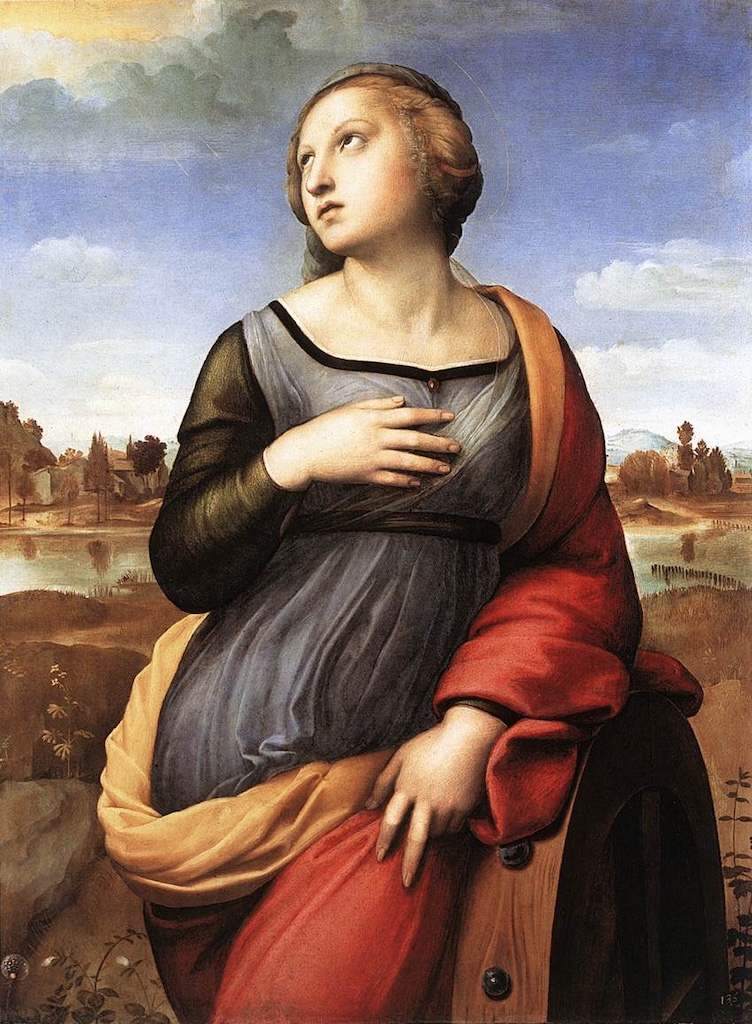

She did not renounce her faith in the face of threats
According to tradition, Catherine was a young woman of noble birth from Alexandria in Egypt, known for her beauty and high level of learning.
Around the year 305, during a civic celebration, she is said to have come into contact with the Roman emperor (possibly Maxentius or, more likely, Maximinus Daia). On that occasion, she refused to take part in the pagan rites and urged the sovereign to recognize Jesus Christ as the Savior, presenting her convictions with profound philosophical arguments.
Struck by her intelligence and charm, the emperor summoned several rhetoricians in an attempt to make her renounce her faith, and at the same time proposed marriage to her. Catherine, however, not only rejected his advances, but succeeded in converting to Christianity all those who had been appointed to persuade her. Enraged by this, the emperor condemned her to die on the spiked wheel, a torture device that, according to tradition, miraculously broke. The young woman was then beheaded. Another account states that angels carried her body to Mount Sinai, where an Orthodox monastery dedicated to her now stands.
In Italy alone, more than forty municipalities consider her their patron saint, along with numerous hamlets, the Sovereign Military Order of Malta, and various faculties of law at Italian universities.
Among the traditional symbols associated with Saint Catherine of Alexandria, one of the most recurrent is the ample cloak typical of philosophers, as seen in the frescoes of the Giotto-Rimini school in the Basilica of San Nicola in Tolentino. She is often depicted wearing a crown and regal garments, highlighting her noble origins.
The palm she holds in her hand signifies the martyrdom she endured, while the book refers to her wisdom and her role as patroness of studies, teachers, and various religious orders such as the Dominicans and the Augustinians. At other times, she is portrayed with a sword—the weapon by which she was killed—and especially with the wheel, the symbol of her martyrdom. This wheel may appear whole, broken, at her feet, or beside her, which is why she is often called “Saint Catherine of the Wheel.” The presence of the wheel has also created an iconographic connection with various arts and crafts that use similar tools, particularly with potters, of whom the Saint is considered the patroness.