


18 November: Saint Odo of Cluny
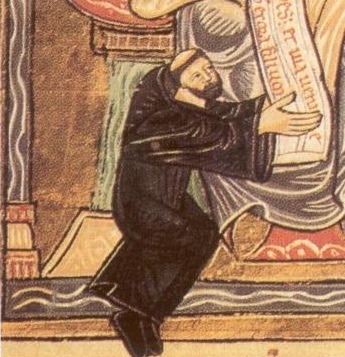

In the Footsteps of Saint Martin of Tours
The figure of Saint Odo stands within the vast panorama of medieval monasticism, that era in which the Benedictine ideal spread to such an extent that it gave rise, throughout Europe, to a dense constellation of monasteries. These centers of prayer and culture contributed to shaping the spiritual identity of the continent. Among them, the monastery of Cluny held an absolutely prominent role: a place celebrated for its inner discipline, care for study, and above all for the solemnity of divine worship. Odo was its second abbot and one of its most eminent personalities.
Born around the year 880 in an area between Maine and Touraine, in present-day France, he received from his father a special devotion to the great Saint Martin of Tours, under whose influence he lived his whole life and at whose tomb he would end his earthly journey. His decision to consecrate himself to God matured after an intense inner experience, recounted by Odo himself to John the Italian, the monk who would write about his life. He was an adolescent when, during a Christmas vigil, he found himself spontaneously addressing the Virgin in a prayer full of trust, calling her “Mother of Mercy,” a title he would keep as his favorite in the years that followed. Around the same time, he encountered the text of the Rule of Saint Benedict: he was so captivated by it that he began to follow it little by little, even though he was not yet a monk. He would later describe Benedict as a “lamp that shines in the world’s darkness” and a “master of life according to the Spirit,” recognizing in him one of the greatest Fathers of the Church and a luminous guide for the Christian journey.
Driven by the desire to live that ideal fully, he left the city of Tours and became a monk first at Baume and later at Cluny. In 927 he was elected abbot of that great spiritual center, from which he exerted a decisive influence on the monastic reform of the period. Many European monasteries, including various Italian cenobies—among them Saint Paul Outside the Walls—benefited from his presence and his teaching. During his journeys he reached Rome several times, and visited the monasteries of Subiaco, Montecassino, and Salerno. In 942, while staying in the capital, he was struck by a severe illness. Wishing to end his life beside his beloved Saint Martin, he managed to return to Tours, where he died on 18 November, during the octave of the Saint’s feast.
His biographer emphasizes how richly endowed with virtues Odo was: perseverance in trials, detachment from the vanities of the world, tireless zeal for the salvation of souls, dedication to peace within Christian communities. His heart longed for concord among rulers, fidelity to God’s law, attention to the poor, the education of the young and respect for the elderly. Though he loved the solitude of his cell, where he sought an ever-deeper relationship with God, he did not shirk the service of preaching and spiritual guidance, weeping over the fragility of the world.