


19 November: Saint Mechthild of Hackeborn
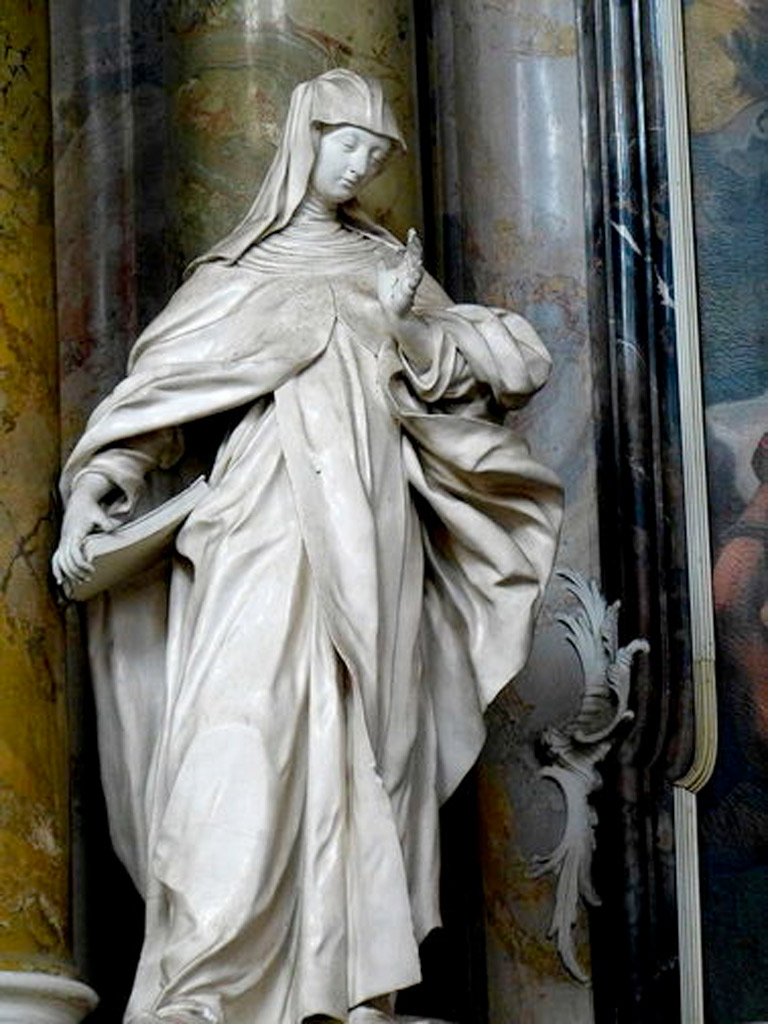

The Nightingale of God
Among the brightest figures of the monastery of Helfta in the 13th century stands Mechthild of Hackeborn, a woman of extraordinary spirituality and a distinctive voice in medieval mysticism. Her fellow nun, Gertrude the Great, in the sixth book of the Liber specialis gratiae—a work collecting the divine revelations received by Mechthild—acknowledges that what was written represents only a small portion of what the Saint actually experienced. She explains that it would have been unjust to remain silent about such abundant gifts, for they were granted by God not only for Mechthild herself, but as a spiritual treasure offered to the Church of every age.
Born in 1241/42 in the castle of the Hackeborn family—one of the most illustrious families of Thuringia and connected to Emperor Frederick II—Mechthild grew up in a noble and cultured environment. At the age of seven, she visited with her mother her older sister Gertrude, already a nun and later abbess for forty years, who had raised Helfta to a center of advanced theological and mystical formation. Fascinated by that way of life, young Mechthild wished to remain and was accepted as a student. In 1258 she became a nun in the new site of the Helfta monastery. She naturally distinguished herself by purity, zeal, gentleness, and an extraordinary capacity to relate to God, Mary, and the saints.
Gifted with a lively intelligence, great learning, and an exceptionally melodious voice, she was soon entrusted with leading the monastic school, the choir, and the formation of the novices. Her presence became a precious gift for the community and for anyone who sought her out. For this reason she was nicknamed the “Nightingale of God.” Her words, her advice, her ability to probe hearts, and the consoling strength of her listening drew people from all over. The prayers she composed were so numerous that, if collected, they would have exceeded the length of a psalter.
In 1261 she was entrusted with a five-year-old girl: the future Gertrude the Great, who became her disciple and confidante. About ten years later Mechthild of Magdeburg also entered the monastery. Thus Helfta became home to four exceptional women—two Mechthilds and two Gertrudes—who profoundly shaped European spirituality.
Throughout her life Mechthild endured intense sufferings, which she united to severe penances offered for the conversion of sinners. Her life, immersed in the liturgy, was a continuous weaving together of contemplation, intercession, teaching, and charity. Her writings and the testimonies gathered by her sisters reveal her astonishing capacity to draw from liturgical prayer—from the feasts of the Lord, the Virgin, and the saints—a continuous flow of deep contemplations and practical applications for the daily life of the community.
During Mass, and particularly at Communion, she was often caught up in ecstasy: her heart found refuge in Christ, perceived as a burning and supremely sweet fire. In these moments she asked for light for herself and for her sisters, bringing the entire world before the Lord.
The heart of Mechthild’s inner life was rooted in liturgical and personal prayer: the Liturgy of the Hours, the Eucharistic celebration, and the assiduous listening to the Word were for her the daily nourishment that guided her into an ever more intimate relationship with Christ, lived in full obedience to the Church.
Gertrude described Mechthild’s final moments with great intensity: a period of profound suffering, transfigured by a vivid awareness of the presence of the Trinity, of Christ, of the Virgin, and of all the saints. When she understood that her hour had come, Mechthild asked to be able to offer her pain once more for the salvation of souls; the Lord accepted this final act of love. She died at the age of 58, after a long illness, known everywhere for her holiness. At the moment of her entrance into glory, as the Liber recounts, God Himself called her with the words of the Gospel: “Come, you who are blessed by my Father,” leading her into eternal joy.
The history of the book that transmits her life is remarkable: when Mechthild, around the age of fifty, was going through a deep spiritual trial accompanied by physical suffering, she confided to two friends the many graces she had received from God. She did not know that these confidences were being written down; when she found out, she was troubled. Only the Lord’s intervention reassured her, making her understand that these recollections would serve the divine glory and the good of many.