


August 8: Saint Dominic de Guzmán
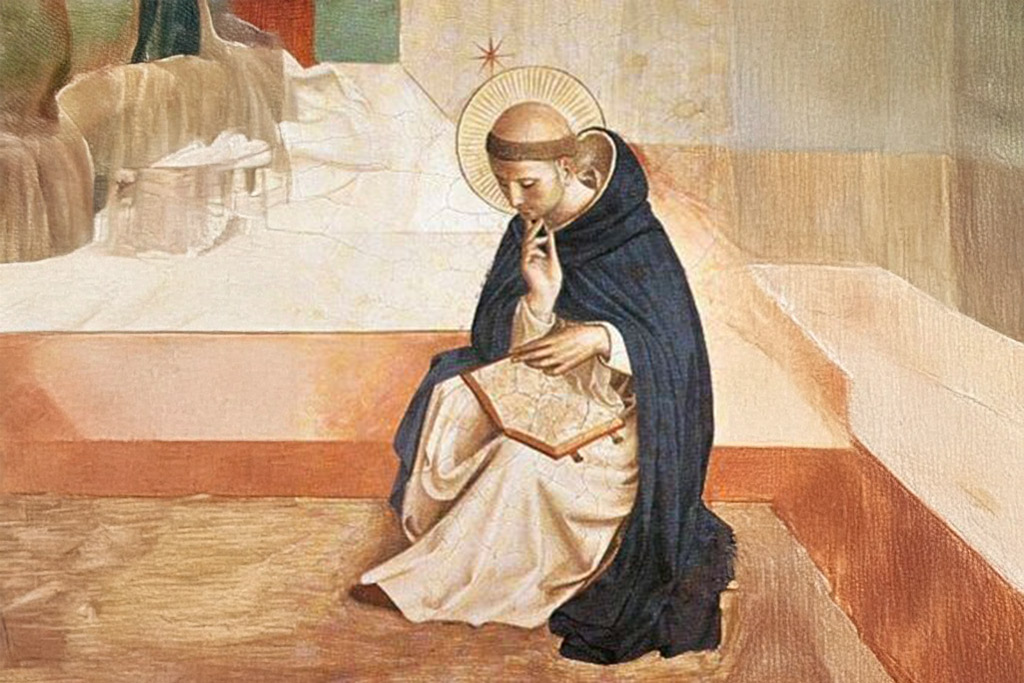

At the Service of the Gospel, in Truth and Poverty
A life wholly dedicated to preaching and proclaiming salvation to all people, in truth and in poverty, he united contemplation and action in service to the Church and the Kingdom of God.
Such was the human journey of Saint Dominic de Guzmán. Born around 1170 in Caleruega, Castile (Spain), to Felix de Guzmán and Joanna d’Aza, he was entrusted at an early age to his uncle, an archpriest, who guided him in his studies. At the age of 15, he began studying philosophy, theology, dialectic, and Sacred Scripture at the University of Palencia. During a famine, he stood out for his generosity: he even sold his books to help the poor.
Upon completing his studies, around the age of 24, Dominic joined the Canons Regular of the Cathedral of Osma, where he devoted himself to prayer and community life under the guidance of Bishop Diego of Acebes. In 1203, he accompanied the bishop on a diplomatic mission to Denmark, traveling through southern France, where they first encountered the Cathar and Albigensian heresies. A famous episode from this time is the all-night conversation Dominic had with a heretical innkeeper in Toulouse, attempting to bring him back to the Catholic faith.
In 1206, after a second mission to Denmark, Dominic and Diego went to Rome to request papal permission to preach among the pagans. However, Pope Innocent III asked them instead to focus on preaching against heresy in France. After Diego’s death on December 30, 1207, Dominic continued this difficult mission alone, engaging in public debates, personal conversations, prayer, and penance.
In 1215, Bishop Foulques of Toulouse appointed him official preacher of the diocese. A small group of companions gathered around Dominic, inspired by his mission and enthusiastic about preaching. Foulques gave him the church of Santa Maria of Prouille, where Dominic welcomed a group of converted women who supported the mission with prayer. This place became the center of his apostolic work.
In the same year, Dominic and Foulques went to Rome to seek official recognition for the group from the new pope, Honorius III. On December 22, 1216, the pope approved the Order and named it the Order of Preachers, better known as the Dominicans.
In 1217, Dominic sent his friars throughout Europe, especially to the cities of Paris and Bologna, to spread the mission through study, preaching, and evangelical poverty. At the General Chapters of 1220 and 1221 in Bologna, the rules, missions, and structure of the Order were formally established.
Dominic died on August 6, 1221, in Bologna, worn out by his apostolic labors. Surrounded by his friars, he left them a simple spiritual testament: “Have charity, guard humility, embrace voluntary poverty.” On May 24, 1233, his body was solemnly transferred to the Basilica dedicated to him in Bologna and on July 3, 1234, Pope Gregory IX canonized him.