


August 17: Saint Clare of Montefalco
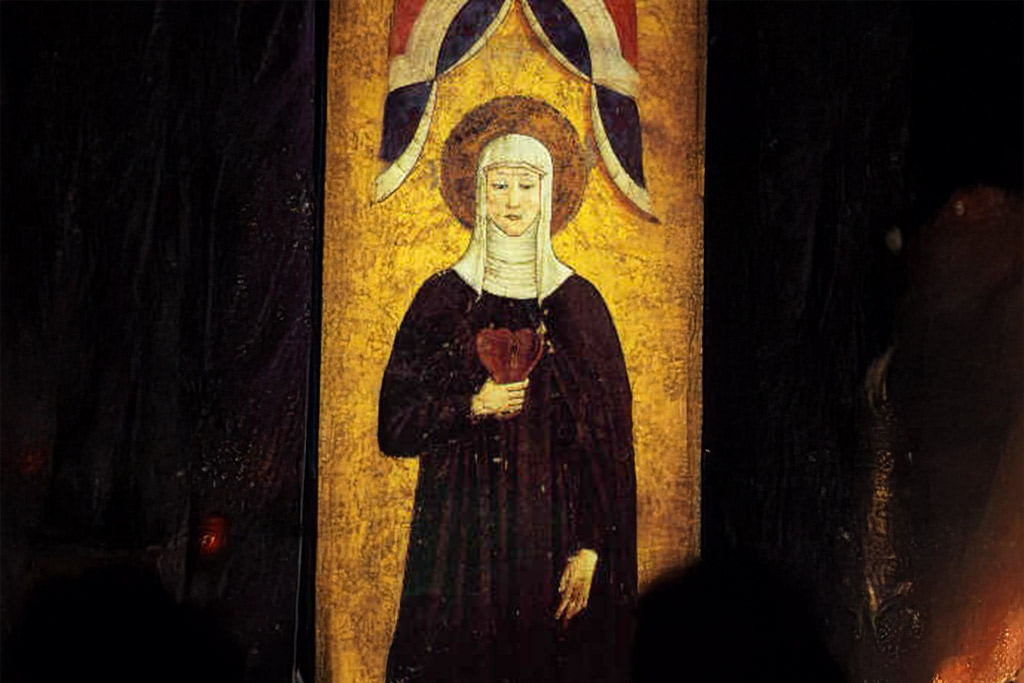

In her heart, the marks of Christ’s Passion
The cross she bore was not symbolic, but real—a sign of her deep union with Christ and her solidarity with the sufferings of all humanity. Clare of Montefalco carried it imprinted on her heart, as her fellow sisters discovered after her death.
Clare was born in Montefalco in 1268. At the age of just six, she chose to leave her parents’ home to follow Jesus, dedicating herself to prayer and the life of the Church. She entered the enclosure founded by her father Damiano, where her sister Giovanna was already living, drawn by a way of life centered on contemplation and devotion to God.
From a young age, Clare showed herself to be lively, intelligent, generous, always ready to help others, hardworking, and obedient.
In 1280, as the example set by Clare and Giovanna began to attract many young women eager to live as they did, their father built a larger enclosure, where the Montefalco monastery now stands.
In 1290, the community adopted the Rule of Saint Augustine. The following year, after the death of her sister Giovanna, Clare was elected superior. From that moment, she led the community with enthusiasm, acting as both mother and spiritual guide.
Between 1288 and 1299, she endured a long period of spiritual trial. After years of experiencing the joy of God’s closeness, she suddenly no longer felt His presence—for eleven years. This spiritual dryness exposed her to her own weaknesses, but also deepened her understanding of the beauty of virtue. It wasn’t a learned knowledge, but one deeply lived and interiorized.
During this time of suffering, at the beginning of 1294, Christ appeared to her carrying a large cross and said:
“I have searched for a strong place to plant this cross: here, and nowhere else, have I found it.”
From then on, Clare often repeated:
“I have Jesus Christ crucified within my heart.”
Through this difficult trial, Clare learned humility and became even more available to her sisters and to all who came seeking help at the monastery.
She always forgave, even those who slandered her, and, in a time of great turmoil between Umbria and Tuscany, worked for peace—not only through prayer but also through concrete actions.
Although she had no formal education, many people—scholars, priests, sinners and saints—came to her seeking counsel and support.
She was the only one to recognize the error of the Franciscan Friar Bentivenga of Gubbio, leader of a misguided religious movement that combined mysticism with moral corruption. Clare reported him to Church authorities thereby protecting many souls from the path of perdition.
She lived with her eyes always fixed on God, never forgetting her brothers and sisters. Her love for the Lord translated into a total self-giving on a daily basis with simplicity and faithfulness.
She died on August 17, 1308, joyfully singing:
“Belgliè, belgliè, belgliè, eternal life! Such great reward, Lord, overwhelms me!”
The next day, the nuns opened her heart, remembering the words she often said:
“I have Jesus Christ crucified within my heart.”
There, they found the marks of Christ’s Passion imprinted within it.