

August 9: Saint Teresa Benedicta of the Cross, Patroness of Europe

The Discovery of the Science of the Cross
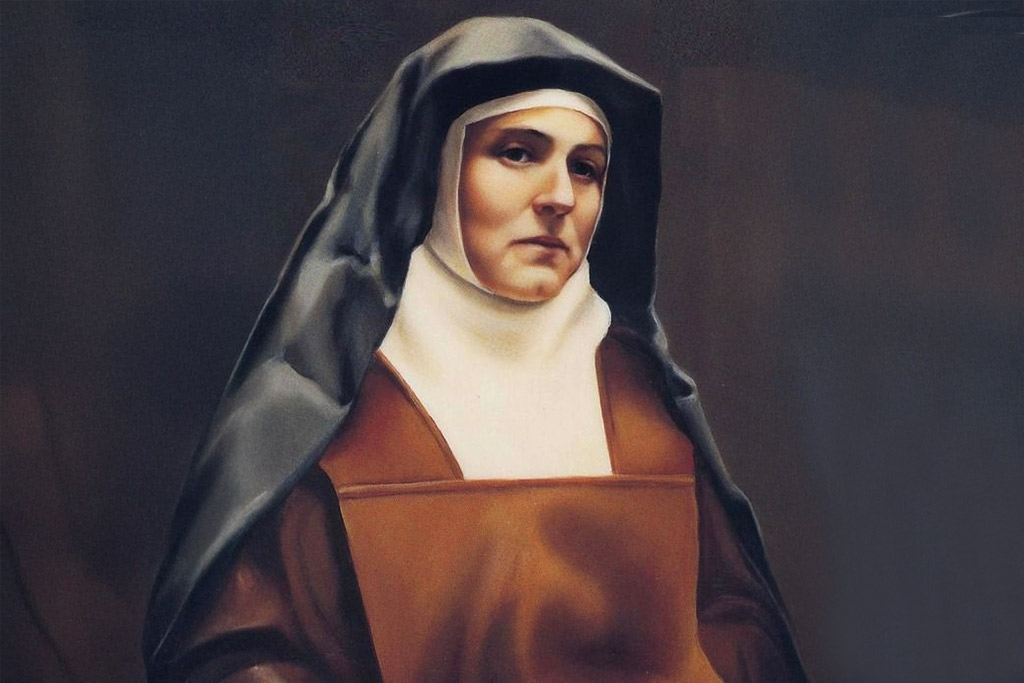
A refined intellectual whose tireless search for truth culminated in the discovery of Christ and His Cross. Born Jewish, a renowned philosopher and writer, Edith Stein converted to the Catholic faith and chose to consecrate her life to God among the Discalced Carmelites.
Teresa Benedicta of the Cross, known in the world as Edith Stein, was born on October 12, 1891, in Breslau (now Wrocław, Poland) into a Jewish family. Her mother, a strong and devout woman, raised her children with a deep sense of respect and responsibility. However, during her adolescence, Edith lost her faith, unable to find satisfying answers to her profound inner questions.
Endowed with lively intelligence and keen insight, she was an excellent student throughout her academic journey. In her quest to find meaning in life, she began studying psychology, but it did not quench her thirst for truth. She then turned her attention to philosophy, as well as to German language and history, which she studied in greater depth at the University of Breslau.
A pivotal moment in her intellectual journey came at her encounter with Logical Investigations by Edmund Husserl, founder of phenomenology, who later became her mentor. Phenomenology opened new paths for her in understanding reality. She continued her studies at the University of Göttingen, where she met other prominent philosophers such as Max Scheler, Adolf Reinach, and the couple Conrad-Martius, who became her close friends.
When World War I broke out, Edith volunteered for the Red Cross. Her experience in field hospitals, witnessing suffering and death, deepened her desire to dedicate her life to others.
She completed her doctoral thesis on empathy, which received the highest honors, summa cum laude. She dreamed of teaching at the university, but was denied the opportunity because she was a woman.
Two events deeply marked her spiritual life and brought her closer to Christianity: the serene acceptance of death by Mrs. Reinach, the widow of a dear friend who had fallen in the war, and the chance discovery of the Autobiography of Saint Teresa of Ávila in the home of her friend Hedwig Conrad-Martius.
These episodes opened her heart to the Christian faith. After years of study, prayer, and interior growth, she embraced Catholicism and longed to dedicate her life to God in the Carmelite order. Before entering, she taught at the Dominican Sisters' school in Speyer and at the pedagogical institute in Münster. During this time, she also gained recognition for her translations and philosophical lectures, particularly on Saint Thomas Aquinas and Cardinal Newman.
Due to anti-Semitic racial laws, she was forced to stop teaching. In 1933, after a painful final farewell to her mother—who never accepted her conversion—she entered the Carmel of Cologne. She remained there until 1938, when she was transferred to the Carmel of Echt in the Netherlands, seeking refuge from Nazi persecution of Jews who had converted to Christianity.
In the convent, she lived her spirituality fully, delving deeply into what she called the “science of the Cross”—a profound understanding of redemptive suffering in union with Christ. In a message sent to the Prioress of the Carmel of Echt, she wrote:
“One can only gain a scientia crucis* if one begins to truly suffer under the weight of the cross. I had this inner conviction from the very first moment, and from the depths of my heart I said: Ave crux, spes unica (Hail, O Cross, our only hope).”
On August 9, 1942, she was deported with her older sister Rosa, also a converted Carmelite, to the Auschwitz-Birkenau concentration camp, where they died in a gas chamber.
Edith Stein is a radiant witness to the pursuit of Truth, to faith lived in radical commitment, and to the dialogue between Judaism and Christianity. She was beatified in 1987 and canonized in 1998 by Pope John Paul II, who proclaimed her co-patroness of Europe in 1999, alongside Saint Bridget of Sweden and Saint Catherine of Siena.
*Science of the Cross (Scientia Crucis) was the title of her last work and also of her spiritual path.