


September 4: Saint Rosalia
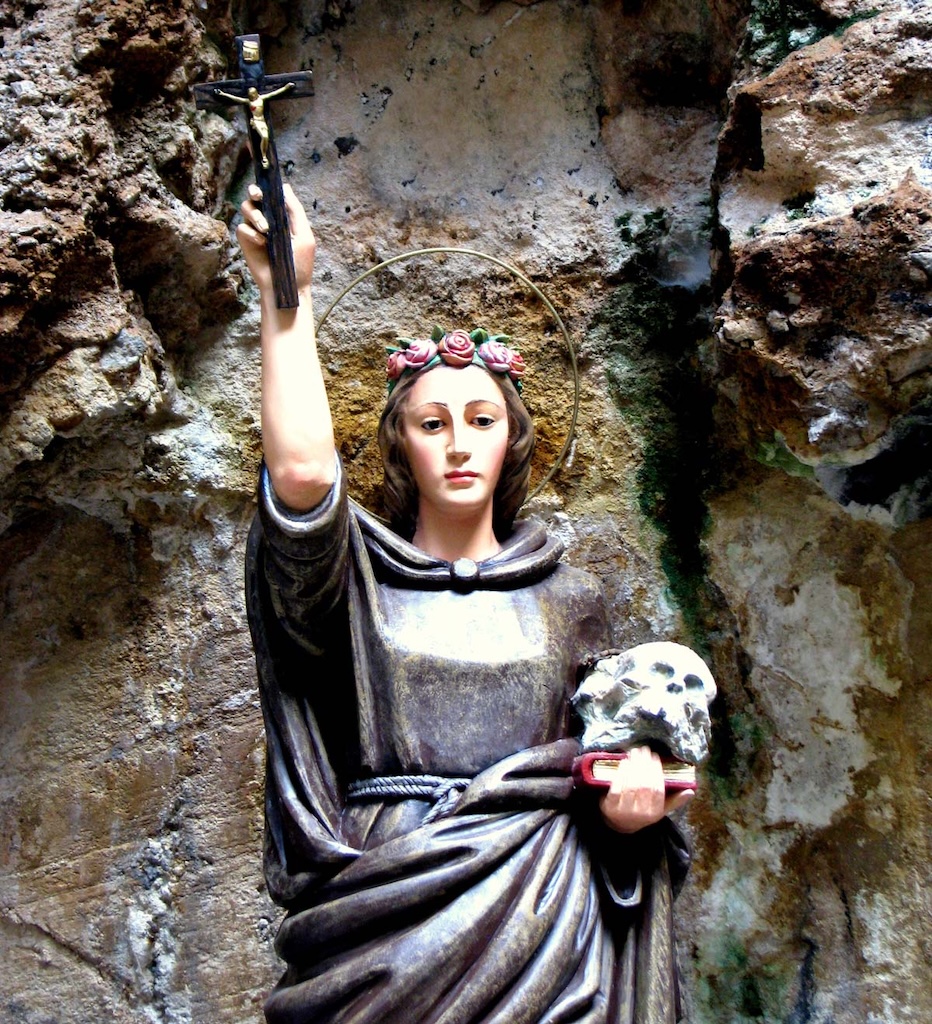

Thanks to her intersession, the plague in Palermo came to an end
Saint Rosalia lived between 1130 and 1170, during the reign of William I of Sicily, known as “the Bad.” At that time, there was a revival of Christian spirituality. Following the end of Arab rule, both Byzantine and Western monasticism flourished, enthusiastically supported by the Norman kings. The hermit’s life, dedicated to prayer and solitude, was considered one of the highest forms of devotion.
Rosalia was born in Palermo around 1130. There are no certain historical sources about her family, but an inscription found in a cave near Santo Stefano Quisquina (Agrigento) states that she was the daughter of Sinibaldo, lord of the Quisquina and Mount of the Roses, and of Maria Guiscardi.
According to tradition, she lived in the Olivella district, in a villa near the church now known as “Sant’Ignazio all’Olivella,” one of the first to be dedicated to her.
From the age of 14 or 15, Rosalia secretly chose to consecrate herself to Christ. It is said that her father, as a reward for a heroic deed performed by Count Baldwin (who saved the king from a wild beast), promised his daughter’s hand in marriage to him. But Rosalia refused and revealed her desire to embrace religious life.
She left her father’s house and, probably for a short time, followed the Basilian monastic rule. Indeed, an ancient 13th-century altarpiece depicts her in Basilian monastic garb.
Her first experience as a hermit took place as a guest of the church of Santa Maria in Palazzo Adriano (Palermo) and in a nearby forest, where a mountain pass still bears her name. She later withdrew to a cave in the mountains near Santo Stefano Quisquina (Agrigento), living in solitude for about twelve years.
After leaving that place, she returned to Palermo, stopping briefly at her father’s house in the Olivella district, and then continued to Mount Pellegrino. There she lived as a hermit for about eight to ten years in the so-called “water cave,” near a small church built over an ancient rock sanctuary that had already been frequented in Punic times and was later transformed by the Byzantines and Normans.
It is said that in the last months of her life she secluded herself definitively in the “sacred cave” of Mount Pellegrino, where she died in solitude. Although the exact year of her death is unknown, it is believed to have occurred around 1170. The day of her death, however, is certain: September 4, as recorded in the Roman Martyrology.
Her fame for holiness spread even during her lifetime: by 1196, documents such as the Codex of Constance of Altavilla already referred to “Saint Rosalia.” Her remains were discovered more than 450 years after her passing.
On May 7, 1624, the plague arrived in Palermo on a ship from Tunis, quickly causing hundreds of deaths.
On February 13, 1625, the soap-maker Vincenzo Bonello, having lost his young wife to the plague, climbed Mount Pellegrino with suicidal intentions, carrying his dog and his rifle. There, Saint Rosalia appeared to him in a vision and led him to the cave, instructing him to tell Cardinal Giannettino Doria to carry her relics in procession through the city so that the plague would immediately cease.
On June 9, 1625, a solemn procession took place, followed enthusiastically by a vast crowd. Instead of worsening the contagion, as might have been expected, during the singing of the Te Deum Laudamus the plague came to a halt and miraculous healings began to occur immediately. The king’s scribes meticulously recorded the details of each person healed: name, age, place of healing and all other relevant information.
On July 15, 1625, exactly one year after the discovery of her bones, the epidemic was officially declared over. On September 3, Cardinal Doria, as Lieutenant General of the Kingdom of Sicily, acknowledged that, thanks to Saint Rosalia’s intercession, Palermo had been delivered from the plague and the free movement of people, animals, and goods was once again permitted.