

August 30: Blessed Ildefonso Schuster

A Monk in the Service of the Church
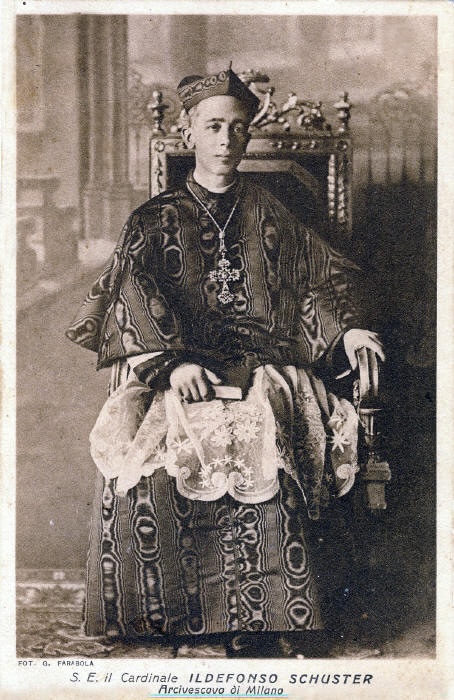
A contemplative at the service of the ecclesial community, committed to promoting reforms and pastoral initiatives, faithful to the Benedictine Rule and to Ora et labora. This was Cardinal Ildefonso Schuster, born Alfredo Schuster in Rome on January 18, 1880, into a family of Bavarian origin.
When he was still a child, he lost his father. Thanks to the support of a nobleman, at just eleven years old he entered the Benedictine monastery of St. Paul Outside the Walls as a student. He later decided to become a monk and, on November 13, 1898, he began his novitiate, taking the name Ildefonso.
The following year, he professed his monastic vows, and on March 19, 1904, he was ordained a priest. Four years later, he was appointed novice master; he then became procurator general of the Cassinese Benedictine Congregation, and in 1918 he was elected abbot ordinary of the monastery of St. Paul Outside the Walls. During those years, he preached spiritual retreats to prominent figures of the Church, including Cardinal Angelo Roncalli, later Pope John XXIII, with whom he formed a deep friendship. He taught, wrote, and published works on Church history, Christian archaeology, and liturgy. He also served as president of the Pontifical Oriental Institute, the Pontifical Commission for Sacred Art, and as an apostolic visitor.
In this capacity, he also visited Milan, where he promoted the construction of the new diocesan seminary at Venegono. On June 26, 1929, he was appointed Archbishop of Milan, and on July 21 of the same year, Pope Pius XI consecrated him a bishop and created him cardinal. He was the first Italian bishop appointed after the signing of the Lateran Pacts, at the time of the Fascist period in Italy.
Formed in Benedictine spirituality, he lived his episcopal role as a commitment to sanctification, constantly taking inspiration from St. Charles Borromeo. He followed Borromeo’s example in his care for the poor, his defense of the faith and the Church’s freedom, his dedication to liturgy and catechesis, and his constant presence among the people through pastoral visits, which he undertook five times throughout the vast diocese.
During World War II, he remained in Milan, even throughout the German occupation, and personally worked to prevent the destruction of the city. He helped everyone, without distinction, alleviating the suffering and hardships caused by the war. He convened five diocesan synods and a provincial council, and organized Eucharistic and Marian congresses, all met with great enthusiasm by the participants. He wrote many letters to the faithful and clergy, promoted liturgical renewal, built and consecrated new churches, supported Catholic publications, cultural centers, and social initiatives.
Despite his intense activity, he never abandoned the monastic spirit. His inner strength sprang from this deep connection to the life of prayer, which was also reflected in his demeanor: rigorous habits, simple lifestyle, and detachment from worldly conventions. For health reasons, doctors advised him to rest, and he retired to the seminary in Venegono, where he died on August 30, 1954. On May 12, 1996, he was beatified by Pope John Paul II.