


September 20: Andrew Kim Taegon and 102 Companion Martyrs
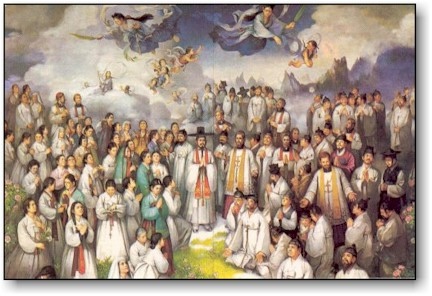

At the Roots of the Church in Korea
The evangelization of Korea began at the start of the 17th century, when some Koreans came into contact with Christianity during a journey to Beijing. Upon returning home, they founded a vibrant and persevering Christian community, despite the initial absence of priests.
Among the key figures is Saint Andrew Kim Taegon, the first Korean priest, born in 1821 into a persecuted Christian family (his father was also a martyr). He studied in Macao to become a priest and was ordained in 1845. Upon returning to Korea, he collaborated with Bishop Ferréol to evangelize in secret. He was arrested in 1846, tortured, and beheaded on September 16, 1846, never renouncing his faith.
Alongside him, we remember Saint Paul Chong Hasang, a layman born in 1795. The son and brother of martyrs, he was imprisoned as a young man and lost all his possessions. After being released, he dedicated himself to caring for the Christian community deprived of pastors. He made long journeys to Beijing to request the sending of priests, and he hoped to become a priest himself. But during a new wave of persecutions, he was captured and beheaded on September 22, 1839.
In total, it is estimated that around 10,000 Korean martyrs gave their lives for the faith. Of these, 103 were canonized by Pope John Paul II on May 6, 1984, in Seoul — among them Andrew Kim, Paul Chong, three bishops, another seven priests, and all the others who were laypeople, men and women, young and old (the youngest was 13 years old, the oldest 79).
Among the martyrs were also ten French missionaries from the Paris Foreign Missions Society and the first bishops of the Church in Korea. Their stories, recounted in the Acta Martyrum of the 19th century, show how the missionary spirit and fidelity to the Gospel have been present in every age and in every part of the world, since the early days of the ancient Church.