


September 22: Saint Maurice and Companions, Martyrs
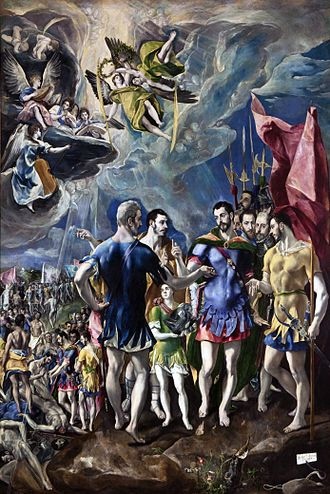

A legion of soldiers faithful to Christ
The oldest account of the martyrdom of Saint Maurice and his companions, members of the Theban Legion of Rome, dates back to 450–455 AD and was written by Bishop Eucherius of Lyon. Eucherius says he learned the facts from Isaac, Bishop of Geneva, who in turn had heard them from Theodore, Bishop of Octodurum, who lived in the 4th century.
Theodore discovered the bodies of the martyrs and had them transferred to a basilica he had built at Agaunum, which today is called Saint-Maurice, in the canton of Valais (Switzerland). According to the account, Maurice was an officer of the Theban Legion, a military unit composed of Egyptian soldiers and transferred to Gaul by Emperor Maximian Herculeus to persecute Christians.
Tradition places his birth around 250 AD to a pagan family. His name, Mauritius, meant “African knight.” Thanks to his courage and abilities, he was appointed commander of the Theban Legion, a military unit made up of Christian Egyptian soldiers stationed in Thebes, Egypt, and tasked with defending the frontiers of the Roman Empire.
At the beginning of the 4th century (early 300s), Emperor Maximian ordered that the legion be transferred to the Alps. Their mission was to repel attacks by the Marcomanni and to fight the people of the Valais in Switzerland, who had converted to Christianity.
Tradition says that all the soldiers of the legion refused to fight against fellow Christians. In a later, but more credible version, they are said to have opposed a pagan sacrifice during a campaign against the Bagaudae (rebel populations of Gaul).
The emperor then ordered that one in ten be put to death (the so-called “decimation”), and afterwards that the survivors also be beheaded—but none renounced their faith. After a second decimation, the commanders Maurice, Exuperius, and Candidus encouraged their soldiers to remain steadfast. In the end, the entire legion was executed. The martyrdom is said to have occurred in 286.
In 380, under Bishop Theodore, an ancient Roman cemetery was discovered, believed to be that of the martyrs, and their bones were translated to the basilica of Agaunum. In the centuries that followed, various churches and abbeys were built on the site. The present church dates back to the 17th century, a sign of a devotion that has never waned.
Several chivalric orders have been dedicated to Saint Maurice, such as the Order of Saints Maurice and Lazarus, founded by Amadeus of Savoy in 1434. The cross of his banner is also present in the flag of Switzerland. On July 19, 1941, Pope Pius XII proclaimed him Patron of the Alpini military corps of Italy.