


October 3: Saint Gerard of Brogne
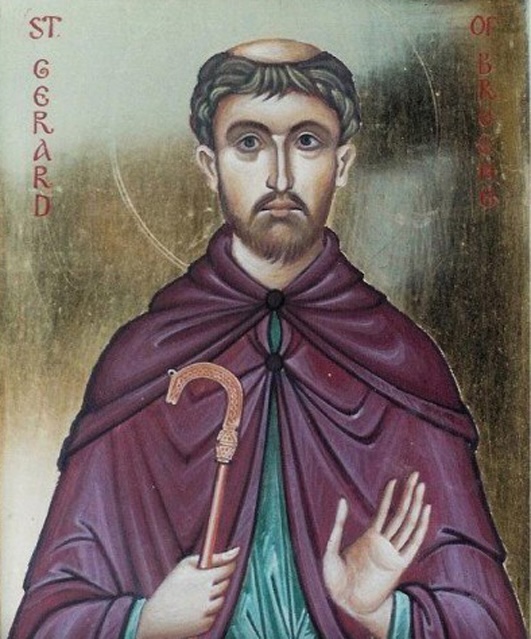

A missionary monk
Gerard of Brogne emerged as a charismatic figure, highly esteemed by the important families of Lotharingia and Flanders. For twenty-five years he tirelessly traveled these lands, renewing more than a dozen religious communities. In some cases, he temporarily assumed the role of abbot, but only until monastic life had been restored, after which he returned autonomy to the community.
Born around the year 898 near Lomme, in what is now Belgium’s Namur region, Gerard came from a noble family. His father, Sancio, owned vast lands between the rivers Sambre and Meuse, while his mother’s side appears to have been related to Bishop Stephen of Liège. Gifted from a young age with strong moral character and physical ability, Gerard pursued a knightly career, distinguishing himself in the service of Count Berengar. However, a sudden event changed the course of his life: returning from a hunting trip, he entered the church of Brogne to attend Mass. Finding no priest, he sat in silence and dozed off. In his sleep, he dreamed of Saint Peter, who, walking around the small church, invited him to build an oratory there and bring to it the relics of Saint Eugenius of Toledo.
Devotion to Saint Eugenius — a figure who, according to tradition, was a companion of Saint Denis in Paris and later an evangelizer of Toledo — became central to Gerard’s mission. Though he knew nothing of Eugenius’s story, Gerard followed the call of the dream and went to the priory of Deuil, from where he obtained the saint’s relics. The translation took place in August 919, and with the relics came manuscripts, sacred objects and the support of the monks from Saint-Denis, who joined the new foundation.
It was in this context that Gerard, captivated by the monastic ideal, received his initial training at the Abbey of Saint-Denis, near Paris. Upon returning to his lands, he founded a Benedictine monastery, bringing in monks from Saint-Denis. This was the era when, in 910, the monk Berno launched the Cluniac reform movement, placing renewed emphasis on the Rule of Saint Benedict.
It is unclear whether Gerard was already an abbot at this time or if he became one later; some historians suggest he was ordained a priest only in 927. Later, he traveled to Tours, bringing back relics of Saint Martin and there met the lay noble Hugh the Great. The oratory of Brogne was eventually consecrated during the episcopate of Bishop Richer of Liège; the relics were sealed in a reliquary and the monastery was placed under the protection of Saint Eugenius. The relics remained there, except in 954 when the monks temporarily fled to Namur due to Hungarian invasions.
Among his many reform activities, Gerard also intervened at the ancient Abbey of Saint Ghislain, founded in the 7th century, plundered by the Normans and later seized by lay owners. After the discovery of the saint’s relics in 930 and miracles attributed to them, the Bishop of Cambrai authorized their translation to the church of Saints Peter and Paul. Later, Gerard visited Flanders, at the court of Count Arnulf the Great, a man as devout as he was impulsive. Suffering greatly from kidney stones, the count sought the spiritual aid of the Abbot of Brogne. Gerard spoke to him frankly, attributing his illness to a need for repentance and urging him to do penance and grant acts of justice. After three days of fasting and prayer, Gerard healed him during the celebration of Mass. Arnulf, grateful, offered Gerard anything he desired, but Gerard refused wealth and honors, accepting only what could be distributed to the needy and to the monks. Arnulf then decided to donate land to the Abbey of Saint Peter in Ghent, where his parents were buried, and entrusted Gerard with reforming that monastery.
In the final years of his life, Gerard continued his commitment to monastic reform with steady dedication. Tradition recounts that he even traveled to Rome. During the journey, an extraordinary event occurred: a cart carrying porphyry slabs for a church was about to fall from the Alps but was miraculously saved through the saint’s intercession. Gerard died on October 3, 959 at the monastery of Brogne. Devotion to him was officially recognized as early as 1131 and his tomb became a popular pilgrimage site. In his honor, the very place changed its name from Brogne to Saint-Gérard.